Alvise Vivarini stands as a significant, though sometimes underappreciated, figure in the vibrant artistic landscape of late fifteenth-century Venice. Active during a period of profound stylistic transition, he navigated the waning influence of the International Gothic style and the burgeoning ideals of the Renaissance, forging a distinct artistic identity. Born into a family deeply embedded in the Venetian artistic tradition, Alvise inherited a legacy of craftsmanship and innovation, which he skillfully blended with the groundbreaking developments introduced by his contemporaries. His works, characterized by their sculptural solidity, emotional depth, and often complex architectural settings, mark him as a pivotal artist who contributed to the unique character of the Venetian School.
The Vivarini Workshop: A Family Legacy in Art
The Vivarini family was a prominent artistic dynasty originating from Murano, an island renowned for its glassmaking. Alvise's father, Antonio Vivarini (c. 1418 – c. 1484), was a prolific painter who often collaborated with his brother-in-law, Giovanni d'Alemagna, until the latter's death around 1450. Subsequently, Antonio frequently worked with his younger brother, Bartolomeo Vivarini (c. 1432 – c. 1499). This familial workshop was a powerhouse in Venice and its territories, producing numerous altarpieces, polyptychs, and devotional paintings. Their early style was rooted in the decorative elegance of the late Gothic tradition, but they were also receptive to the emerging Renaissance humanism and naturalism, particularly influences emanating from Padua, notably from the workshop of Francesco Squarcione and his most famous pupil, Andrea Mantegna.
Alvise Vivarini was born into this rich artistic environment, likely between 1445 and 1453. His precise birth year remains a subject of scholarly debate, but these dates align with his documented activity. He would have received his initial training within the family workshop, absorbing the techniques and stylistic tendencies of his father, Antonio, and his uncle, Bartolomeo. Bartolomeo, in particular, seems to have been a formative influence, known for his sharper, more incisive lines and a greater inclination towards the sculptural forms inspired by Mantegna. Some scholars suggest Bartolomeo may have been Alvise's primary teacher, especially after Antonio's artistic output waned.
Early Career and Developing Style
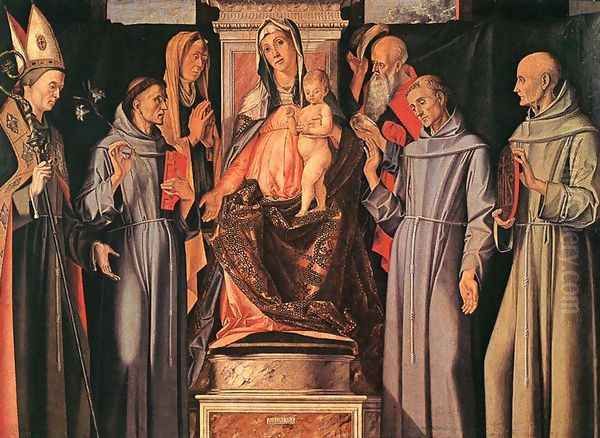
Alvise's independent artistic career likely began in the 1470s. One of his earliest documented and significant works is the polyptych for the Observant Franciscan convent of Montefiorentino in the Marche region, dated around 1475-1476. This work already demonstrates a departure from the more purely Gothic sensibilities of his father, showing a stronger grasp of perspective and a more robust, three-dimensional rendering of figures, indicative of the influence of Paduan art and, by extension, Andrea Mantegna. The figures possess a certain gravitas and a clear definition that would become hallmarks of Alvise's style.
During the late 1470s and early 1480s, Alvise's style continued to mature. He undertook commissions in Southern Italy, including altarpieces for Barletta and Naples between 1483 and 1485. These experiences outside Venice may have exposed him to different artistic currents, further enriching his visual vocabulary. However, it was the artistic climate within Venice itself that would prove most decisive for his development. The arrival of Antonello da Messina in Venice in 1475-1476 was a watershed moment for Venetian painting. Antonello, with his mastery of the oil medium and his synthesis of Netherlandish detail with Italianate monumentality, profoundly impacted many local artists, including Alvise.
The influence of Antonello can be discerned in Alvise's increased attention to light, texture, and psychological nuance in his figures. Furthermore, the towering presence of Giovanni Bellini (c. 1430 – 1516), who was by then the leading painter in Venice, also left an indelible mark on Alvise. Bellini's ability to suffuse his paintings with a soft, atmospheric light and to convey deep human emotion resonated with Alvise, leading to a greater subtlety and warmth in his own work, tempering the somewhat harsher linearity he might have inherited from Bartolomeo or absorbed from Mantegna.
Defining Characteristics and Notable Works
Alvise Vivarini's mature style is characterized by a strong sense of design, clear and often cool lighting, firm modeling of figures, and an interest in expressive, sometimes intense, human emotion. He often placed his figures within carefully constructed architectural settings, enhancing the illusion of depth and creating a tangible space for the sacred narratives he depicted.
One of his most celebrated works is the Sacra Conversazione (Sacred Conversation), painted around 1480 and now housed in the Gallerie dell'Accademia, Venice. This altarpiece, originally for the church of San Francesco in Treviso, depicts the Virgin and Child enthroned, flanked by saints. The figures are rendered with a sculptural solidity, and their expressions convey a quiet solemnity. The architectural throne and the carefully delineated space demonstrate Alvise's command of perspective. The clarity of form and the somewhat austere dignity of the figures are typical of his approach.
Another significant work is the Madonna and Child Enthroned, often referred to as the "Redentore Madonna" (c. 1485-1490), now in the Chiesa del Santissimo Redentore in Venice. Here, the Virgin is depicted with a tender yet dignified expression, and the Christ Child is lively. The work showcases Alvise's skill in rendering drapery with sharp, defined folds, a characteristic that often links his style to that of Mantegna and the Paduan school.
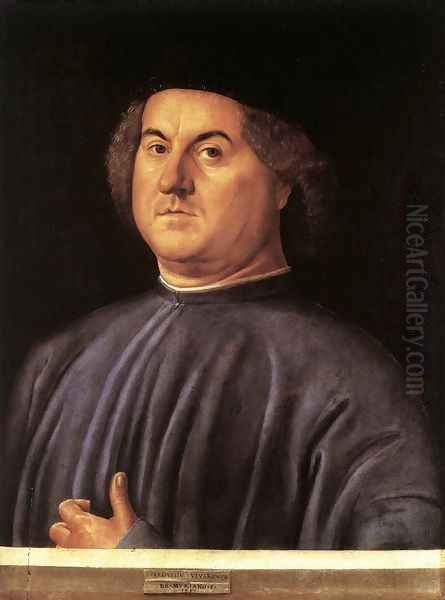
His portraiture also deserves mention. The Portrait of a Man (c. 1497), in the National Gallery, London, is a compelling example. The sitter is presented with a direct gaze, and Alvise captures a sense of thoughtful introspection. The precise rendering of features and the subtle modeling reveal the influence of Antonello da Messina, while the overall austerity and strength of character are typical of Alvise's own artistic temperament.
Other notable paintings include Christ Blessing (Pinacoteca di Brera, Milan), which shows a powerful and compassionate Christ, and various depictions of St. Jerome, a popular subject at the time, often portrayed with a rugged intensity that suited Alvise's style. His St. Jerome in the Wilderness (National Gallery of Art, Washington D.C.) is a fine example, showcasing the saint's asceticism against a meticulously rendered rocky landscape.
The Doge's Palace and Later Commissions
A testament to Alvise Vivarini's standing in Venice was his involvement in the prestigious project to redecorate the Sala del Maggior Consiglio (Great Council Hall) in the Doge's Palace. This vast chamber had been adorned with frescoes by earlier masters like Gentile da Fabriano and Pisanello, but these were deteriorating. In 1488, Alvise was commissioned to paint three large historical canvases for the hall, working alongside Giovanni Bellini and his brother Gentile Bellini (c. 1429 – 1507), who were also major contributors to this ambitious undertaking.
This commission was a significant honor and provided Alvise with a substantial salary. Unfortunately, the works in the Doge's Palace, including those by Alvise, were destroyed in the devastating fire of 1577. The loss of these large-scale narrative paintings is a major lacuna in our understanding of his full capabilities, particularly in handling complex historical compositions. It is known that he worked on these canvases for several years, but progress was reportedly slow, possibly due to his meticulous technique or perhaps declining health in his later years.
Despite the challenges, Alvise continued to receive important commissions. His workshop remained active, producing altarpieces and devotional images. His style in these later years maintained its characteristic clarity and strength, though some art historians have suggested a slight decline in inventive power or a greater reliance on workshop assistants for certain passages.
The Frari Altarpiece: A Final Testament
Alvise Vivarini's last major documented work is the monumental altarpiece depicting the Madonna and Child Enthroned with Six Saints for the Cappella Bernardo in the Basilica di Santa Maria Gloriosa dei Frari, Venice. This significant commission, dated by inscription to 1503 on its frame, was left unfinished at Alvise's death. The painting is a grand sacra conversazione, with the Virgin and Child elevated on a high throne, flanked by Saints Anthony of Padua, Louis of Toulouse, Anne, Joachim, Francis, and Bernardino of Siena.
The architectural setting is particularly elaborate, with a coffered apse and classical pilasters, demonstrating Alvise's continued interest in creating a convincing and imposing spatial environment. The figures, though somewhat static, possess a solemn dignity. Following Alvise's death, which occurred sometime between late 1503 and early 1505 (the exact date is uncertain, though 1503 is often cited in connection with this altarpiece), the work was completed by his pupil, Marco Basaiti (c. 1470 – c. 1530). Basaiti, an artist of Greek or Albanian origin, had absorbed much from Alvise but also developed his own softer, more Bellini-esque style. His hand is generally recognized in the smoother modeling and warmer tonalities of certain figures, particularly some of the saints.
Despite its collaborative completion, the Frari altarpiece stands as a powerful testament to Alvise's artistic vision. It encapsulates his commitment to clear composition, sculptural form, and the dignified representation of sacred figures within an architecturally defined space. It also marks the end of the Vivarini workshop's significant output, as Alvise was the last truly prominent painter of his family.
Alvise's Place in the Venetian School
Alvise Vivarini occupied a distinct position within the Venetian School of the late Quattrocento. He was a contemporary of giants like Giovanni Bellini, Gentile Bellini, and Vittore Carpaccio (c. 1460 – 1526), and slightly older than figures like Cima da Conegliano (c. 1459 – c. 1517). While Giovanni Bellini is rightly considered the dominant force in Venetian painting of this era, pioneering a style characterized by luminous color, atmospheric effects, and profound human emotion, Alvise offered a somewhat different, though equally valid, artistic path.
His style, with its emphasis on firm drawing, sculptural solidity, and a certain austerity, can be seen as a continuation of the Paduan tradition of Mantegna, adapted to the Venetian context. This contrasted with Bellini's softer, more painterly approach. Alvise's figures often have a more defined, almost metallic quality compared to the fleshy warmth of Bellini's. This is not to say Alvise's work lacked emotion; rather, it was often expressed with a more restrained intensity.
He can be seen as a bridge figure, maintaining some of the linear precision and formal rigor of the earlier Quattrocento while also responding to the new developments in oil painting and atmospheric perspective. His engagement with architectural space in his compositions was particularly noteworthy, creating a sense of order and monumentality. While perhaps not as innovative as Giovanni Bellini or as charmingly narrative as Carpaccio, Alvise Vivarini provided a strong, clear voice that contributed to the diversity and richness of Venetian art. He also competed directly with Bellini for commissions, indicating his recognized status.
Influence and Legacy
Alvise Vivarini's influence extended primarily through his workshop and his pupils. Marco Basaiti is the most notable artist to emerge from his studio, and Basaiti's early works clearly show the impress of his master's style before he developed a more independent artistic personality, increasingly influenced by Giovanni Bellini and later, Giorgione.
Beyond Basaiti, Alvise's impact can be seen in the works of several other, lesser-known painters active in Venice and its territories. His clear articulation of form and his dignified figure types provided a model for artists who sought a more structured and less overtly sensuous approach than that offered by Bellini.
Furthermore, the early works of Lorenzo Lotto (c. 1480 – 1556), a highly individualistic and expressive painter, show discernible traces of Alvise Vivarini's influence, particularly in the somewhat sharp modeling of figures and a certain intensity of expression. Lotto, who likely had contact with Alvise's workshop or his works in Treviso and Venice, seems to have absorbed elements of Alvise's style before embarking on his own unique artistic journey. Jacopo de' Barbari, another Venetian contemporary known for his engravings and paintings, also shares some stylistic affinities with Alvise, particularly in the precise rendering of form.
While the Vivarini workshop did not continue as a major force after Alvise's death, his contribution to Venetian art was significant. He upheld a tradition of strong draftsmanship and sculptural form, providing an alternative to the more coloristic and atmospheric tendencies that came to dominate Venetian painting in the High Renaissance through artists like Giorgione and Titian. His works remain as testaments to a dedicated artist who skillfully synthesized tradition and innovation at a crucial moment in the history of art.
Anecdotes and Artistic Innovations
While detailed personal anecdotes about Alvise Vivarini are scarce, as is common for many artists of his period, certain aspects of his career highlight his professional life and artistic approach. His commitment to integrating architecture and painting was a notable feature. The aforementioned sketch for a St. Ambrose altarpiece, for instance, reportedly emphasized the architectural setting to such a degree that the viewer would feel immersed within the depicted sacred space. This concern for the overall visual and spatial impact of an altarpiece within its ecclesiastical setting was a hallmark of his thoughtful approach.
The unfortunate incident of one of his "Madonna and Child" paintings being stolen by a Mafia figure, only to be recovered later, speaks to the enduring value and desirability of his works, even centuries after their creation. Such events, while regrettable, underscore the cultural significance attributed to Old Master paintings.
His artistic evolution is also a point of interest. Beginning with the more Gothic-inflected style of his family workshop, influenced by Antonio and Bartolomeo, Alvise progressively refined his art. The encounter with the works of Giovanni Bellini and Antonello da Messina led to a greater subtlety in his handling of light and emotion, and a more nuanced psychological portrayal, as seen in his later portraits. This capacity for growth and adaptation, while retaining a core stylistic identity, marks him as a dynamic artist.
Conclusion: An Enduring Contribution
Alvise Vivarini's career spanned a critical period of artistic transformation in Venice. As the last major painter of the Vivarini dynasty, he carried forward a legacy of workshop practice while simultaneously engaging with the revolutionary artistic ideas of his time. His paintings, with their characteristic blend of sculptural solidity, clear design, expressive intensity, and carefully constructed architectural spaces, offer a distinct and valuable perspective on the Venetian Renaissance.
Though perhaps overshadowed in popular accounts by the immense fame of Giovanni Bellini, Alvise Vivarini was a respected and sought-after master in his own right, undertaking major commissions and contributing significantly to the artistic fabric of Venice. His influence on pupils like Marco Basaiti and his resonance in the early work of a master like Lorenzo Lotto further attest to his importance. Studying Alvise Vivarini allows for a richer, more nuanced understanding of the multifaceted nature of Venetian art at the threshold of the High Renaissance, revealing an artist of integrity, skill, and enduring historical significance. His works continue to be admired in major collections worldwide, a testament to his lasting artistic achievement.