Albrecht Dürer stands as one of the most formidable and influential figures in the history of art, a true polymath whose genius illuminated the Northern Renaissance. Born in the bustling imperial city of Nuremberg, Germany, Dürer was not only a painter and printmaker of unparalleled skill but also a theorist, mathematician, and keen observer of the natural world. His relentless curiosity, technical mastery, and intellectual depth propelled him to international fame within his own lifetime, and his legacy continues to resonate powerfully through the centuries. This exploration delves into the life, work, and enduring impact of this remarkable artist.
Early Life and Formative Influences
Albrecht Dürer was born on May 21, 1471, in Nuremberg, a vibrant center of commerce, craftsmanship, and humanist thought. His father, Albrecht Dürer the Elder, was a successful goldsmith who had emigrated from Ajtós, near Gyula in Hungary. The family name was originally Ajtósi, which, meaning "doormaker" in Hungarian, was translated to Thürer and eventually evolved into Dürer. Albrecht was the third child and second son of his parents, Albrecht Dürer the Elder and Barbara Holper, who had between fourteen and eighteen children in total, though many did not survive to adulthood.
His initial training began in his father's goldsmith workshop. This early exposure to the meticulous craft of metalworking, with its emphasis on precision, fine detail, and the use of the burin for engraving, undoubtedly laid a crucial foundation for his later mastery in printmaking. Dürer himself acknowledged this debt, and his early drawings, such as the astonishingly accomplished silverpoint Self-Portrait at Thirteen (1484), already reveal a prodigious talent and a keen eye for observation.
Recognizing his son's exceptional aptitude for drawing, Dürer the Elder apprenticed young Albrecht in 1486 to Michael Wolgemut, then the leading painter and woodcut illustrator in Nuremberg. Wolgemut's workshop was a large and busy enterprise, producing a variety of artworks, including altarpieces and, significantly, designs for woodcut book illustrations. Here, Dürer learned the fundamentals of painting in the late Gothic German tradition, as well as the techniques of woodcut design and production. He would have participated in major projects, such as the woodcuts for Hartmann Schedel's Nuremberg Chronicle (1493), a monumental illustrated history of the world.
The Journeyman Years and Italian Awakening
Upon completing his apprenticeship in 1490, Dürer embarked on his "Wanderjahre," or journeyman years, a traditional period of travel for craftsmen to gain experience and broaden their horizons. He traveled through various German-speaking regions, likely visiting Colmar, a center of printmaking where he hoped to work with Martin Schongauer, the most renowned Northern European engraver of his time. Unfortunately, Schongauer died in 1491, shortly before Dürer's potential arrival. However, Dürer was received by Schongauer's brothers, also goldsmiths and painters, and likely studied Schongauer's prints extensively, absorbing their refined technique and compositional elegance.
He also spent time in Basel and Strasbourg, both important centers for printing and humanist scholarship. In Basel, he produced woodcut illustrations for several books, further honing his skills in this medium. These early travels exposed him to different artistic styles and intellectual currents, broadening his perspective beyond the confines of Nuremberg.
In 1494, Dürer returned to Nuremberg and, following arrangements made during his absence, married Agnes Frey, the daughter of a prosperous local coppersmith and lute maker. The marriage, while providing social standing and financial stability, is often described by scholars as not particularly happy, based on Dürer's own somewhat melancholic references in his writings. Shortly after his marriage, Dürer undertook his first major journey to Italy, a trip that would prove transformative for his artistic development. He traveled to Venice, a city teeming with artistic innovation and a gateway for Northern Europeans to the wonders of the Italian Renaissance.
In Italy, Dürer encountered firsthand the works of artists like Andrea Mantegna, whose powerful classicism and mastery of perspective deeply impressed him, and Giovanni Bellini, whose use of color and light in painting he greatly admired. He diligently copied Italian prints and studied their principles of proportion, perspective, and human anatomy. This exposure to Italian Renaissance ideals—its emphasis on humanism, classical forms, and the scientific study of art—began to meld with his Northern European heritage of detailed realism and expressive intensity. His watercolor landscapes from this period, such as View of Arco (1495), are remarkable for their atmospheric sensitivity and topographical accuracy, representing some of the earliest pure landscape studies in Western art.
The Master of Print: Woodcuts and Engravings
Upon his return to Nuremberg in 1495, Dürer established his own workshop and quickly gained renown, particularly for his prints. He revolutionized both woodcut and engraving, elevating them from primarily illustrative or devotional crafts to independent art forms of immense power and sophistication. His technical virtuosity, combined with his intellectual depth and imaginative vision, set a new standard for printmaking across Europe.
His woodcut series, The Apocalypse (1498), comprising fifteen large-scale prints illustrating scenes from the Book of Revelation, was a groundbreaking achievement. Works like The Four Horsemen of the Apocalypse display an unprecedented dynamism, dramatic intensity, and complexity of composition. Dürer pushed the boundaries of the woodcut medium, achieving remarkable tonal variations and textural effects through intricate networks of lines. These prints were not mere illustrations but powerful visual interpretations that captured the eschatological fervor of the era. He also produced other significant woodcut series, including the Large Passion (c. 1497-1510) and the Life of the Virgin (c. 1501-1511), which further showcased his narrative skill and technical brilliance.
Simultaneously, Dürer excelled in copperplate engraving, a medium demanding even greater precision. His engravings are characterized by their meticulous detail, subtle gradations of tone, and profound intellectual content. Early masterpieces like The Prodigal Son Amidst the Swine (c. 1496) demonstrate his ability to convey deep human emotion and rich textures. He explored a wide range of subjects, from religious scenes and allegories to genre studies and portraits.
Perhaps his most famous engravings are the so-called "Meisterstiche" (master engravings) of 1513-1514: Knight, Death, and the Devil, Saint Jerome in His Study, and Melencolia I. These three prints are celebrated for their technical perfection and complex, enigmatic symbolism. Knight, Death, and the Devil portrays a Christian knight steadfastly riding through a perilous landscape, embodying moral fortitude. Saint Jerome in His Study offers a serene vision of scholarly contemplation, bathed in meticulously rendered light. Melencolia I, perhaps the most debated of his works, is a profound allegory of the creative mind, grappling with the limits of human knowledge and the burden of genius, a theme that resonated with Renaissance humanism and Dürer's own introspective nature.
Dürer was also an early adopter of etching, a technique he experimented with between 1515 and 1518, producing works like The Desperate Man. His iconic "AD" monogram, prominently featured on his prints, became a mark of quality and a form of copyright, so widely recognized that his prints were often copied, leading Dürer to famously take legal action against infringers like Marcantonio Raimondi in Venice.
Achievements in Painting and Drawing
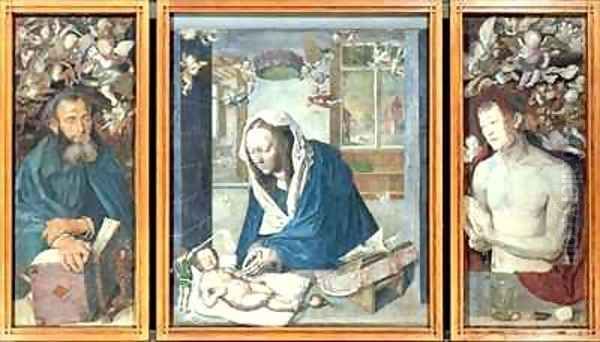
While Dürer's prints disseminated his fame far and wide, he was also a painter of considerable talent, though his painted oeuvre is smaller. His early paintings, such as the Dresden Altarpiece (c. 1496) and the Paumgartner Altarpiece (c. 1498-1504), show his assimilation of both German traditions and Italian influences, particularly in their detailed realism and attempts at more monumental compositions.
His self-portraits are among his most compelling paintings. The Self-Portrait at Twenty-Six (1498, Prado, Madrid) presents him as a confident, elegantly dressed gentleman, reflecting his rising status and Italianate sophistication. Even more striking is the Self-Portrait at Twenty-Eight (1500, Alte Pinakothek, Munich), in which he depicts himself frontally, in a pose traditionally reserved for Christ. This bold image is not an act of blasphemy but rather an assertion of the artist's divine gift of creativity, a concept central to Renaissance thought, and a reflection of the Imitatio Christi (imitation of Christ) ideal.
During his second extended stay in Venice (1505-1507), Dürer produced one of his most important paintings, the Feast of the Rose Garlands (1506), commissioned by German merchants for their church, San Bartolomeo. This large altarpiece, depicting the Virgin Mary distributing rose garlands to the Pope and the Holy Roman Emperor, demonstrates his mastery of Venetian color and compositional harmony, earning him the admiration of local artists, including the aged Giovanni Bellini, who reportedly praised Dürer highly. He also painted portraits during this period, such as the Portrait of a Young Venetian Woman (1505).
Dürer's drawings and watercolors are equally remarkable. He was a prolific draftsman, and thousands of his drawings survive, showcasing his versatility and keen observational skills. His nature studies, such as The Large Piece of Turf (1503) and Young Hare (1502), are astonishing in their meticulous detail and lifelike rendering, revealing his profound interest in the natural world. These works transcend mere scientific illustration, imbued with an almost spiritual reverence for creation. His Praying Hands (1508), a study for an apostle in the Heller Altarpiece, has become one of the most iconic and widely reproduced images in Western art.
Theoretical Writings and Scientific Pursuits
Dürer was not content merely to create art; he sought to understand and articulate its underlying principles. He was deeply interested in mathematics, geometry, and the theory of human proportion, believing that art should be grounded in scientific knowledge. He planned to write a comprehensive treatise on painting but ultimately published parts of his research in separate volumes.
His first major theoretical work was Unterweisung der Messung mit dem Zirkel und Richtscheit (Instruction in Measurement with Compass and Ruler), published in 1525. This groundbreaking manual on geometry for artists and craftsmen covered topics such as linear perspective, the construction of regular polygons, conic sections, and the design of lettering. It was intended to provide German artists with the theoretical foundations that Italian artists had long possessed.
His most famous theoretical work, Vier Bücher von menschlicher Proportion (Four Books on Human Proportion), was published posthumously in 1528, though he had completed it before his death. In this extensively illustrated treatise, Dürer systematically explored the proportions of the human body, presenting a variety of male and female figure types. He drew upon the work of Vitruvius and was influenced by contemporary Italian theorists like Leon Battista Alberti and Leonardo da Vinci, though he developed his own complex systems for varying proportions to achieve different effects. These books were highly influential, translated into Latin and other languages, and became standard texts for artists for generations.
Later Life, Patronage, and the Netherlands Journey
Dürer enjoyed significant patronage throughout his career. He worked for prominent Nuremberg citizens and, most notably, for the Holy Roman Emperor Maximilian I from around 1512. For Maximilian, he designed parts of the monumental woodcut print The Triumphal Arch (1515-1517), a vast propaganda piece celebrating the Emperor's lineage and achievements, involving many artists including Hans Schäufelein and Hans Baldung Grien. He also produced engraved portraits of key figures of his time, such as Cardinal Albrecht of Brandenburg and Frederick the Wise, Elector of Saxony, who was one of his earliest patrons.
In 1520-1521, Dürer undertook a journey to the Netherlands with his wife. The primary purpose was to secure the renewal of his imperial pension from the new Emperor Charles V, Maximilian's successor. His detailed travel diary from this trip provides invaluable insights into his experiences, encounters, and financial transactions. He was received with honor by artists, scholars, and dignitaries in cities like Antwerp, Brussels, and Ghent. He met with fellow artists such as Quentin Matsys, Joachim Patinir, and Lucas van Leiden, exchanging prints and drawings. He also encountered the works of earlier Netherlandish masters like Jan van Eyck and Rogier van der Weyden, which he greatly admired.
During this journey, he produced numerous drawings, including portraits and studies of local life and exotic animals, such as a walrus. He was fascinated by the treasures brought back from the New World, marveling at Aztec goldwork shown to him in Brussels. The trip, while successful in securing his pension, may have also taken a toll on his health; he likely contracted a chronic illness, possibly malaria, during his travels in the marshy regions of Zeeland.
Final Years and Enduring Legacy
Dürer returned to Nuremberg in 1521 and spent his final years continuing his artistic and theoretical work. The religious turmoil of the Protestant Reformation deeply affected him. Nuremberg officially adopted Lutheranism in 1525, and Dürer himself was a sympathetic follower of Martin Luther, with whom he corresponded, though they never met. His later works reflect his religious convictions and a more austere, monumental style.
His last great paintings, The Four Apostles (1526), presented to the city council of Nuremberg, are considered his artistic testament. These imposing figures of John, Peter, Mark, and Paul embody Protestant ideals of faith and scripture, serving as a powerful warning against false prophets and religious extremism. The paintings showcase a new monumentality and psychological depth, perhaps influenced by his renewed contact with Italian art through prints and his own theoretical studies.
Albrecht Dürer died in Nuremberg on April 6, 1528, at the age of 56. His close friend, the humanist scholar Willibald Pirckheimer, wrote a moving epitaph for his tomb: "What was mortal of Albrecht Dürer lies beneath this mound."
Dürer's influence on subsequent generations of artists was immense and widespread. His prints circulated throughout Europe, inspiring artists from Italy (where even Raphael was known to have Dürer prints in his studio and exchanged drawings with him) to Spain and Eastern Europe. His technical innovations in printmaking set a standard that few could match. Artists like Titian and Parmigianino were known to have studied his prints. Later masters such as Rembrandt van Rijn collected Dürer's prints and were clearly influenced by his dramatic use of light and shadow and his psychological acuity. Even centuries later, artists like Francisco Goya and, in the modern era, Pablo Picasso, found inspiration in his powerful imagery and technical mastery.
His theoretical writings provided a crucial bridge between Italian Renaissance theory and Northern European artistic practice, helping to elevate the status of artists in Germany from mere craftsmen to respected intellectuals. He demonstrated that an artist could be both a skilled practitioner and a profound thinker. His meticulous studies of nature anticipated later scientific illustration, and his self-portraits established a tradition of artistic self-examination that continues to this day.
Anecdotes and Character
Several anecdotes illuminate Dürer's character and experiences. His early self-portrait at thirteen, inscribed with his own words about its creation, speaks to his early self-awareness and confidence. The story of his legal battle with Marcantonio Raimondi over the unauthorized copying of his Life of the Virgin prints in Venice highlights his business acumen and his determination to protect his artistic creations—an early instance of asserting intellectual property rights.
His travel diary from the Netherlands journey reveals a man who was keenly observant, interested in a wide array of subjects, and careful with his finances. It also shows his pride in his artistic achievements and the respect he commanded. He records with satisfaction the honors paid to him and the gifts he received.
One curious work, the woodcut The Rhinoceros (1515), was based on a written description and a rough sketch of an Indian rhinoceros that had arrived in Lisbon. Though Dürer never saw the animal himself, his imaginative and powerful depiction, complete with armor-like plates, became the definitive European image of a rhinoceros for centuries, despite its anatomical inaccuracies. This demonstrates his ability to create compelling images even from secondary sources.
His relationship with his wife Agnes is often portrayed as strained. Pirckheimer, in a letter written after Dürer's death, blamed Agnes for nagging Dürer and contributing to his ill health, though this account may be biased. Dürer's own writings are more circumspect, but there is a sense of melancholy that pervades some of his personal reflections.
Dürer was known for his diligence, his intellectual curiosity, and his deep piety. He engaged with the leading humanists of his day, including Pirckheimer and Erasmus of Rotterdam, whose portrait he engraved. He was a man of his time, deeply affected by the religious and intellectual currents of the Reformation and the Renaissance, yet his genius transcended his era.
Conclusion
Albrecht Dürer was more than just a supremely gifted artist; he was a pivotal figure who synthesized the artistic traditions of Northern Europe with the intellectual innovations of the Italian Renaissance. His mastery of printmaking revolutionized the medium, allowing his work to reach an unprecedentedly wide audience and securing his international reputation. His paintings, drawings, and theoretical writings further attest to his versatile genius and his profound impact on the course of Western art.
From the intricate details of a humble piece of turf to the cosmic drama of the Apocalypse, from the introspective gaze of his self-portraits to the systematic exploration of human proportion, Dürer's work reveals an artist of extraordinary range, technical brilliance, and intellectual depth. He remains a towering figure, whose contributions continue to inspire awe and scholarly investigation, a true colossus of the Northern Renaissance whose light has never dimmed.