Antoine Caron (c. 1521–1599) stands as a pivotal yet often underappreciated figure in the landscape of French Renaissance art. Active during a period of intense religious and political turmoil, Caron’s work provides a unique window into the sophisticated, extravagant, and often anxious world of the Valois court. As one of the few native French masters of the School of Fontainebleau, his distinctive style, characterized by elongated figures, complex allegories, and vibrant, sometimes unsettling, palettes, left an indelible mark on the art of his time and influenced subsequent generations.
Early Life and Artistic Formation
Born in Beauvais, a town north of Paris, around 1521, Antoine Caron's early life and initial artistic training are somewhat shrouded in obscurity, a common fate for many artists of the period before the more systematic record-keeping of later centuries. However, it is widely accepted that he received his foundational artistic education in his hometown, possibly working on cartoons for stained glass, a prominent local industry. Beauvais, with its magnificent Gothic cathedral, would have exposed the young Caron to a rich visual tradition.
By the 1540s, Caron had gravitated towards the epicenter of artistic innovation in France: the royal Château de Fontainebleau. Under King Francis I, Fontainebleau had been transformed into a dazzling showcase of Renaissance art and architecture, largely through the efforts of Italian masters. It was here that Caron came under the tutelage of two such luminaries: Francesco Primaticcio (1504–1570) and Niccolò dell'Abate (c. 1509/1512–1571). Primaticcio, who had arrived in France in 1532 after working with Giulio Romano in Mantua, became the leading figure at Fontainebleau after the death of Rosso Fiorentino in 1540. Dell'Abate joined Primaticcio in 1552, bringing with him a refined Emilian Mannerism.
Working within the bustling royal workshops, Caron absorbed the prevailing Mannerist style. This style, which emerged after the High Renaissance, favored elegance, artifice, and intellectual complexity over naturalism. Characteristics included elongated human proportions, contorted poses (figura serpentinata), crowded compositions, and often, a heightened, non-naturalistic use of color. Caron's training would have involved not just painting but also decorative arts, stuccowork, and tapestry design, reflecting the versatile demands placed on court artists.
A Career at the Valois Court
Antoine Caron's career began to flourish in the late 1540s and early 1550s. He was initially involved in projects at Fontainebleau, including designing stained glass windows and assisting Primaticcio. A significant early commission involved working with Primaticcio in 1559 on the restoration of the Galerie François I, a masterpiece of the First School of Fontainebleau originally decorated by Rosso Fiorentino. He also collaborated with Niccolò dell'Abate on the decoration of various apartments within the château.
His talents did not go unnoticed. By 1561, Caron had earned the prestigious title of court painter, serving under King Charles IX and later King Henry III. This position was not merely about producing paintings; it entailed a wide array of responsibilities. Crucially, Caron became an important organizer and designer for the elaborate court festivals, tournaments, royal entries, coronations, and weddings that were a hallmark of the Valois dynasty. These ephemeral spectacles were potent tools of political propaganda and cultural display, and Caron’s designs for them, often known through drawings and prints, reveal his imaginative flair and understanding of theatricality.
Catherine de' Medici, the powerful Queen Mother, was a particularly important patron for Caron. She commissioned numerous works from him, including designs for the famous Valois Tapestries (though the final execution involved other artists like Lucas de Heere) and illustrations for allegorical texts. His close association with the court, and particularly with Catherine, placed him at the heart of French political and cultural life during the tumultuous French Wars of Religion (1562–1598).
Artistic Style and Thematic Concerns
Antoine Caron is one of the most distinctive painters of the French Mannerist school, often associated with the later developments of the School of Fontainebleau. His style is immediately recognizable for its elongated, slender, and almost ethereal human figures, often clad in elaborate, fantastical costumes that blend contemporary court fashion with classical and theatrical elements. These figures move with a choreographed grace, their gestures often exaggerated and expressive.
His compositions are typically crowded and complex, filled with a multitude of figures and intricate architectural backdrops. Caron demonstrated a fascination with perspective, often employing deep, exaggerated vistas that draw the viewer's eye into fantastical cityscapes or landscapes. These architectural settings are not merely backgrounds but active participants in the narrative, frequently featuring a mix of classical ruins and imaginative structures. His color palette is often bright and jewel-like, though sometimes veering into more somber or acidic tones, reflecting the dramatic or unsettling nature of his subjects.
Caron’s thematic range was broad, encompassing historical events, mythological scenes, complex allegories, and religious subjects, all filtered through the sophisticated and erudite lens of the Valois court. He frequently depicted scenes of spectacle, such as tournaments, ballets, and processions, reflecting his work as a festival designer. However, a darker undercurrent often pervades his art, particularly in his depictions of massacres and scenes of violence, which undoubtedly mirrored the brutal realities of the French Wars of Religion.
Masterpieces and Major Works
While many of Caron's works, particularly designs for ephemeral events, have been lost, a significant body of paintings and drawings survives, attesting to his unique vision.
The Massacres of the Triumvirate (1566)
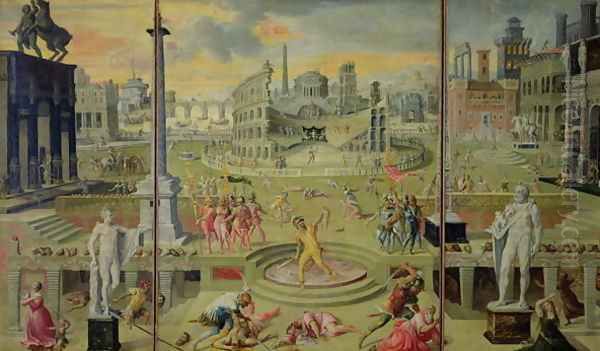
Perhaps Caron’s most famous and arguably most powerful work is The Massacres of the Triumvirate, dated 1566 and now housed in the Musée du Louvre, Paris. This painting is notable for being one of the few works Caron signed and dated. Ostensibly depicting the proscriptions and executions ordered by the Roman Triumvirs Octavian, Antony, and Lepidus in 43 BC, the painting is widely interpreted as a chilling allegory for the contemporary violence of the French Wars of Religion, particularly the massacres that punctuated this period.
The scene unfolds across a vast, panoramic cityscape dominated by classical architecture, including recognizable Roman monuments like the Colosseum and Castel Sant'Angelo, albeit imaginatively rearranged. The foreground and middle ground are teeming with scenes of brutal execution: beheadings, hangings, and bodies strewn across public squares. Despite the horrific subject matter, Caron’s figures retain their characteristic elegance and balletic poses, creating a disturbing disconnect between the beauty of the execution and the brutality of the events. This aestheticization of violence is a hallmark of some Mannerist art and reflects the complex attitudes of the era. The painting served as a stark commentary on the political instability and savagery that plagued France.
The Story of Artemis (or Artemisia)
Another significant body of work comprises Caron's designs illustrating the Story of Artemis (often referred to as Artemisia). These were created for a manuscript written by Nicolas Houel, a Parisian apothecary and humanist, intended for Catherine de' Medici. The story of Queen Artemisia II of Caria, who famously mourned her husband Mausolus and commissioned the Mausoleum at Halicarnassus, one of the Seven Wonders of the Ancient World, was a popular allegory for Catherine de' Medici's widowhood and her devotion to her late husband, King Henry II.
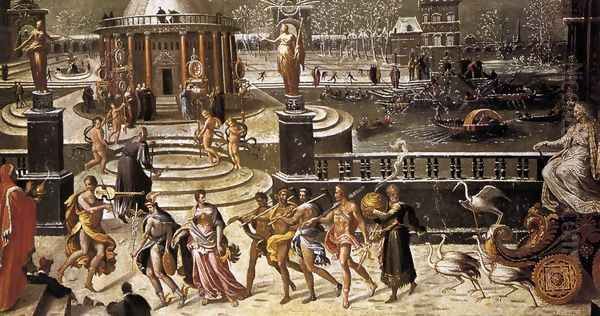
Caron’s drawings for this series, many of which are preserved in the Bibliothèque Nationale de France, showcase his skill in narrative composition and his imaginative depiction of classical scenes. These designs were later used as cartoons for a series of tapestries, further disseminating his artistic vision. The scenes often feature grand architectural settings, elaborate processions, and Caron’s signature elongated figures, all imbued with a sense of courtly refinement and allegorical depth.
The Valois Tapestries
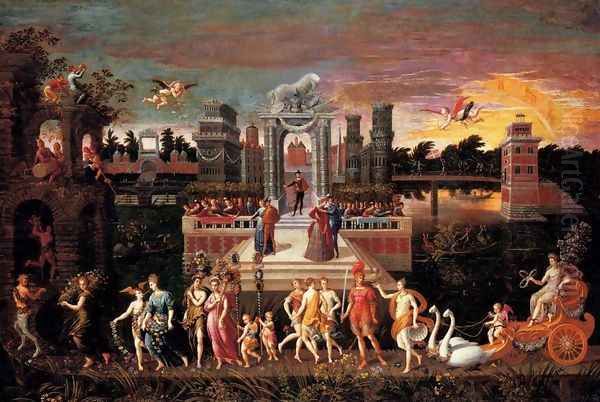
While Caron's direct hand in the final execution of the Valois Tapestries is debated, his designs were certainly influential, and he is often credited with some of the initial concepts. This series of eight large tapestries, now in the Uffizi Gallery in Florence, depicts lavish court festivals, tournaments, and water pageants held by the Valois court, particularly during the reign of Henry III, with Catherine de' Medici and other prominent courtiers prominently featured in the foreground.
These tapestries are invaluable historical documents, offering a vivid glimpse into the opulent world of the French court. They celebrate the magnificence of the Valois dynasty and were likely intended as diplomatic gifts or propaganda pieces. Caron’s influence can be seen in the complex compositions, the detailed rendering of costumes and settings, and the overall sense of theatrical spectacle. The Flemish artist Lucas de Heere is also strongly associated with their design, highlighting the collaborative nature of such large-scale commissions.
Other Notable Works
Several other paintings further illustrate Caron's diverse talents and thematic interests:
<em>Astronomers Studying an Eclipse</em> (c. 1570s): This intriguing painting, now in the J. Paul Getty Museum (another version exists), depicts a group of scholars, including Catherine de' Medici, observing an astronomical event. It reflects the Renaissance interest in science and the occult, and the elongated figures and dramatic lighting create an atmosphere of mystery and intellectual inquiry.
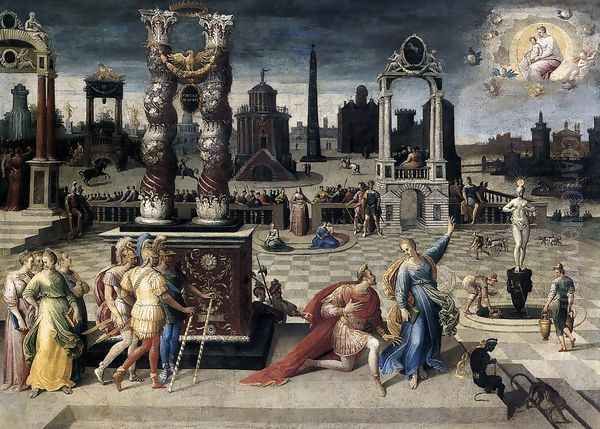
<em>Augustus and the Sibyl</em> (c. 1575-1580): Housed in the Louvre, this work depicts the Roman Emperor Augustus consulting the Tiburtine Sibyl, who reveals a vision of the Virgin and Child, interpreted as a prophecy of Christ's coming. The scene is set against a backdrop of fantastical ruins, typical of Caron's style, and blends classical history with Christian allegory.
<em>The Submission of Milan to Francis I in 1515</em> (c. 1570s): This historical painting celebrates a key victory of one of the Valois kings, demonstrating Caron's role in glorifying the dynasty.
Illustrations for Philostratus: Caron also produced drawings illustrating the Imagines of Philostratus, a classical text describing various paintings. These demonstrate his engagement with classical literature and his ability to translate textual descriptions into visual form.
<em>Le Livre et l'Epée</em> (The Book and the Sword): This allegorical work, likely from the 1560s, explores the relationship between learning and power, a pertinent theme for the humanist-influenced Valois court.
Versatility Beyond Painting: A Renaissance Man
Like many Renaissance artists, Antoine Caron was not confined to a single medium. His early training in Beauvais likely involved stained glass design, and he continued to work in this field. His most significant contributions beyond panel painting, however, were in the realm of tapestry design and printmaking.
Tapestries were among the most prized and expensive art forms of the Renaissance, and Caron’s designs for series like the Story of Artemis and his contributions to the Valois Tapestries underscore his importance in this medium. These large-scale works adorned the walls of royal palaces and châteaux, serving as both decoration and powerful statements of wealth and cultural sophistication.
Caron also produced numerous drawings that were intended to be translated into prints by engravers such as Thomas de Leu (who became his son-in-law) and René Boyvin. Prints played a crucial role in disseminating artistic styles and iconographies across Europe. Caron’s designs for festivals, allegories, and historical scenes reached a wider audience through this medium, further solidifying his reputation and influence. His involvement in designing ephemeral court spectacles also highlights his understanding of stagecraft and theatrical design.
The School of Fontainebleau Context
Antoine Caron is a key figure of the School of Fontainebleau, specifically its later phase, sometimes distinguished as the Second School of Fontainebleau, though his career bridges both. The First School, established under Francis I, was dominated by Italian artists like Rosso Fiorentino, Primaticcio, and Dell'Abate. They created a distinctive French Mannerist style characterized by elegant, elongated figures, intricate stucco work, and complex allegorical programs.
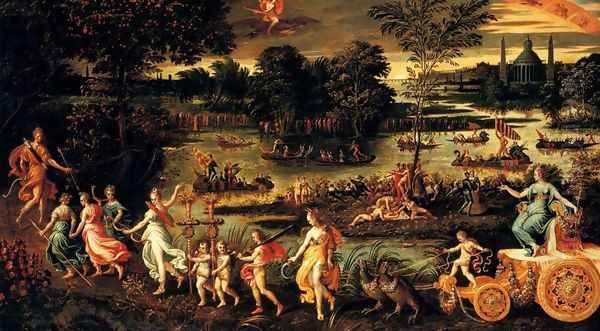
Caron, as a native Frenchman trained by these Italian masters, represents a continuation and adaptation of this style. He inherited their penchant for sophistication and artifice but infused it with his own unique sensibility, perhaps reflecting the specific cultural and political climate of France during the Wars of Religion. While the Italian influence is undeniable, Caron’s work possesses a distinctly French flavor, particularly in its theatricality and its engagement with contemporary events. Other French artists associated with the broader Fontainebleau tradition include Jean Cousin the Elder and Jean Cousin the Younger, whose work sometimes shares stylistic affinities with Caron's. The portraitist François Clouet, while working in a different genre, was also a prominent contemporary at the French court.
Collaborations and Contemporaries
Caron's career was marked by collaboration. His work with Primaticcio and Niccolò dell'Abate at Fontainebleau was formative. His partnership with the humanist Nicolas Houel on the Story of Artemis project demonstrates the close links between artists and scholars at the Valois court. The production of tapestries and prints inherently involved collaboration with weavers, engravers, and publishers.
Beyond his direct collaborators, Caron was part of a vibrant artistic milieu. The Valois court, despite its political instability, was a major center of patronage. Artists from across Europe were drawn to France, creating a dynamic environment of exchange and influence. Caron’s engagement with classical themes, his sophisticated allegories, and his refined style placed him firmly within the mainstream of late Renaissance European art.
Influence and Legacy
Antoine Caron's influence extended to the next generation of artists in France. The artists of the Second School of Fontainebleau, such as Toussaint Dubreuil, Martin Fréminet, and Ambroise Dubois, who decorated Fontainebleau and other royal residences under King Henry IV, show stylistic debts to Caron, particularly in their elongated figures and complex compositions.
Even later, echoes of Caron’s approach to historical and allegorical painting can be discerned. While Nicolas Poussin, the great master of French Classicism in the 17th century, developed a very different style, Caron’s ambitious historical compositions and his attempts to visualize complex narratives may have provided a distant precedent for Poussin’s own erudite paintings. The grand tradition of French history painting, which flourished in the 17th and 18th centuries with artists like Philippe de Champaigne and Charles Le Brun, owes something to the foundations laid by earlier masters like Caron who tackled large-scale narrative subjects.
Despite his importance during his lifetime, Caron's reputation faded somewhat in subsequent centuries, overshadowed by later artistic movements. However, the 20th and 21st centuries have seen a renewed scholarly interest in his work, recognizing his unique contribution to French art and his role as a chronicler of a fascinating and turbulent era.
Rediscovery and Scholarly Attention
Modern art historical scholarship has been instrumental in reassessing Antoine Caron's significance. Exhibitions dedicated to his work, or featuring him prominently within the context of the School of Fontainebleau and Valois art, have brought his paintings and drawings to a wider public. For instance, the exhibition "Antoine Caron (1521-1599): Le Théâtre de l'Histoire" held at the Musée national de la Renaissance at the Château d'Écouen in 2023, showcased many previously unexhibited works, including paintings, manuscripts, drawings, prints, and tapestries, further illuminating his diverse talents and the rich context of his creations.
Scholarly publications, such as Frédéric Hueber's comprehensive monograph and catalogue raisonné, have provided a deeper understanding of Caron's oeuvre, his patrons, and his artistic development. Research continues to explore the complex iconography of his works, his role in court festivals, and his connections to contemporary intellectual and political currents. The study of his drawings, in particular, has revealed much about his working methods and his inventive approach to composition.
Conclusion: An Artist of His Time
Antoine Caron died in Paris in 1599, his life spanning a period of profound transformation and upheaval in France. As a court painter to the last Valois kings, he was both a product and a shaper of the sophisticated, intellectually charged, and often perilous world he inhabited. His art, with its blend of elegance and anxiety, spectacle and violence, provides an invaluable visual record of this era.
Through his distinctive Mannerist style, his mastery of complex allegories, and his versatile engagement with various media, Caron carved out a unique place in the history of French art. He successfully navigated the demands of royal patronage, producing works that glorified the dynasty, entertained the court, and subtly commented on the turbulent times. While the world of the Valois may seem distant, Antoine Caron’s art continues to fascinate and intrigue, offering a glimpse into a refined, yet fragile, golden age of the French Renaissance. His legacy is that of a highly original artist who captured the spirit of his age with a unique and enduring vision.