Jan Harmensz. Muller, a name that resonates with connoisseurs of Northern European printmaking, stands as a pivotal figure in the Dutch Golden Age, particularly celebrated for his virtuoso engravings. Active during a period of profound artistic transformation, Muller (1571-1628) not only mastered the intricate art of the burin but also pushed its expressive potential to new heights. His life and work offer a fascinating window into the vibrant artistic milieu of Amsterdam and the international connections that shaped late Mannerist and early Baroque art. This exploration will delve into his biography, artistic development, key influences, significant works, and his enduring legacy within the grand tapestry of art history.
Early Life and Artistic Foundations in Amsterdam
Jan Harmensz. Muller was born in Amsterdam in 1571, a city on the cusp of becoming a major European economic and cultural hub. His artistic inclinations were nurtured from a young age, as he was the son of Harmen Jansz. Muller (c. 1540-1617), himself a respected printer, publisher, and engraver. This familial environment provided Jan with an invaluable early education in the technical and commercial aspects of printmaking. The Muller workshop was a place of craft and commerce, where the young Jan would have been exposed to the entire process, from the preparation of copper plates to the printing and distribution of finished engravings.
His father, Harmen Jansz. Muller, was known for publishing works by prominent artists, including prints after Maarten van Heemskerck and later, those by his own son. This background undoubtedly instilled in Jan Muller a deep understanding of the print market and the role of engravings in disseminating artistic ideas. It was within this context that he began to hone his skills, likely learning the fundamentals of drawing and engraving directly from his father before seeking more specialized training.
Apprenticeship with Goltzius and the Haarlem Mannerists
A defining moment in Jan Muller's early career was his association with Hendrick Goltzius (1558-1617), the preeminent Dutch printmaker and draughtsman of his generation. Muller is believed to have entered Goltzius's workshop in Haarlem as an apprentice or assistant in the late 1580s. Goltzius was a towering figure, renowned for his technical brilliance, particularly his innovative "swelling line" technique, which allowed for remarkable tonal variations and a sense of plasticity in his figures. Working under Goltzius would have been an immersive and demanding experience, exposing Muller to the highest standards of craftsmanship and artistic ambition.
The artistic environment in Haarlem at this time was dominated by Mannerism, a style characterized by elegance, artificiality, elongated figures, complex poses, and often, erotic undertones. Goltzius, along with artists like Cornelis Cornelisz. van Haarlem (1562-1638) and Karel van Mander (1548-1606) – the latter also an influential art theorist – formed the core of what is known as Haarlem Mannerism. Muller absorbed these stylistic tendencies, evident in his dynamic compositions, exaggerated musculature, and sophisticated handling of the human form. The influence of Cornelis van Haarlem, with his powerful, often contorted nudes, can be seen in Muller's approach to anatomy.
The Development of a Mannerist Virtuoso
Jan Muller quickly distinguished himself as an engraver of exceptional talent. His style, while rooted in the teachings of Goltzius, evolved to display his own distinct characteristics. He became known for his meticulous attention to detail, the richness of his textures, and the dramatic interplay of light and shadow in his prints. His lines are often dense and energetic, creating a sense of vibrant movement and sculptural volume. This technical command allowed him to translate the complex designs of other artists into compelling engraved images, but also to create powerful original compositions.
Muller's Mannerism was not merely a stylistic affectation; it was a visual language well-suited to the intellectual and often allegorical themes popular at the time. The elongated proportions, intricate draperies, and dynamic, sometimes precarious, poses of his figures contributed to a sense of heightened drama and sophistication. He excelled in depicting scenes filled with numerous figures, managing complex spatial arrangements with apparent ease. His ability to render different materials – flesh, fabric, metal, foliage – with convincing texture was particularly admired.
Engraving the Masters: Muller's Reproductive Prints
A significant portion of Jan Muller's oeuvre consists of reproductive engravings, translating paintings and drawings by other artists into the print medium. This practice was common and highly valued in the era before photography, as prints were the primary means by which artistic compositions could be widely disseminated and studied. Muller's skill in this area was such that his engravings were not mere copies but were often considered artworks in their own right, capturing the spirit and power of the original designs while showcasing his own interpretive abilities.
He engraved works after various masters, including his teacher Hendrick Goltzius. However, he is perhaps most famous for his engravings after the designs of Bartholomeus Spranger (1546-1611). Spranger, a Flemish painter, was a leading artist at the imperial court of Rudolf II in Prague. His sophisticated, often erotically charged Mannerist paintings were highly influential, and Muller's prints played a crucial role in spreading Spranger's fame across Europe. These collaborations resulted in some of the most iconic images of late Mannerism.
Other artists whose designs Muller translated into engravings include Abraham Bloemaert (1566-1651), another prominent Dutch Mannerist who later transitioned towards a more Baroque style, and Adriaen de Vries (c. 1556-1626), a Dutch sculptor also active at the Prague court. Muller's ability to capture the essence of such diverse artistic personalities speaks to his versatility and profound understanding of different visual languages.
The Prague Connection: Rudolf II's Imperial Court
While Jan Muller was primarily based in Amsterdam, his career was significantly impacted by his connections to the artists of Emperor Rudolf II's court in Prague. This court was a renowned center of arts and sciences, attracting leading talents from across Europe. Muller's engravings after Bartholomeus Spranger, Hans von Aachen (1552-1615), and Adriaen de Vries forged a strong link between the artistic scenes of Amsterdam and Prague.
It is plausible that Muller himself visited Prague, perhaps between 1596 and 1602, to work more closely with these artists. The imperial court fostered a unique artistic climate, characterized by a taste for the esoteric, the allegorical, and the exquisitely crafted. Muller's refined engraving technique was perfectly suited to rendering the sophisticated and often complex compositions favored by Rudolfine artists. His prints after Spranger, such as Minerva and Mercury Arming Perseus or Venus and Adonis, exemplify this high Mannerist style, with their elegant, elongated figures, intricate details, and mythological themes.
The sculptor Adriaen de Vries, known for his dynamic bronze figures, also provided designs for Muller. This connection was further solidified by family ties, as Muller was related by marriage to de Vries. These relationships underscore the interconnectedness of the European artistic community at the turn of the 17th century, where artists, ideas, and styles traveled across borders, often facilitated by the medium of print.
Key Thematic Concerns in Muller's Work
Jan Muller's subject matter was diverse, encompassing religious scenes, mythological narratives, allegories, and occasionally portraits. His approach to these themes was consistently imbued with the dramatic intensity and intellectual depth characteristic of Mannerism.
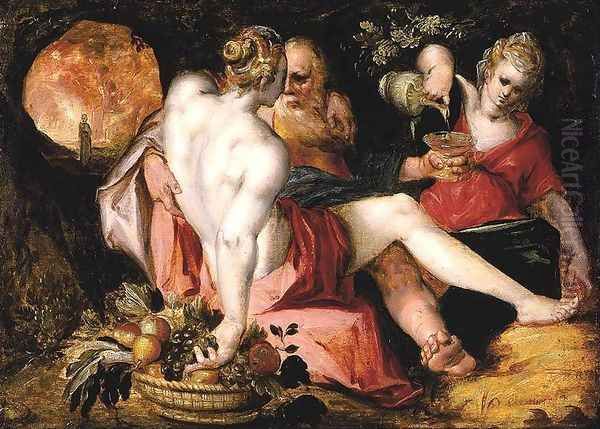
Biblical subjects were a staple for artists of this period, and Muller produced numerous engravings depicting scenes from both the Old and New Testaments. Works like Lot and His Daughters and The Baptism of Christ showcase his ability to convey complex narratives and profound emotional states. In Lot and His Daughters, for instance, the tension of the biblical story is palpable, rendered through the expressive poses of the figures and the dramatic use of chiaroscuro. The Baptism of Christ is notable for its dynamic composition and the spiritual intensity of the figures, often including celestial beings and intricate landscapes.
Mythological themes, drawn from classical antiquity, provided fertile ground for Mannerist artists to explore the human form in dynamic and often sensual ways. Muller's engravings of mythological subjects, such as the previously mentioned Minerva and Mercury Arming Perseus, or scenes featuring gods and goddesses like Venus, Mars, and Cupid, are characterized by their elegance, intricate detail, and often, a subtle eroticism. These prints catered to a sophisticated audience familiar with classical literature and appreciative of artistic virtuosity.
Allegorical subjects also featured prominently in his work. Bellona Leading the Armies of the Emperor, for example, depicts the Roman goddess of war in a powerful and dynamic composition, likely intended as a tribute to imperial military might. Such allegories often carried complex political or moral messages, requiring a high degree of artistic skill to convey effectively.
Notable Works and Their Significance
Several of Jan Muller's engravings stand out for their artistic merit and historical importance.
Lot and His Daughters (c. 1600): This engraving, likely after a design by Bartholomeus Spranger or another artist in his circle, is a powerful depiction of the biblical narrative. Muller masterfully captures the psychological tension and moral ambiguity of the scene. The figures are rendered with characteristic Mannerist elongation and muscularity, and the dramatic lighting enhances the emotional impact. The intricate details of the landscape and drapery showcase Muller's technical prowess.
The Baptism of Christ (c. 1590s): Often cited as one of his significant religious works, this print demonstrates Muller's ability to handle complex multi-figure compositions. The scene is imbued with a sense of divine energy, with angels and celestial light surrounding the central figures of Christ and John the Baptist. Muller's use of varied line work creates a rich tapestry of textures, from the flowing water to the ethereal forms of the angels.
Minerva and Mercury Arming Perseus (after Bartholomeus Spranger, c. 1590s-1600s): This is a quintessential example of Muller's collaboration with Spranger and a hallmark of Rudolfine Mannerism. The composition is packed with dynamic figures, intricate armor, and symbolic attributes. Minerva, the goddess of wisdom, and Mercury, the messenger god, assist Perseus in preparation for his heroic deeds. Muller's engraving brilliantly captures the polished surfaces of the armor, the sinuous forms of the figures, and the overall elegance of Spranger's design.
Bellona Leading the Armies of the Emperor (c. 1600): This powerful allegorical print showcases Bellona, the Roman goddess of war, in a dynamic and commanding pose, leading imperial troops into battle. The print is a tour-de-force of engraving, with its swirling smoke, gleaming armor, and energetic figures. It reflects the political context of the time, likely celebrating the military prowess of the Holy Roman Emperor.
The "Night Pieces": Muller, like Goltzius, also experimented with "night pieces," engravings that explored dramatic chiaroscuro effects to depict scenes set at night or in dimly lit interiors. Works like The Last Supper or Angels Mourning Christ (if these are indeed by him or in his style) would utilize deep shadows and stark highlights to create a sense of mystery and heightened emotion, a technique that foreshadowed the dramatic lighting of Baroque painters like Caravaggio and Rembrandt van Rijn.
These examples, among many others, highlight Muller's versatility as an engraver, his ability to adapt his style to different subjects and source materials, and his consistent technical excellence. His prints were not merely functional reproductions; they were sophisticated works of art that engaged the viewer on both an intellectual and aesthetic level.
Original Compositions and Draughtsmanship
While Jan Muller is widely recognized for his reproductive engravings, he was also a capable draughtsman and created original compositions. His drawings, though less numerous than his prints, reveal a confident hand and a strong understanding of form and composition. These original works often share the same Mannerist characteristics as his engravings: dynamic figures, complex poses, and a penchant for dramatic narratives.
His activity as a painter is less well-documented, but it is known that he did engage in painting. However, his primary and most lasting contribution to art history lies firmly in the realm of printmaking. The creation of original designs for engraving required a different set of skills than reproductive work, involving conceptualization, composition, and a deep understanding of how a drawn design would translate into the linear language of the burin. Muller's success in both areas underscores his comprehensive artistic abilities.
Technical Mastery and Innovation in Engraving
Jan Muller's technical skill with the burin was exceptional. He built upon the innovations of his master, Hendrick Goltzius, particularly the use of the swelling and tapering line to create effects of volume and light. By varying the pressure on the burin and the width and density of the lines, Muller could achieve a remarkable range of tones, from delicate highlights to deep, velvety shadows. This allowed him to simulate the textures of different materials with astonishing verisimilitude – the sheen of silk, the hardness of metal, the softness of flesh.
His cross-hatching was incredibly fine and controlled, creating subtle gradations and a sense of atmospheric depth. In complex compositions with multiple figures and intricate backgrounds, his ability to maintain clarity and differentiate between various elements was remarkable. This technical virtuosity was not an end in itself but served to enhance the expressive power of his images. Artists like Albrecht Dürer and Lucas van Leyden had earlier set high standards for Northern European engraving, and Muller, alongside Goltzius and others like Jacques de Gheyn II (another Goltzius pupil), pushed these boundaries further, demonstrating the full potential of the engraved line. The precision required for such work was immense, and Muller's prints are a testament to his patience, control, and artistic vision.
Muller's Workshop, Publishing, and Influence
Following in his father's footsteps, Jan Muller was also involved in the publishing side of the print business. This meant he not only created plates but also oversaw their printing and distribution, a common practice for successful engravers of the period. His workshop in Amsterdam would have been a busy center of artistic production, possibly employing assistants or apprentices, though specific names are not always well-documented.
His prints were widely circulated throughout Europe, contributing significantly to the dissemination of Mannerist aesthetics. They were collected by connoisseurs and used as models by other artists. The influence of his work, and that of the Goltzius school more broadly, can be seen in the work of subsequent generations of engravers. Figures like Aegidius Sadeler II, another prominent engraver active in Prague, were part of this international network of printmakers who shared stylistic affinities and often engraved works by the same painters.
The impact of Muller's reproductive engravings was particularly significant. By making the designs of artists like Spranger, Bloemaert, and de Vries accessible to a wider audience, he played a crucial role in shaping artistic tastes and trends across the continent. This was a period when Italian Renaissance masters like Raphael and Michelangelo, and later Italian Mannerists such as Giulio Romano and Parmigianino, were also known in the North partly through prints, highlighting the medium's importance.
Jan Muller in the Context of the Dutch Golden Age
Jan Muller's career spanned the late 16th and early 17th centuries, a period that saw the Dutch Republic rise to prominence and witness an unprecedented flourishing of the arts – the Dutch Golden Age. While Muller is primarily associated with the international Mannerist style that preceded the more naturalistic trends of the High Baroque in Holland (exemplified by artists like Frans Hals or Rembrandt), his work forms an important part of this artistic efflorescence.
Mannerism, with its emphasis on artifice and invention, was a style favored by courts and sophisticated urban elites. Amsterdam, as a burgeoning center of international trade and culture, provided a receptive market for Muller's refined and often intellectually demanding prints. His work represents a bridge between the late Renaissance and the early Baroque, embodying the elegance and complexity of Mannerism while also displaying a technical command that paved the way for later developments in printmaking.
His contemporaries included not only the Haarlem Mannerists but also artists working in other Dutch cities, such as Joachim Wtewael in Utrecht, who also embraced a highly refined Mannerist style. The artistic landscape was diverse, and Muller's contribution lay in his mastery of engraving and his role in the international exchange of artistic ideas.
Later Career and Death
Jan Muller continued to be active as an engraver and publisher in Amsterdam throughout his career. While the peak of high Mannerism began to wane in the early 17th century with the rise of new Baroque tendencies, Muller's skills remained in demand. He adapted to changing tastes to some extent, but his foundational style remained rooted in the Mannerist tradition he had mastered.
He passed away in Amsterdam in 1628. By the time of his death, the Dutch art scene was already witnessing the emergence of a new generation of artists who would define the High Baroque. However, Muller's legacy as one of the foremost engravers of his time was secure. His prints continued to be collected and admired for their technical brilliance and artistic sophistication.
Conclusion: The Enduring Legacy of Jan Muller
Jan Harmensz. Muller was a towering figure in the history of printmaking. As a virtuoso engraver, he not only mastered the complex techniques of his craft but also pushed its expressive boundaries. His work exemplifies the elegance, dynamism, and intellectual depth of late Mannerism, a style that flourished in the courts and cultural centers of Europe at the turn of the 17th century.
Through his numerous engravings, particularly those after designs by leading artists like Bartholomeus Spranger, Hendrick Goltzius, and Adriaen de Vries, Muller played a crucial role in the international dissemination of artistic ideas. His prints made sophisticated Mannerist compositions accessible to a wide audience, influencing artists and shaping tastes across the continent. His connections to the imperial court in Prague and his base in the thriving artistic center of Amsterdam placed him at the crossroads of European art.
Today, Jan Muller's engravings are prized by museums and collectors worldwide. They are studied for their technical mastery, their iconographic richness, and their importance as documents of a key period in European art history. He stands as a testament to the vital role of the printmaker in the cultural life of the Renaissance and Baroque eras, an artist whose skill with the burin transformed copper plates into windows onto worlds of myth, religion, and allegory, leaving an indelible mark on the visual culture of his time. His contributions ensure his place among the great masters of Northern European art.