Giovanni Battista Cimaroli, an artist whose life spanned from 1687 to 1758, stands as a significant, if sometimes underappreciated, figure in the vibrant tapestry of 18th-century Venetian painting. Primarily celebrated as a landscape painter, Cimaroli carved a niche for himself with his evocative depictions of the Venetian terraferma, idyllic rural scenes, meticulously rendered architectural vistas (vedute), and charming portrayals of daily life, often populated by elegant figures amidst classical ruins or rustic settings. His work, deeply rooted in the Venetian tradition yet infused with a distinct personal sensibility, offers a captivating window into the artistic currents and patronage systems of his time.
Early Life, Artistic Formation, and Lombard Roots
Born in Salò, a picturesque town on the shores of Lake Garda near Brescia in the Lombardy region of Italy, Giovanni Battista Cimaroli's early environment likely played a formative role in shaping his artistic inclinations. The natural beauty of the Lombard countryside, with its rolling hills, serene lakes, and rustic architecture, would have provided a rich visual vocabulary that later found expression in his mature works.
His formal artistic training commenced under the tutelage of Antonio Aureggio (also recorded as Areoldo Angeru), a painter about whom less is extensively documented but who evidently provided Cimaroli with foundational skills. Subsequently, he studied with Antonio Calza, a painter known for his battle scenes and landscapes, which may have further honed Cimaroli's ability to manage complex compositions and depict figures within expansive settings. To deepen his artistic education, Cimaroli also undertook further studies in Bologna, a city with a rich artistic heritage, home to the influential Carracci academy and a strong tradition of classicism and naturalism. This period in Bologna would have exposed him to a broader range of artistic styles and theories, enriching his developing visual language. The Lombard tradition itself, with its inherent inclination towards realism and detailed observation, also left an indelible mark on his approach, providing a counterpoint to the more idealized tendencies he would later encounter and adopt.
Arrival in Venice and Integration into the Artistic Milieu
Around the year 1713, Cimaroli made the pivotal decision to relocate to Venice. La Serenissima, as the Republic of Venice was known, was at this time a dazzling cosmopolitan center, a hub of international trade, and one of the most important artistic capitals in Europe. It was a city renowned for its opulent festivals, its unique urban fabric, and a flourishing school of painting that was celebrated for its mastery of color, light, and atmospheric effects.
Upon his arrival, Cimaroli quickly began to establish himself within the competitive Venetian art world. The city was teeming with talent, with established masters and ambitious newcomers vying for commissions from a discerning clientele that included local patricians, wealthy merchants, religious institutions, and, increasingly, foreign visitors, particularly British aristocrats on the Grand Tour. Cimaroli's particular skill in landscape painting found a ready market, as pastoral scenes and vedute were highly fashionable. He became an important figure, contributing to the city's artistic output with works that captured both the urban splendor of Venice and the tranquil beauty of its surrounding mainland territories.
Artistic Style: Influences and Characteristics
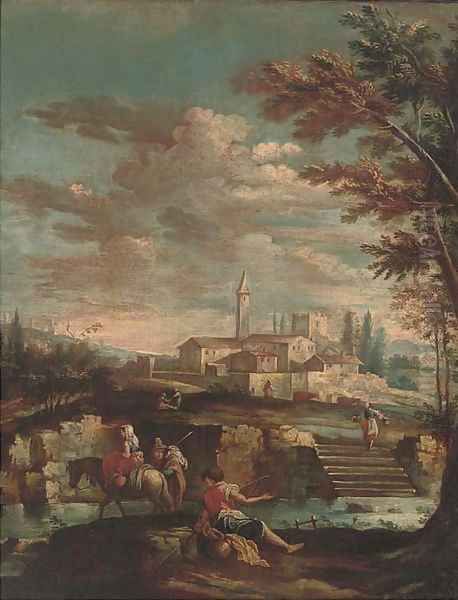
Cimaroli's artistic style is a fascinating amalgamation of various influences, reflecting the eclectic artistic environment of 18th-century Venice. His work is often characterized by idealized pastoral landscapes, a genre that found particular favor during the Rococo period. These scenes typically feature serene countryside vistas, charming farmhouses, picturesque villas, and often include elegant figures engaged in leisurely pursuits or rustic characters going about their daily tasks. The inclusion of classical ruins, a popular motif, added a touch of Arcadian nostalgia and historical gravitas to his compositions.
A significant influence on Cimaroli's style was Francesco Zuccarelli (1702-1788), a contemporary and fellow landscape painter who became highly successful, particularly with British patrons. Zuccarelli was renowned for his Arcadian landscapes, characterized by their gentle, idyllic mood, soft lighting, and delicate figures. Cimaroli absorbed elements of Zuccarelli's Rococo sensibility, evident in the lightness of touch, the harmonious compositions, and the often-dreamlike quality of his pastoral scenes. However, Cimaroli's work retained a connection to the Lombard tradition of realism, which tempered the purely decorative aspects of the Rococo. This Lombard heritage manifested in a careful attention to detail, a more solid rendering of forms, and a tangible sense of place, even in his most idealized landscapes.
His paintings often exhibit a fluid, confident brushwork and a palette that, while capable of rich tonal variations, frequently favored lighter, more airy hues, contributing to the overall charm and elegance of his work. He was adept at capturing the specific atmospheric conditions of the Venetian lagoon and its hinterlands, rendering light and shadow with a sensitivity that brought his scenes to life. His ability to integrate figures seamlessly into his landscapes, making them an organic part of the composition rather than mere afterthoughts, was another hallmark of his skill. The figures, though often small in scale, are typically well-observed and contribute to the narrative or mood of the scene.
The broader artistic context of Venice, with masters like Giovanni Battista Tiepolo (1696-1770) dominating large-scale decorative painting and Rosalba Carriera (1675–1757) achieving international fame for her pastel portraits, created an environment where specialization, such as Cimaroli's focus on landscape, could flourish. Earlier vedutisti like Luca Carlevarijs (1663-1730) had already established a strong tradition for view painting in Venice, paving the way for the next generation.
Key Themes and Subjects
Cimaroli's oeuvre demonstrates a consistent engagement with several key themes and subjects. His primary focus was landscape, interpreted in various forms:
Venetian Vedute: Like many of his contemporaries, Cimaroli produced views of Venice itself. These paintings captured the iconic canals, bridges, palazzi, and churches of the city. He depicted famous landmarks, such as views looking south from the Piazzetta, encompassing the Doge's Palace, the Library, and the island of San Giorgio Maggiore in the distance. These urban landscapes were highly sought after by Grand Tourists eager to take home a visual memento of their Venetian sojourn.
Rural and Pastoral Landscapes: Perhaps even more central to his output were his depictions of the Venetian mainland (terraferma) and idealized pastoral scenes. These works often featured rustic farmhouses, meandering rivers, ancient bridges, and tranquil woodlands. He populated these scenes with peasants, shepherds, and gentlefolk, creating an atmosphere of bucolic charm and serenity. These landscapes often reflect the Arcadian ideals popular in the 18th century, evoking a mythical golden age of harmony between humanity and nature.
Architectural Capricci and Ruins: Cimaroli also painted architectural capricci, which are imaginary compositions that combine existing architectural elements with fantastical or ruined structures. The inclusion of classical ruins was a common feature, lending an air of timelessness and reflecting the 18th-century fascination with antiquity.
Collaborative Works: As was common practice at the time, Cimaroli engaged in collaborations, most notably on projects that combined his landscape skills with the figurative or architectural expertise of other artists.
Representative Masterpieces and Notable Works
While a comprehensive catalogue raisonné might still be a subject of ongoing scholarly refinement, several works are consistently attributed to Cimaroli and exemplify his artistic prowess:
"View of the Piazzetta, looking South towards San Giorgio Maggiore": This type of Venetian view, though also famously painted by Canaletto and others, would have been a staple. Cimaroli's versions would showcase his ability to handle complex architectural perspectives while imbuing the scene with atmospheric light.
"Landscape with Waterfall" and "Cattle Crossing a Bridge near a Small Town": These titles are indicative of his pastoral and rural scenes. Such works would highlight his skill in composing harmonious landscapes, his delicate rendering of foliage and water, and his ability to create a sense of depth and tranquility. The figures of cattle and townspeople would add life and narrative interest.
"The Grand Canal with the Church of San Geremia, Palazzo Labia, and the Entrance to the Cannaregio": This specific veduta demonstrates his capacity for detailed architectural representation combined with the lively depiction of gondolas and figures animating the famous waterway. The Palazzo Labia, with its famous Tiepolo frescoes, would have been a notable landmark.
"Bullfighting Scene in Piazza San Marco": This subject, less common for Cimaroli but documented, shows his versatility. Bullfights (cacce dei tori) were occasional, spectacular events held in Venice, and depicting such a scene would require skill in managing a large crowd and dynamic action within a grand architectural setting. Canaletto also famously depicted festivals in Piazza San Marco.
The "Allegorical Tombs of British Worthies": This series, discussed further below, represents a major collaborative project where Cimaroli's landscape contributions were crucial.
His works are held in various public and private collections, including the Royal Collection in the United Kingdom, a testament to the early appreciation of his art by British connoisseurs.
Collaborations: The McSwiney Project and Canaletto
One of the most significant aspects of Cimaroli's career was his collaboration with other leading Venetian artists, most notably Giovanni Antonio Canal, universally known as Canaletto (1697-1768). Their association was particularly prominent in the context of a unique and ambitious project orchestrated by the Irish impresario Owen McSwiney.
Around 1722-1730, McSwiney commissioned a series of large allegorical paintings intended as "tombs" or memorials to celebrated British worthies – statesmen, scientists, writers, and military heroes. This series, known as the "Allegorical Tombs of British Worthies" or "Tombeaux des Princes," was primarily intended for Charles Lennox, 2nd Duke of Richmond. Several prominent Venetian and Bolognese artists were involved, each contributing their specific talents.
In this collaborative venture, Cimaroli was often tasked with painting the landscape backgrounds, providing the settings for the allegorical figures and fantastical architectural elements designed by others. Canaletto was a key figure in this project, often handling the architectural components or principal figures. Other distinguished artists who contributed to McSwiney's series included Giovanni Battista Piazzetta (1683-1754), known for his powerful figurative work and dramatic chiaroscuro, and Giovanni Battista Pittoni (1687-1767), celebrated for his elegant and richly colored history paintings and altarpieces. Donato Creti and Francesco Monti from Bologna were also involved.
This collaboration highlights Cimaroli's recognized expertise in landscape. His ability to create evocative and appropriate natural settings was essential to the success of these complex allegorical compositions. The project also underscores the interconnectedness of the Venetian art world, where artists with different specializations frequently worked together on large-scale commissions. The figures in some of Cimaroli's independent landscapes are sometimes attributed to other hands, a common practice that allowed for efficient production and the combination of diverse talents. For instance, figures in some landscapes might have been added by specialists like Tiepolo or Zuccarelli, though Cimaroli was certainly capable of painting his own.
Patronage and International Recognition
Cimaroli's art found favor not only with local Venetian patrons but also, significantly, with the burgeoning market of foreign collectors, particularly the British. The 18th century was the era of the Grand Tour, a rite of passage for young British noblemen and gentlemen who traveled to Italy to absorb its classical heritage and contemporary culture. Venice was an essential stop on this itinerary, and these wealthy tourists were avid collectors of art, especially vedute and landscapes that served as sophisticated souvenirs of their travels.
His close association with Canaletto, who was exceptionally popular with British patrons (largely through the agency of Consul Joseph Smith), likely facilitated Cimaroli's access to this lucrative market. Works by Cimaroli made their way to England, and as mentioned, some were acquired by King George III and are now part of the Royal Collection at Buckingham Palace. This royal patronage is a clear indicator of his international standing and the high regard in which his art was held. The demand from British collectors significantly shaped the production of landscape and veduta painting in Venice, and Cimaroli was well-positioned to cater to this taste.
Contemporaries and the Venetian Art Scene
Cimaroli operated within a vibrant and competitive artistic ecosystem. Beyond his direct collaborators like Canaletto, Piazzetta, and Pittoni, and influences like Zuccarelli, the Venetian art scene of his time was rich with other notable talents.
Marco Ricci (1676-1730): An older contemporary, Ricci was a highly influential landscape painter, also known for his romantic ruins and stormy scenes. He collaborated with his uncle Sebastiano Ricci and had a significant impact on the development of landscape painting in Venice, influencing both Zuccarelli and Canaletto. Cimaroli would have been well aware of Ricci's work.
Pietro Longhi (1701-1785): Longhi specialized in genre scenes, intimate depictions of Venetian daily life, and conversation pieces. While his subject matter differed from Cimaroli's, he provides another facet of the 18th-century Venetian artistic output, focusing on the social customs of the city.
Michele Marieschi (1710-1743): Another skilled vedutista, Marieschi's career was shorter, but he produced vibrant and dynamic views of Venice, sometimes with a more theatrical flair than Canaletto. As noted in the provided information, there has occasionally been confusion in attributions between Cimaroli and Marieschi, highlighting stylistic similarities or shared subject matter within the veduta tradition.
Bernardo Bellotto (1721/2-1780): Canaletto's nephew and pupil, Bellotto developed his own distinct style of veduta painting, characterized by a cooler palette, sharp lighting, and meticulous detail. He later worked extensively in Dresden, Warsaw, and Vienna. While younger, his emergence represents the continuation of the veduta tradition.
Francesco Guardi (1712-1793): Guardi, along with his brother Gian Antonio Guardi, represents a later phase of Venetian painting. Francesco's vedute and capricci are known for their more atmospheric, painterly, and often melancholic quality, a contrast to the crystalline clarity of Canaletto or the pastoral charm of Cimaroli.
The presence of these and other artists created a dynamic environment of influence, competition, and collaboration, pushing the boundaries of Venetian painting.
Challenges in Attribution and Rediscovery: The "Unpatterned Figures" and Scholarly Re-evaluation
Like many artists of his era who did not consistently sign their works or whose styles shared commonalities with contemporaries, Cimaroli's oeuvre has presented challenges for art historians regarding attribution. The provided information mentions that his painting style was similar to Francesco Zuccarelli's, leading to potential misattributions. Furthermore, the "unique leaves and unpatterned figures" noted by critics suggest specific stylistic markers that scholars use to distinguish his hand.
The art market and collections have, at times, seen works by Cimaroli mistakenly assigned to more famous names or, conversely, his own identity obscured. The anecdote about a painting previously thought to be by Jacopo or Michele Marieschi being correctly reattributed to Cimaroli through high-resolution imagery and expert analysis is a case in point. Such re-evaluations are crucial for a more accurate understanding of an artist's contribution and stature.
The mention of 59 paintings in a Dresden apartment, once thought to be by various contemporaries but later confirmed as Cimaroli's, and their good state of preservation, points to significant caches of his work that aid in defining his style and scope. It also suggests that while he may have been overshadowed at times, he was prolific and his works were valued.
His relative obscurity for a period, followed by a re-evaluation, particularly from the mid-20th century onwards, is not uncommon for artists who were successful in their time but whose reputations waned before being revived by later scholarship. This process of rediscovery often involves painstaking connoisseurship, archival research, and the re-examination of previously held assumptions.
Legacy and Art Historical Significance
Giovanni Battista Cimaroli's legacy lies in his contribution to the rich tradition of 18th-century Venetian landscape and veduta painting. While perhaps not achieving the towering fame of Canaletto or Tiepolo, he was a highly skilled and respected artist who produced a significant body of work characterized by its charm, elegance, and technical proficiency.
His paintings offer a valuable record of the Venetian landscape, both urban and rural, as it appeared in the 18th century, filtered through the artistic conventions and tastes of the period. His idealized pastoral scenes reflect the Rococo fascination with Arcadian themes, while his vedute contributed to the enduring visual image of Venice that captivated Grand Tourists and continues to enchant viewers today.
His collaborations, particularly on the McSwiney project, place him at the heart of important artistic enterprises of his time and demonstrate his ability to work alongside the leading talents of Venice. The international demand for his work, especially from British collectors, underscores his contemporary appeal and his role in the dissemination of Venetian artistic styles abroad.
In art historical terms, Cimaroli is recognized as an important representative of the Venetian school of landscape painting. His ability to blend influences from Lombard realism with the Rococo grace of artists like Zuccarelli, all while operating within the dominant Venetian tradition of color and light, resulted in a distinctive and appealing artistic voice. The ongoing scholarly work to clarify his attributions and fully assess his oeuvre continues to solidify his position as a noteworthy master of his era. His art remains a testament to the enduring allure of the Italian landscape and the artistic vibrancy of 18th-century Venice.
Conclusion
Giovanni Battista Cimaroli was more than just a minor master; he was a gifted and productive painter who played a distinct role in the Venetian art world of the Settecento. His landscapes and vedute, with their harmonious compositions, delicate handling, and evocative atmosphere, captured the imagination of his contemporaries and continue to be appreciated for their artistic merit. From the shores of Lake Garda to the bustling canals of Venice and the collections of British royalty, Cimaroli's artistic journey reflects a successful career built on talent, adaptability, and a keen understanding of the prevailing artistic tastes. As art history continues to refine its understanding of this period, Cimaroli's contributions are increasingly recognized, securing his place among the significant landscape painters of 18th-century Italy.