Hans Hassenteufel: A German Painter of Intimate Portraits and Genre Scenes
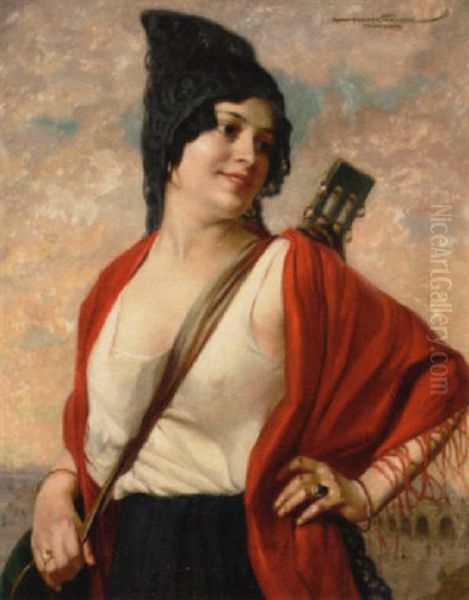
Hans Hassenteufel (1887-1943) was a German artist whose body of work, though not as widely known as some of his more revolutionary contemporaries, offers a fascinating glimpse into the enduring appeal of figurative painting during a period of significant artistic upheaval. Active primarily in the first half of the 20th century, Hassenteufel specialized in portraits, particularly of women, as well as genre scenes and still lifes, executed with a sensitivity to light, detail, and mood. His paintings often convey a quiet intimacy, capturing moments of contemplation or serene domesticity.
Born in Hamburg, Germany, in 1887, Hassenteufel's formative years coincided with a dynamic era in German art. While specific details about his formal artistic training or direct mentorship remain somewhat elusive in readily available records, his style suggests a grounding in academic traditions, emphasizing skilled draughtsmanship and a nuanced handling of oil paint. He later became primarily active in Munich, a city that, at the turn of the century and in the subsequent decades, was a vibrant hub of artistic activity, rivaling Berlin and Paris in its cultural significance.
The Artistic Milieu of Munich
Munich, during Hassenteufel's active years, was a city teeming with artistic currents. It was home to the Munich Secession, founded in 1892 by artists like Franz von Stuck, Wilhelm Trübner, and Fritz von Uhde, who sought to break away from the conservative constraints of the established art academies. This movement championed modern approaches, including Impressionism and Symbolism. Later, Munich would also become a crucible for German Expressionism, with groups like Der Blaue Reiter (The Blue Rider), co-founded by Wassily Kandinsky and Franz Marc around 1911, pushing the boundaries of color and form.
While Hassenteufel's work does not align with the radical abstraction of Kandinsky or the intense emotionalism of Expressionists like Ernst Ludwig Kirchner or Emil Nolde, he would have undoubtedly been aware of these movements. His adherence to a more traditional, representational style places him in a different, yet equally valid, stream of artistic practice that continued to find appreciation. His focus on finely rendered surfaces and the psychological portrayal of his subjects suggests an artist dedicated to the craft of painting in a manner that valued subtlety and technical proficiency.
Stylistic Characteristics and Thematic Concerns
Hans Hassenteufel's paintings are characterized by their delicate brushwork and a keen observation of light and shadow, which he used effectively to model forms and create atmosphere. His palette, while capable of richness, often leaned towards nuanced tones that enhanced the contemplative or gentle mood of his compositions. He excelled in capturing textures, whether the softness of fabric, the sheen of hair, or the smoothness of skin, lending a tangible quality to his subjects.
A significant portion of his oeuvre is dedicated to portraiture, with a particular emphasis on female subjects. These are not typically grand, formal portraits in the aristocratic tradition, but rather more intimate depictions. His sitters are often shown in moments of quiet reflection, engaged in simple activities, or presented with a gentle, sometimes enigmatic, allure. This focus aligns him with a long tradition of artists fascinated by the portrayal of femininity, from Renaissance masters to contemporaries like Gustav Klimt or the more classical portraitists such as John Singer Sargent, though Hassenteufel's approach was generally more subdued and less overtly stylized than Klimt's.
Genre scenes also feature in his work, depicting everyday life or moments imbued with a narrative suggestion. These paintings, like his portraits, often possess a quiet charm and an appreciation for the beauty found in ordinary moments. Still lifes, though perhaps less prominent, would have allowed him to explore form, color, and texture in a controlled setting, a common practice for artists honing their technical skills.
Representative Works
Several works by Hans Hassenteufel provide insight into his artistic preoccupations and skill. Among his most frequently cited pieces is Junge Frau mit Schleier (Young Woman with Veil), painted in 1925. This oil on canvas, measuring 62.5 x 60.5 cm, exemplifies his sensitive approach to female portraiture. The subject, a young woman, is depicted with a veil partially obscuring her features, adding an element of mystery and softness to the composition. The interplay of light on the delicate fabric of the veil and the woman's skin would have been a key focus, showcasing Hassenteufel's ability to render different textures with finesse. The painting was reportedly sold at auction for 900 Euros, indicating a continued, if modest, market interest in his work.
Another known title is The Mandolin Player. While specific details regarding its date or dimensions are not always readily available, the subject itself is a classic theme in art history, explored by artists from Caravaggio to Jean-Baptiste-Camille Corot and even early modernists like Picasso. For Hassenteufel, such a subject would have offered the opportunity to combine portraiture with the depiction of a musical instrument, allowing for an exploration of form, the human figure in a relaxed pose, and perhaps the evocation of a gentle, melodic atmosphere. The theme of music and musicians often carries connotations of harmony, leisure, and artistic sensibility.
The painting Schimmel auf der Weide (Dapple-Gray Horse in the Pasture) indicates Hassenteufel's engagement with animal painting and landscape. This work, mentioned in an auction catalog (VAN HAM 324), suggests an appreciation for pastoral scenes. The depiction of a horse in a field would require careful observation of animal anatomy and the rendering of natural light and environment, differing from the interior settings of many of his portraits. Artists like George Stubbs in England or Rosa Bonheur in France had elevated animal painting to a high art, and Hassenteufel's foray into this genre shows a versatility in his subject matter.
A piece titled Spanish Tanzerin (Spanish Dancer) further broadens the scope of his thematic interests. This subject, popular among many artists of the 19th and early 20th centuries, including Édouard Manet and John Singer Sargent, allowed for the depiction of vibrant costume, dynamic movement, and a sense of exoticism or cultural flair. Hassenteufel's interpretation would likely have focused on the grace and energy of the dancer, capturing the "beauty of the human body" in motion, as suggested by some descriptions.
His inclusion in publications such as Classic Fine Art Nudes Volume Two and the catalog Graphik Gemälde confirms his work within the tradition of the nude. The nude figure has been a cornerstone of Western art for centuries, serving as a vehicle for exploring ideal beauty, human anatomy, and allegorical themes. Hassenteufel's contributions to this genre would likely have been characterized by the same sensitivity and technical refinement seen in his other figurative works, perhaps leaning towards a classical or softly realistic portrayal rather than the more provocative or abstracted nudes of some of his avant-garde contemporaries like Egon Schiele or Amedeo Modigliani.
Hassenteufel in the Context of His Contemporaries
Placing Hans Hassenteufel within the broader art scene of his time requires acknowledging the diverse artistic landscape. While movements like Cubism, spearheaded by Pablo Picasso and Georges Braque, and Fauvism, with artists like Henri Matisse, were revolutionizing artistic expression in Paris, and Expressionism was taking firm root in Germany and Austria, many artists continued to work in more traditional representational styles.
In Germany itself, alongside the Expressionists, there were prominent figures like Max Liebermann, Lovis Corinth, and Max Slevogt, who were leading proponents of German Impressionism. Their work, while modern in its approach to light and brushwork, remained committed to depicting the visible world. Hassenteufel's style, though perhaps more polished and less overtly "impressionistic" than these figures, shared a common ground in its dedication to figurative representation.
Other Munich-based artists of the period included figures associated with Symbolism and Jugendstil (Art Nouveau), such as Franz von Stuck, whose mythological and allegorical paintings were highly influential. While Hassenteufel's known works do not strongly suggest a Symbolist leaning, the artistic atmosphere of Munich was rich with such influences.
Internationally, artists like the Swedish painter Anders Zorn were renowned for their vibrant portraits and genre scenes, often executed with a fluid, virtuoso brushwork. The Spanish artist Joaquín Sorolla captivated audiences with his sun-drenched depictions of Spanish life. These artists, like Hassenteufel, found success and appreciation through their skilled rendering of the human figure and everyday scenes, appealing to a broad audience that valued technical mastery and relatable subject matter. Even in an era of radical experimentation, the demand for well-executed portraits and appealing genre paintings persisted.
Hassenteufel's work can be seen as part of this continuum of figurative art that provided an alternative to the more challenging idioms of the avant-garde. His paintings offered a sense of calm, beauty, and skilled craftsmanship that resonated with a segment of the art-buying public and critics who perhaps found the rapid changes in the art world disorienting.
The Art Market and Legacy
The presence of Hans Hassenteufel's works in auction catalogs and art historical publications, albeit not as extensively as more famous names, indicates that he achieved a degree of recognition during his lifetime and that his work continues to circulate in the art market. His paintings appear in collections, and their inclusion in thematic compilations, such as those focusing on nudes, suggests an acknowledgment of his contribution to specific genres.
The auction price of €900 for Junge Frau mit Schleier, while not placing him in the top tier of market values, signifies that his works are collected and hold value. For many artists of his era who did not align with the major avant-garde movements, this level of posthumous recognition is typical. Their appeal often lies in their aesthetic qualities, their historical context, and their representation of a particular artistic sensibility.
Hans Hassenteufel's legacy is that of a skilled painter who dedicated his career to capturing the nuances of human expression and the quiet beauty of his surroundings. He navigated a period of intense artistic innovation by remaining true to a more traditional, yet refined, approach to figurative art. His paintings, with their careful execution and gentle sensitivity, offer a counterpoint to the often more turbulent and radical expressions of his time. They remind us of the diverse paths available to artists and the enduring human desire for art that reflects the world with grace and technical skill.
While he may not have been a revolutionary figure who dramatically altered the course of art history like Kandinsky or Picasso, Hans Hassenteufel contributed to the rich tapestry of early 20th-century European art. His work provides valuable insight into the continuation of figurative traditions and the artistic tastes of a segment of society during that era. His portraits and genre scenes stand as a testament to his dedication to his craft and his ability to imbue his subjects with a quiet, contemplative dignity. His art offers a window into a world rendered with care, precision, and an appreciation for the subtle beauties of life.