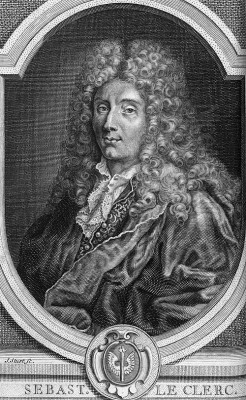
Sébastien Le Clerc, a name that resonates with the grandeur and intellectual fervor of 17th and early 18th-century France, stands as a monumental figure in the history of art. Born on September 26, 1637, in Metz, in the Duchy of Lorraine, and passing away in Paris on October 25, 1714, Le Clerc was not merely an artist but a polymath whose talents spanned engraving, etching, scientific illustration, and authorship of influential treatises. His life and work are inextricably linked with the cultural zenith of Louis XIV's reign, a period where art and science were often pursued with equal passion and royal patronage.
Early Life and Artistic Awakening in Lorraine
Sébastien Le Clerc's journey into the world of art began in Metz, a city with a rich artistic heritage. His father, Laurent Le Clerc, was a respected goldsmith, and it was under his tutelage that young Sébastien received his initial artistic training. The meticulous craftsmanship required in goldsmithing undoubtedly instilled in him a profound appreciation for detail and precision, qualities that would later define his engraving work. Lorraine, at the time, was a region that had already produced significant figures in the printmaking world, most notably Jacques Callot, whose innovative etching techniques and vivid portrayals of contemporary life had left an indelible mark. While Callot had passed away two years before Le Clerc's birth, his legacy would have been part of the artistic atmosphere in which Le Clerc grew.
From an early age, Le Clerc demonstrated a remarkable aptitude for drawing and engraving. He was largely self-taught in these disciplines, driven by an innate curiosity and a diligent work ethic. Beyond the visual arts, he also displayed a keen interest in mathematics and sciences, particularly geometry and military engineering. This dual passion for art and science would become a defining characteristic of his career, allowing him to bridge these seemingly disparate fields with remarkable synergy. His early works in Metz, though perhaps less documented than his Parisian output, began to showcase his burgeoning talent and technical skill.
The Parisian Ascent: Patronage and Royal Recognition
The allure of Paris, the epicenter of French art and culture, eventually drew Sébastien Le Clerc from his native Lorraine. He arrived in the capital around 1665, a move that would prove pivotal for his career. In Paris, his exceptional talents did not go unnoticed for long. He came to the attention of Charles Le Brun, the powerful First Painter to King Louis XIV and director of the Académie Royale de Peinture et de Sculpture, as well as the Gobelins Manufactory. Le Brun, a dominant figure in the French art world, recognized Le Clerc's skill and potential, becoming an important patron and advocate.
Under Le Brun's influence and through his own merits, Le Clerc's career flourished. In 1672, a significant honor was bestowed upon him when he was appointed Professor of Geometry and Perspective at the Académie Royale de Peinture et de Sculpture. This position acknowledged not only his artistic prowess but also his scholarly understanding of the scientific principles underpinning visual representation. His lectures were highly regarded, and he played a crucial role in educating a generation of artists.
Further royal recognition followed. Le Clerc was appointed "Graveur ordinaire du Roi" (Ordinary Engraver to the King), a prestigious title that cemented his status within the royal artistic establishment. He also held a position at the Gobelins Manufactory, the royal factory renowned for its luxurious tapestries and furnishings, where he likely contributed designs and engravings. His association with the court of Louis XIV placed him at the heart of France's artistic production, contributing to the magnificent visual culture that defined the era of the Sun King.
The Engraver's Art: Technique and Thematic Diversity
Sébastien Le Clerc was an extraordinarily prolific artist, with a catalogue of over 3,400 original engravings and etchings to his name. His technical mastery was exceptional. He possessed an uncanny ability to render minute details with clarity and precision, creating compositions that were both intricate and harmonious. His lines were fine and controlled, capable of conveying a wide range of textures and effects, from the delicate folds of fabric to the ruggedness of a landscape or the polished surfaces of architectural elements.
The thematic range of Le Clerc's work was vast. Religious subjects formed a significant portion of his output, including illustrations for Bibles, lives of saints (such as the notable Saints' Lives series), and devotional images. He also excelled in depicting mythological scenes, allegories, and historical events, often imbued with the grandeur and classicism favored by the court. His engravings frequently adorned books, providing visual narratives that complemented the written word and made texts more accessible and engaging.
Military subjects also featured prominently in his oeuvre, reflecting the martial preoccupations of Louis XIV's reign. Le Clerc produced detailed representations of battles, sieges, and military fortifications, showcasing his understanding of military engineering and tactics. Furthermore, he captured contemporary life through series like The Fashions of Paris, offering valuable insights into the dress and customs of the period. His landscapes, such as the evocative Rocky Landscape with River (1693), demonstrate a sensitive observation of nature, rendered with his characteristic finesse.
Masterpieces of the Burin and Needle
Among Le Clerc's extensive body of work, several pieces and publications stand out as particularly significant. His illustrations for Charles Le Brun's designs, such as the series on the Four Elements and the Four Seasons (first published in 1668), exemplify his skill in translating the concepts of a leading painter into the engraved medium. These works highlight his ability to collaborate effectively while maintaining his distinct artistic voice.
His scientific and theoretical publications are equally important. Pratique de la Géométrie sur le Papier et sur le Terrain (Practice of Geometry on Paper and in the Field), first published in 1669, was a highly influential manual. Illustrated with numerous clear and precise engravings by Le Clerc himself, it provided practical instruction in geometry for artists, architects, engineers, and surveyors. The book went through many editions and was translated into several languages, attesting to its widespread appeal and utility.
Another significant work was his Traité d'Architecture (Treatise on Architecture), which, like his geometry treatise, combined theoretical principles with practical guidance, all elucidated by his masterful engravings. These illustrations often depicted classical orders, architectural plans, and decorative elements with an accuracy and elegance that made complex concepts understandable. His later work, Système du monde, ou l'explication du mouvement des planètes (System of the World, or the Explanation of the Movement of the Planets, 1706-1708), demonstrated his continued engagement with scientific inquiry, venturing into the realm of astronomy.
The sheer volume and consistent quality of his prints, whether standalone pieces or illustrations for texts, underscore his dedication and skill. Each plate, regardless of its subject, was executed with meticulous care, contributing to his reputation as one of the foremost engravers of his time. His ability to convey complex information, whether artistic, scientific, or narrative, through the engraved line was unparalleled.
A Scholar in Art: Treatises on Geometry, Perspective, and Architecture
Sébastien Le Clerc's contributions extended far beyond the creation of individual prints; he was a significant intellectual figure whose writings had a profound impact on artistic and scientific education. His treatises were not merely academic exercises but practical guides designed to impart knowledge effectively, and his own engravings were integral to their success.
His Pratique de la Géométrie (1669) was revolutionary in its approach. It demystified geometric principles, making them accessible to a wider audience. The clarity of his explanations, coupled with the precision of his illustrations, made it an indispensable tool for anyone needing to understand and apply geometry. This work was particularly valued by artists and architects who relied on geometric principles for composition, perspective, and structural design. The influence of this book can be seen in the improved understanding and application of perspective in the art of the period.
Similarly, his Traité de Géométrie Théorique et Pratique (Treatise of Theoretical and Practical Geometry, 1690) further elaborated on these concepts, offering a more comprehensive exploration of the subject. His writings on perspective were particularly important, as the convincing representation of three-dimensional space on a two-dimensional surface was a central concern for artists of the Baroque era. Le Clerc's systematic approach helped to codify and disseminate the rules of perspective.
His Traité d'Architecture provided a clear exposition of architectural principles, from the classical orders to the design of entire buildings. The accompanying engravings were not just illustrative but were works of art in themselves, showcasing ideal proportions and elegant designs. These treatises, widely circulated and translated, helped to standardize and elevate the understanding of these foundational subjects across Europe, influencing figures like William Hogarth in England, who adapted some of Le Clerc's principles in his own theoretical writings.
Le Clerc's engagement with optics, another area of scientific interest for him, also informed his understanding of visual perception and representation. His ability to integrate scientific knowledge with artistic practice made him a unique figure, embodying the Renaissance ideal of the artist-scholar in the context of the French Baroque.
Teaching and Influence at the Royal Academy
As Professor of Geometry and Perspective at the Académie Royale de Peinture et de Sculpture from 1672, Sébastien Le Clerc played a direct and vital role in shaping the artistic education of his time. The Academy, founded in 1648, was central to the codification and dissemination of artistic theory and practice in France, and its teachings had a profound influence on the development of French art. Le Clerc's position within this institution underscores his esteemed status among his peers.
His lectures would have been based on the principles articulated in his published treatises, providing students with a rigorous grounding in the mathematical and optical foundations of art. He taught them how to construct accurate perspective, a skill essential for creating convincing illusions of depth and space in paintings, drawings, and even large-scale decorative schemes like those at Versailles. Artists such as Antoine Watteau, though of a slightly later generation, would have benefited from the academic environment shaped by teachers like Le Clerc.
The emphasis on geometry and perspective was part of the broader academic concern with disegno – the intellectual and conceptual foundation of art, encompassing both drawing and design. Le Clerc's teaching reinforced the idea that art was not merely a manual craft but an intellectual discipline requiring knowledge and understanding. His influence extended beyond his direct students through his widely circulated publications, which served as textbooks and reference works for artists across Europe.
His role as an educator also connected him with other prominent members of the Academy, including painters like Pierre Mignard, who succeeded Le Brun as First Painter, and sculptors such as François Girardon and Antoine Coysevox, all of whom were deeply involved in the artistic projects of Louis XIV. The intellectual exchange within the Academy, fostered by figures like Le Clerc, contributed to the high level of technical skill and theoretical sophistication that characterized French art of this period.
Collaborations and Contemporaries
Sébastien Le Clerc's career unfolded within a vibrant and competitive artistic milieu. His most significant early collaboration was with Charles Le Brun. Le Brun, as the arbiter of artistic taste and director of major royal projects, often commissioned engravers to disseminate his designs and compositions. Le Clerc's work for Le Brun, including the aforementioned Four Elements and Four Seasons, helped to popularize Le Brun's style and iconography. This collaboration was mutually beneficial, providing Le Clerc with high-profile commissions and associating him with the leading artist of the day.
Beyond Le Brun, Le Clerc would have interacted with a wide array of artists, writers, and scientists. Within the printmaking world, he was a contemporary of other distinguished engravers such as Robert Nanteuil, renowned for his portraits, and Gérard Edelinck, also celebrated for his reproductive engravings after painters like Le Brun and Hyacinthe Rigaud. Claude Mellan, an older master known for his unique single-spiral line technique, was another significant figure in French engraving whose career overlapped with Le Clerc's earlier years. Le Clerc's work stands out for its versatility and its strong connection to scientific and theoretical concerns, distinguishing him even among these accomplished peers.
His involvement with the Gobelins Manufactory would have brought him into contact with designers and craftsmen working in various media. The architects of the era, such as Jules Hardouin-Mansart and Louis Le Vau, who were responsible for the monumental building projects of Louis XIV, including the expansion of the Louvre and the Palace of Versailles, created the architectural contexts that Le Clerc often depicted or analyzed in his treatises. His work on architectural theory directly engaged with the principles being applied in these grand constructions.
The intellectual climate of Paris also fostered connections with writers and scholars. Le Clerc's scientific treatises placed him in a community that included figures interested in mathematics, optics, and astronomy. The Royal Academy of Sciences (Académie Royale des Sciences), founded in 1666, was a hub for such activities, and while Le Clerc was primarily associated with the art academy, his work clearly resonated with the scientific spirit of the age. Even earlier printmakers like Abraham Bosse had published influential treatises on engraving and perspective, setting a precedent for artist-theorists in France.
Personal Life and Character
Details about Sébastien Le Clerc's personal life are less abundant than those concerning his professional achievements, a common situation for artists of his era unless they were subjects of extensive contemporary biographies. We know he was married and had a son, Jacques-Sébastien Le Clerc (also known as Sébastien Le Clerc the Younger, c. 1676-1763), who followed in his father's footsteps to become an accomplished painter and engraver, ensuring the continuation of the family's artistic legacy. Jacques-Sébastien often worked in a style reminiscent of his father but also developed his own distinct manner, contributing to decorative schemes and producing numerous prints.
One aspect of Le Clerc's life that is occasionally mentioned in historical sources relates to his religious beliefs. Some accounts suggest that his family experienced divisions due to religious differences, with Sébastien himself reportedly holding "heterodox" views that may have diverged from mainstream Calvinism or Catholicism during a period of intense religious sensitivity in France, marked by events like the Revocation of the Edict of Nantes in 1685. However, the precise nature of these beliefs and their impact on his personal life or career are not extensively documented and require careful interpretation to avoid confusion with other contemporary figures named Le Clerc who were more overtly involved in theological controversies, such as the scholar Jean Le Clerc. For Sébastien, his public career seems to have navigated these complexities successfully, given his prominent royal and academic appointments.
His character, as inferred from his work and career, suggests a man of immense diligence, intellectual curiosity, and a methodical mind. The sheer volume of his output, coupled with its consistent quality and the intellectual rigor of his treatises, points to a disciplined and dedicated individual. His ability to gain and maintain the patronage of figures like Charles Le Brun and the King himself indicates a degree of diplomatic skill and professionalism.
Later Years and Enduring Legacy
Sébastien Le Clerc remained active into his later years, continuing to produce engravings and contribute to the artistic and intellectual life of Paris. He passed away on October 25, 1714, just a year before the death of his long-time patron, Louis XIV. His death marked the end of an era for French engraving, but his influence was far-reaching and long-lasting.
His legacy is multifaceted. As an engraver, he set a standard for technical excellence and versatility. His prints served not only as works of art in their own right but also as crucial tools for the dissemination of images, ideas, and information in an age before photography. They illustrated books, recorded historical events, depicted scientific concepts, and popularized artistic designs, making them accessible to a broader public. Many artists, including Jean-Honoré Fragonard and François Boucher in the subsequent Rococo period, would have been familiar with his work, either directly or through the academic traditions he helped to shape.
As a theorist and educator, his treatises on geometry, perspective, and architecture had a profound and lasting impact on artistic training in France and beyond. They were reprinted numerous times and translated into various languages, serving as standard textbooks for generations of students. His clear explanations and precise illustrations helped to codify and transmit essential knowledge, contributing to the high level of technical proficiency that characterized French art for much of the 18th century. The clarity he brought to complex subjects influenced even artists outside of France, such as the English painter and satirist William Hogarth, who drew upon similar principles in his own theoretical work, The Analysis of Beauty.
His son, Jacques-Sébastien Le Clerc, continued the family's artistic tradition, further cementing the Le Clerc name in the annals of French art. The vast collection of Sébastien Le Clerc's prints remains a valuable resource for art historians, cultural historians, and historians of science, offering rich insights into the visual culture, intellectual concerns, and daily life of 17th and early 18th-century France.
Historical Evaluation and Conclusion
Historically, Sébastien Le Clerc is consistently evaluated as one of the most important and skilled French engravers of his time. The renowned 18th-century connoisseur and art historian Pierre-Jean Mariette, in his Abecedario, praised Le Clerc highly, recognizing his exceptional talent and the significance of his contributions. Mariette described him as a master who surpassed many of his contemporaries in his specific domain, highlighting the finesse and intelligence of his work.
Modern art historical scholarship continues to affirm Le Clerc's importance. He is recognized not only for his technical virtuosity and prolific output but also for his unique role as an artist-scholar who successfully bridged the worlds of art and science. His ability to translate complex scientific and mathematical principles into clear visual language was a rare gift. His work exemplifies the intellectual ambitions of the French Baroque, particularly during the reign of Louis XIV, when art was often enlisted to project an image of order, rationality, and grandeur.
In conclusion, Sébastien Le Clerc was far more than a skilled craftsman. He was an innovator, an educator, and a key figure in the cultural landscape of Ancien Régime France. His engravings captured the spirit of his age, from its religious devotion and military prowess to its scientific curiosity and artistic refinement. His treatises empowered artists and artisans with fundamental knowledge, elevating the intellectual status of their professions. Through his immense body of work, Sébastien Le Clerc left an indelible mark on the history of art and the dissemination of knowledge, securing his place as a true luminary of the Sun King's court and a pivotal figure in the rich tradition of European printmaking. His influence, though perhaps less overtly celebrated than some contemporary painters, was pervasive and enduring, woven into the very fabric of artistic education and visual culture for decades following his death.