Joshua Hargrave Sams Mann: A Victorian Artist in a World of Change
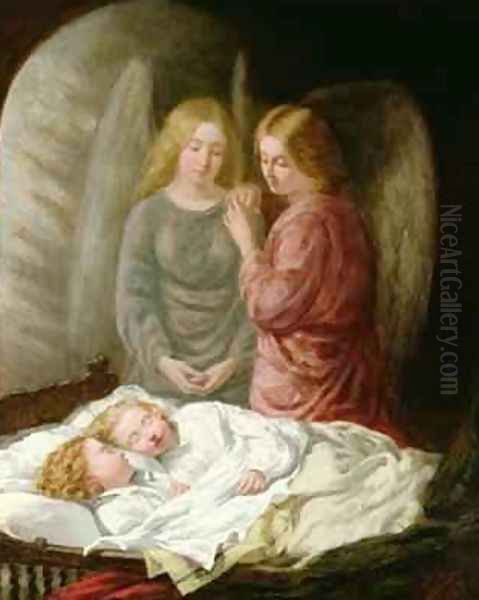
Joshua Hargrave Sams Mann, an artist whose active years spanned the dynamic heart of the Victorian era, offers a fascinating glimpse into the artistic currents and cultural preoccupations of 19th-century Britain. Though perhaps not as universally recognized today as some of his towering contemporaries, Mann's work, particularly his portraiture, literary illustrations, and innovative collaborations in stereoscopic art, reveals an artist deeply engaged with the aesthetic and intellectual trends of his time. His life, approximately from 1826 to 1886, coincided with a period of immense social, technological, and artistic transformation, and his output reflects this multifaceted environment.
The Victorian Artistic Landscape: A Crucible of Styles
To understand Joshua Hargrave Sams Mann, one must first appreciate the rich and often contradictory art world in which he operated. The Victorian era was not a monolithic artistic period; rather, it was a vibrant tapestry woven from diverse threads. The Royal Academy of Arts, a dominant institution, largely upheld traditional values, promoting historical, mythological, and grand narrative paintings, often with a moralizing undertone. Artists like Sir Edwin Landseer, with his popular animal paintings, or William Powell Frith, known for his sprawling, detailed depictions of modern life such as Derby Day and The Railway Station, enjoyed immense success within this framework.
However, the period was also marked by significant challenges to academic convention. The Pre-Raphaelite Brotherhood, founded in 1848 by John Everett Millais, Dante Gabriel Rossetti, and William Holman Hunt, sought a return to the perceived purity and sincerity of art before Raphael. They emphasized meticulous detail, vibrant color, and often drew inspiration from literature, religion, and medieval themes. Their work, initially controversial, profoundly influenced subsequent generations.
Later in the century, the Aesthetic Movement gained prominence, championed by figures like James McNeill Whistler and Albert Moore. This movement advocated for "art for art's sake," prioritizing beauty, harmony, and formal qualities over narrative or didactic content. Whistler's tonal "Nocturnes" and "Symphonies," and Moore's classically inspired figures in decorative arrangements, represented a shift towards a more subjective and sensory experience of art. Artists like Frederic Leighton and Edward Burne-Jones, while sometimes associated with different streams, also contributed to an emphasis on beauty and escapism.
The rise of photography, a revolutionary 19th-century invention, also cast a long shadow, influencing painters' approaches to realism and composition, and offering a new medium for artistic expression, as explored by pioneers like Julia Margaret Cameron. Furthermore, the era saw a flourishing of illustration, driven by the expanding publishing industry and popular periodicals, providing artists with new avenues for their work. It is within this complex and evolving artistic milieu that Mann carved out his career.
Early Life and Artistic Formation: Contextual Clues
Specific details regarding Joshua Hargrave Sams Mann's early life, formal education, and artistic training remain somewhat elusive in readily available records. Born around 1826, he would have come of age during a period when artistic training often involved apprenticeship, study at local art schools, or enrollment at the prestigious Royal Academy Schools in London. The mention of a possible connection to the Hargrave family, known for their involvement in architecture and art, might suggest an environment where artistic pursuits were encouraged, though this link requires further substantiation.
His active period is generally cited from 1849 to 1884, placing the commencement of his professional life firmly in the mid-19th century. This was a time when London was solidifying its status as a global art center, attracting artists from across Britain and beyond. The Great Exhibition of 1851, for instance, showcased not only industrial marvels but also artistic achievements, fostering a climate of innovation and international exchange.
Given the stylistic attributes of his later work, particularly the influence of Whistler and a penchant for poetic themes, it is plausible that Mann, like many artists of his generation, absorbed a wide range of influences. He would have been exposed to the ongoing debates between traditionalists and reformers, the romanticism of earlier figures like J.M.W. Turner, the detailed naturalism of the Pre-Raphaelites, and the emerging aesthetic concerns that would later define the Aesthetic Movement.
Artistic Style: Whistlerian Echoes and Poetic Sensibilities
Joshua Hargrave Sams Mann is noted for a style that bears comparison to that of James McNeill Whistler. This suggests an affinity for subtle tonal harmonies, an emphasis on mood and atmosphere, and a refined, often delicate, approach to his subjects. Whistler, an American-born artist who became a pivotal figure in the London art scene, was renowned for his sophisticated use of color, often limited palettes, and his belief in the intrinsic beauty of art, independent of narrative. His portraits, such as Arrangement in Grey and Black No. 1 (Portrait of the Artist's Mother), and his atmospheric cityscapes, challenged conventional Victorian tastes.
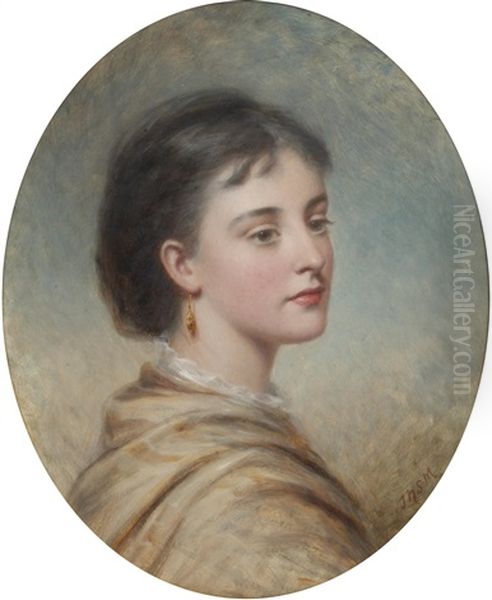
Mann's reported tendency to draw inspiration from poetry further aligns him with a broader Romantic and Aesthetic sensibility. The Victorian era was rich in poetic output, with figures like Alfred, Lord Tennyson, Robert Browning, and Christina Rossetti enjoying widespread popularity. Many artists, including the Pre-Raphaelites and later Aesthetes, found fertile ground in poetic narratives and imagery. For Mann, this likely translated into works that aimed to evoke emotion, capture a fleeting moment, or explore themes of beauty, introspection, and perhaps a touch of melancholy, often characteristic of Victorian sentiment.
His specialization in portraits of young women was a popular genre in the 19th century. Such portraits often served not only as likenesses but also as embodiments of idealized femininity, innocence, or burgeoning womanhood. The demand for these images was high, both for private commissions and for the exhibition market. Mann's success in this area suggests an ability to capture the delicate features and expressions of his sitters, imbuing them with a grace and charm that appealed to contemporary audiences.
Key Themes and Subjects in Mann's Oeuvre
Mann's artistic output, though not exhaustively documented in all its facets, reveals a focus on several key areas that were characteristic of his time, yet often approached with his distinct stylistic inclinations.
Portraiture: Capturing Victorian Womanhood
The core of Mann's recognized work appears to be his portraiture, with a particular emphasis on depictions of young women and girls. These paintings were likely a staple of his practice, catering to a market that valued images of domesticity, innocence, and refined beauty. In an era where the roles of women were undergoing subtle shifts yet still largely confined to the private sphere, portraits of daughters, sisters, and wives held significant cultural currency.
One such example, simply titled A Young Lady, showcases his skill in this genre. While specific details of this and other similar works would require individual study, it's probable they reflect the prevailing fashions and social graces of the period. The influence of Whistler might be seen in the subtle handling of light and color, the focus on the sitter's contemplative expression, or a carefully arranged composition that emphasizes aesthetic harmony over strict, photographic realism. These portraits were more than mere records; they were artistic interpretations, often imbued with a poetic or sentimental quality that resonated with Victorian viewers. The popularity of such works by artists like George Elgar Hicks or even the more society-focused portraits by John Singer Sargent (though Sargent's main impact was slightly later) underscores the demand for such imagery.
Literary Illustration: Visualizing Narrative
Mann's engagement with literature extended to providing illustrations, a significant field for artists in the 19th century. His creation of a design for the book cover of George Eliot's Silas Marner is a noteworthy example. Silas Marner: The Weaver of Raveloe, first published in 1861, is a poignant tale of a miserly linen weaver who is ultimately redeemed through the love of an orphaned child, Eppie. The novel explores themes of loss, community, faith, and the impact of industrialization on rural life.
For an artist to be chosen to illustrate or design a cover for a work by George Eliot (Mary Ann Evans), one of the preeminent novelists of the Victorian era, was a significant commission. Mann's visual interpretation would have needed to capture the essence of the story, perhaps focusing on the solitary figure of Silas, the transformative presence of Eppie, or the rustic setting of Raveloe. Book illustration in this period, by artists such as Hablot Knight Browne ("Phiz") for Charles Dickens or Sir John Tenniel for Lewis Carroll, played a crucial role in shaping the public's visual understanding of literary characters and narratives. Mann's contribution to Silas Marner places him within this important tradition of visual storytelling.
Stereoscopic Art: Innovation and Spiritualism in Guardian Angels
Perhaps one of the most intriguing aspects of Mann's career is his collaboration with Silvester Alfred on the stereoscopic work Guardian Angels. Stereoscopy, which involves creating an illusion of three-dimensional depth from two flat images viewed through a special viewer (a stereoscope), was a hugely popular Victorian invention. It offered a new way of experiencing images, bringing scenes to life with a startling sense of realism and presence. Sir David Brewster and Charles Wheatstone were key figures in its development and popularization.
The collaboration on Guardian Angels suggests Mann was open to exploring new technologies and their artistic potential. The theme itself—guardian angels—taps directly into Victorian spiritual preoccupations. The 19th century witnessed a surge of interest in spiritualism, the afterlife, and the unseen world, partly as a response to rapid scientific advancements and partly due to high mortality rates, especially among children. Images of angels, particularly those watching over children, were common and deeply resonant, offering comfort and a sense of divine protection.
By combining the theme of guardian angels with the immersive medium of stereoscopy, Mann and Alfred would have created a powerful and evocative experience for the viewer. The three-dimensional effect would have enhanced the sense of the angel's presence, making the spiritual theme all the more palpable. This work positions Mann at the intersection of art, technology, and popular belief, showcasing a willingness to engage with innovative forms of visual expression. The Brian May Archive of Stereoscopy, which holds this work, is a testament to the enduring interest in this unique Victorian art form.
Notable Works: A Closer Look
While a comprehensive catalogue raisonné of Mann's work may not be readily available, the pieces that have garnered attention provide valuable insights into his artistic contributions.
Guardian Angels (with Silvester Alfred)
This collaborative piece stands out for its innovative use of stereoscopic photography combined with artistic composition. The subject matter, deeply rooted in Victorian sentiment and spirituality, would have been enhanced by the three-dimensional viewing experience. Such works often involved carefully staged scenes, sometimes with painted backdrops or props, to create a narrative or allegorical image. The collaboration with Silvester Alfred, who was likely more specialized in the photographic aspects, highlights a common practice where artists with different skill sets would team up to explore new media. The work reflects the Victorian fascination with both the spiritual and the scientific, seeing no inherent contradiction in using cutting-edge technology to depict ethereal subjects.
Illustration for George Eliot's Silas Marner
As previously mentioned, Mann's design for the cover of Silas Marner connects him to one of the literary giants of his age. The choice of imagery for such a cover would have been crucial. It might have depicted Silas at his loom, his hunched figure symbolizing his isolation, or perhaps the pivotal moment of Eppie's arrival, her golden hair mistaken for his lost gold. Alternatively, it could have been a more symbolic design, hinting at the novel's themes of loss and redemption. Without viewing the specific design, one can only speculate, but its existence underscores Mann's involvement in the vibrant world of 19th-century publishing and literary culture.
Portraits of Young Women (e.g., A Young Lady)
Mann's portraits of young women and girls were likely his bread and butter. These works, often characterized by their sensitivity and charm, catered to a strong market demand. A piece titled A Young Lady, for instance, would have aimed to capture not just a physical likeness but also an idealized sense of youthful innocence or contemplative grace. The style, potentially influenced by Whistler's aestheticism, might have involved soft brushwork, a harmonious color palette, and a focus on the overall mood of the piece. Such portraits were displayed in homes, cherished as family heirlooms, and sometimes exhibited at public venues, contributing to an artist's reputation. The popularity of artists like Kate Greenaway, known for her charming illustrations of children, also speaks to the Victorian fondness for images of youth.
Collaborations and Connections
The known collaboration with Silvester Alfred on Guardian Angels is a significant aspect of Mann's career, demonstrating his engagement with the burgeoning field of photography and its artistic applications. Such collaborations were not uncommon, as new technologies often required specialized expertise.
The stylistic affinity with James McNeill Whistler suggests that Mann was, at the very least, an astute observer of contemporary artistic developments. Whether there was any direct personal connection or mentorship is unclear, but Whistler's influence was pervasive, particularly among artists seeking alternatives to academic realism. Whistler's own circle included artists like Walter Greaves, who emulated his style, and he engaged in famous public debates, most notably with the critic John Ruskin, which further amplified his ideas about art.
His work for George Eliot's Silas Marner connects him, albeit indirectly, to the literary elite of the Victorian era. Authors and artists often moved in overlapping social and intellectual circles, and the relationship between text and image was a subject of considerable interest and creative exploration.
The Art Market and Mann's Legacy
Information regarding Joshua Hargrave Sams Mann's performance in the art market indicates that his works do appear at auction, with Parker Fine Art Auctions being one venue mentioned. The price range for his paintings, particularly portraits of young women, varies. Some pieces have reportedly fetched over £5,000, while many sell for under £1,000. This variation is typical for artists whose work is not consistently in the highest echelons of demand but still holds appeal for collectors of Victorian art.
The fact that a work like Guardian Angels is preserved in The Brian May Archive of Stereoscopy is significant. Specialized archives and collections play a crucial role in preserving the work of artists who might otherwise be overlooked and in highlighting specific, sometimes niche, areas of art history like stereoscopic imagery.
Mann's legacy is that of a competent and sensitive Victorian artist who navigated the diverse artistic landscape of his time. He engaged with popular genres like portraiture, contributed to the rich field of literary illustration, and even ventured into innovative collaborations using new technologies. While he may not have achieved the fame of a Leighton or a Millais, his work provides valuable insight into the tastes, preoccupations, and artistic practices of the 19th century. His connection to poetic themes and the Whistlerian aesthetic suggests an artist attuned to the more subtle and evocative currents of Victorian art.
Conclusion: An Artist of His Time
Joshua Hargrave Sams Mann (c. 1826-1886) emerges as a figure representative of many Victorian artists who, while perhaps not revolutionary in the grandest sense, contributed meaningfully to the cultural fabric of their era. His portraits of young women captured the ideals and sentiments of his society, his literary illustrations helped bring narratives to life, and his foray into stereoscopic art with Guardian Angels demonstrated an engagement with technological innovation and popular spiritual themes.
Influenced by the poetic sensibilities of his age and the aesthetic advancements championed by figures like Whistler, Mann crafted a body of work that, though deserving of further scholarly attention, offers a window into the diverse artistic expressions of the 19th century. His paintings and collaborations reflect a world grappling with change, embracing new technologies, and seeking beauty and meaning in both the seen and unseen realms. Artists like Mann, operating alongside more famous names such as Ford Madox Brown or Luke Fildes, formed the rich ecosystem of the Victorian art world, each contributing their unique voice to its complex chorus. The continued appearance of his work in auctions and its presence in specialized collections ensure that Joshua Hargrave Sams Mann's contribution to Victorian art is not entirely forgotten, inviting ongoing appreciation and study.