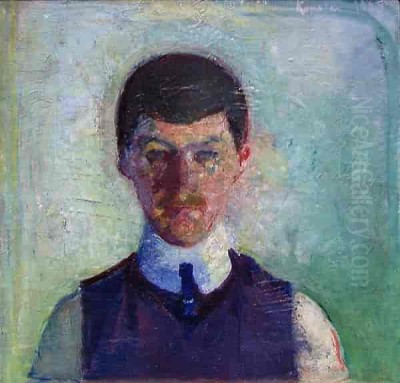
Ludvig Peter Karsten stands as a significant, if sometimes tumultuous, figure in the landscape of early 20th-century Norwegian art. Born on May 8, 1876, in Christiana (now Oslo), and passing away in Paris on October 19, 1926, Karsten's life was one of passionate artistic exploration, marked by vibrant canvases, influential connections, and a personality that often matched the intensity of his palette. He navigated the shifting tides of European art, absorbing influences from Impressionism and Post-Impressionism, and forging a unique path that contributed significantly to the development of modernism in Norway.
Early Life and Artistic Stirrings
Ludvig Karsten was born into a family with a practical background; his father, Hans Heinrich Karsten, was a builder, and his mother was Ida Susanne Pfützenreuter. This upbringing, however, did not stifle the young Karsten's burgeoning artistic inclinations. His formal artistic journey began with drawing lessons at the Norwegian National Academy of Craft and Art Industry (Den kongelige Tegneskole) in Christiana. Even in these early stages, a certain restlessness and a desire for direct engagement with nature and human subjects became apparent.
A pivotal early experience occurred in 1893 when Karsten, still a teenager, ventured into the region of Telemark. This area, renowned for its dramatic landscapes and rich folk culture, had long been a source of inspiration for Norwegian artists. During this period, he notably collaborated with fellow painter Halfdan Egedius, another promising young talent whose life, unfortunately, would be cut short. This early immersion in landscape and portrait painting in the Norwegian countryside laid a foundational layer for Karsten's later work, instilling in him a deep connection to the natural world and the human form.
Formative Travels and European Influences
Like many aspiring artists of his generation, Karsten understood the necessity of broadening his horizons beyond Norway. The late 19th and early 20th centuries were a period of immense artistic ferment in Europe, and cities like Rome, Florence, Munich, and Paris were magnets for those seeking to learn from the masters and engage with contemporary movements. Karsten embarked on extensive travels, absorbing a diverse range of artistic stimuli.
His time in Italy, visiting Rome and Florence, would have exposed him to the monumental works of the Renaissance and Baroque periods. The mastery of light, form, and composition by artists such as Michelangelo, Raphael, and Caravaggio undoubtedly left an impression. Munich, then a significant art center in Germany, offered opportunities for more formal academic training and exposure to the German Secession movements, which were challenging traditional artistic norms.
Karsten also spent a period living and working in Madrid, Spain. Here, he would have encountered the powerful and often somber works of Spanish masters like Diego Velázquez, Francisco Goya, and Jusepe de Ribera. The raw emotional intensity and dramatic use of chiaroscuro found in Spanish art, particularly in the works of Ribera, whom Karsten is known to have studied and even imitated, likely resonated with his own developing expressive tendencies. He also showed an interest in the graphic works of artists like Jacques Callot, indicating a broad appreciation for different artistic traditions and techniques.
Crucially, Karsten was deeply affected by the innovations of French Impressionism and Post-Impressionism. While the provided information mentions him as a follower of Edgar Degas and a pioneer of Impressionism, it's perhaps more accurate to say he was profoundly influenced by Impressionist principles – the emphasis on capturing fleeting moments, the effects of light and atmosphere, and a brighter palette – and integrated these into his own evolving modernism. Degas, with his unconventional compositions and focus on modern life, would have offered a compelling model.
The Norwegian Art Scene and Karsten's Contemporaries
Upon returning to Norway, and throughout his career, Karsten became an active participant in the national art scene. He was part of a generation of Norwegian artists who were breaking away from the dominant National Romanticism of the 19th century, championed by figures like Hans Gude and Adolph Tidemand, and embracing more modern, international currents.
His most significant, and often fraught, relationship was with Edvard Munch, the towering figure of Norwegian Expressionism. Karsten was, in many ways, a follower and admirer of Munch, absorbing aspects of his bold color use and psychological intensity. However, their interactions were not always smooth. A famous incident occurred in 1904 at a dinner in Stockholm, where an alcohol-fueled dispute between the two artists took place. Munch later created a print commemorating, or perhaps exorcising, this event, highlighting the volatile nature of their connection. Munch himself described Karsten as "strange," a testament to Karsten's often unpredictable and fiery temperament.
Despite these personal complexities, Munch's artistic influence on Karsten is undeniable. The emotional depth and expressive force that characterize Munch's work found echoes in Karsten's own canvases, albeit filtered through Karsten's unique sensibility.
Beyond Munch, Karsten was connected to a circle of other important Norwegian modernists. These included Henrik Sørensen, known for his lyrical and often religiously themed paintings, and Rudolph Thygesen, another colorist who contributed to the modernist breakthrough. The sculptor Gustav Vigeland, whose monumental works now dominate Frogner Park in Oslo, was also a contemporary, representing a different facet of Norwegian artistic innovation at the time.
Karsten's engagement with the broader European art world also brought him into contact with the ideas of French artists like Henri Matisse and Henri Rousseau. Matisse, a leader of Fauvism, with his radical use of non-naturalistic color and simplified forms for expressive effect, would have been a powerful contemporary influence. The "naïve" yet sophisticated art of Rousseau, with its dreamlike jungle scenes and meticulous detail, also represented a departure from academic tradition that resonated with the modernist spirit of exploration.
The artistic environment in Norway also included established figures like Christian Krohg, a leading naturalist painter and writer who had mentored an earlier generation, and Frits Thaulow, a prominent Norwegian Impressionist known for his atmospheric depictions of water and snow. Harriet Backer, one of Norway's most important female artists, was also a contemporary, celebrated for her sensitive interior scenes and use of light. Karsten's work developed within this rich and evolving artistic milieu.
Artistic Style and Thematic Concerns
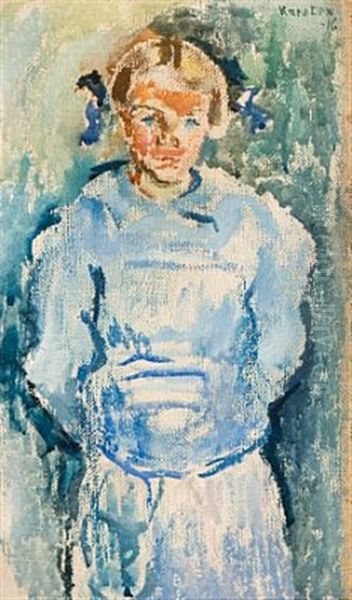
Ludvig Karsten's artistic style is characterized by its vibrant colorism, energetic brushwork, and a profound engagement with light and atmosphere. He was a modernist who drew heavily from Impressionist and Post-Impressionist aesthetics, but his work retained a strong personal stamp, often imbued with a raw, almost visceral energy.
His palette was typically rich and bold, with colors applied in a way that emphasized their emotional and sensory impact rather than strict adherence to naturalistic representation. He was a master of capturing the interplay of light and shadow, whether in sun-dappled landscapes, intimate interiors, or luminous still lifes. His brushstrokes were often visible and dynamic, contributing to the overall sense of vitality in his paintings. Karsten was known for his technique of applying paint in layers, sometimes scraping back or reworking areas of the canvas, a process that speaks to an intense and often restless creative drive.
Karsten's subject matter was diverse. He painted numerous landscapes, capturing the beauty of the Norwegian countryside as well as scenes from his travels. His time in Skagen, Denmark, during the 1920s, was particularly fruitful for his landscape work. Skagen was famous as an artists' colony, attracting painters like P.S. Krøyer, Michael Ancher, and Anna Ancher, who were drawn by its unique coastal light. It was here that Karsten experimented with pointillist techniques, building up his compositions with small dabs of color to create shimmering, light-filled effects.
Still lifes, particularly floral arrangements, were another favorite theme. In these works, such as Vase med blomster (Flowers in a Vase), Karsten explored the pure joy of color and form, often creating compositions bursting with life and energy. He also painted nudes, interiors, portraits, and self-portraits. His portraits, including one of his wife Alise, whom he married in Copenhagen in 1913, often reveal a keen psychological insight, capturing not just the likeness but also the personality of the sitter. His self-portraits, in turn, offer glimpses into his own complex and often intense inner world.
While influenced by Impressionists like Claude Monet and Pierre-Auguste Renoir in terms of light and color, Karsten's work often possessed a greater structural solidity, perhaps reflecting an awareness of Post-Impressionists like Paul Cézanne, or a more Nordic temperament. His expressive use of color also aligns him with the broader Post-Impressionist trends seen in the work of artists like Vincent van Gogh and Paul Gauguin, who prioritized emotional expression over objective reality.
Key Works and Their Significance
Several works stand out in Ludvig Karsten's oeuvre, showcasing his stylistic range and thematic preoccupations.
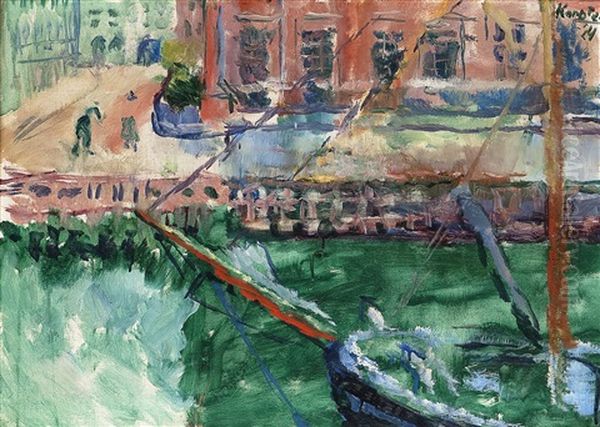
Fra Nyhavn (From Nyhavn) is a notable example of his urban landscape painting. Nyhavn, the iconic harbor district in Copenhagen, with its colorful buildings and bustling maritime life, provided rich subject matter for many artists. Karsten's depiction would likely emphasize the vibrant atmosphere and the play of light on water and architecture, rendered with his characteristic energetic brushwork. Such a piece demonstrates his ability to find artistic inspiration in diverse environments, from the rural Norwegian interior to cosmopolitan cityscapes.
The portrait of Jens Schow Fabricius is another important work. Fabricius was a significant figure, and Karsten's portrayal would have aimed to capture his character and status. Portraiture was a consistent thread in Karsten's career, allowing him to explore human psychology and experiment with form and color in the context of a specific individual.
Vase med blomster (Flowers in a Vase) and Haven (The Garden) represent his engagement with still life and nature. These works are often celebrations of color and light, where Karsten could freely explore the sensuous qualities of paint and the beauty of the natural world. His flower paintings, in particular, are known for their exuberance and vitality, with thickly applied paint and a rich, jewel-like palette. Haven would likely showcase his ability to capture the lushness of a garden scene, perhaps employing the pointillist techniques he developed in Skagen if it dates from that period, or a more broadly impressionistic approach.
The portrait of his wife, Alise Karsten (née Mikkelsen), is a significant personal and artistic statement. Such works often carry an added layer of intimacy and emotional depth. For Karsten, painting his wife would have been an opportunity to explore not just her physical likeness but also their relationship, rendered through his distinctive stylistic lens.
These works, among many others, demonstrate Karsten's versatility and his consistent commitment to a color-rich, expressive form of modernism. His paintings are often characterized by a sense of immediacy and a palpable engagement with his subject matter.
Later Years, Recognition, and Legacy
Ludvig Karsten continued to paint and exhibit throughout his life. He participated in the prestigious Autumn Exhibition (Høstutstillingen) in Christiana as early as 1901 and held his first solo exhibition in 1904, marking his arrival as a distinct voice in Norwegian art. His work gained recognition, and in 1913, he was awarded the Norwegian National Honorary Medal, a significant acknowledgment of his artistic contributions.
His later years were spent partly in Paris, the undisputed art capital of the world. It was here that he passed away in 1926, at the relatively young age of 50. Despite his sometimes difficult personality and a life that was not without its struggles, Karsten left behind a substantial body of work that has secured his place in Norwegian art history.
Posthumously, his reputation has continued to grow. The National Gallery of Norway (now part of the National Museum) began acquiring his works in 1930, and today he is well-represented in Norwegian public and private collections. He is regarded as one of the foremost Norwegian colorists of his generation, a vital link between the legacy of Edvard Munch and the further development of modernism in Norway.
While perhaps not as internationally renowned as Munch, Ludvig Karsten's contribution is undeniable. He brought a passionate, vibrant, and distinctly personal vision to Norwegian painting. His willingness to absorb international influences while retaining a strong individual voice, his bold use of color, and the sheer energy of his canvases ensure his enduring importance. He remains a compelling figure, an artist whose work continues to resonate with its intensity and its celebration of the visual world.
Conclusion: The Enduring Vibrancy of Karsten's Art
Ludvig Peter Karsten was an artist of passion, intensity, and immense talent. His journey through the art worlds of Norway and Europe shaped him into a distinctive modernist voice, one that championed color, light, and emotional expression. From his early explorations in Telemark to his mature works created in Norway, Denmark, and France, Karsten consistently sought to capture the vitality of his subjects, be they landscapes, still lifes, or human figures.
His complex relationship with Edvard Munch, his engagement with Impressionist and Post-Impressionist ideas, and his connections with contemporaries like Henrik Sørensen and Rudolph Thygesen all paint a picture of an artist deeply embedded in the artistic currents of his time. Works like Fra Nyhavn, Jens Schow Fabricius, and his numerous vibrant still lifes and landscapes stand as testaments to his skill and his unique artistic vision.
Though his life was relatively short, Ludvig Karsten's legacy is one of enduring vibrancy. He pushed the boundaries of Norwegian art, contributing significantly to its modernist transformation, and left behind a body of work that continues to captivate with its bold color, energetic execution, and profound connection to the sensory world. He remains a key figure for understanding the rich tapestry of early 20th-century Scandinavian art.