Nicola Grassi, a significant figure in the Venetian art scene of the 18th century, navigated the transition from the dramatic intensity of the late Baroque to the lighter, more graceful sensibilities of the Rococo. Born in Formeaso, a village in the Carnia region of Friuli, in 1682, Grassi's artistic journey would primarily unfold in the vibrant cultural milieu of Venice, the Serenissima. His death in Venice in 1748 marked the end of a prolific career dedicated largely to religious subjects, though his oeuvre also includes mythological scenes and portraiture, leaving a distinct imprint on the artistic heritage of Venice and regions beyond, notably Croatia.
Grassi's work is characterized by a refined sensibility, an evolving palette that moved from darker, tenebrist tones to brighter, more luminous hues, and a consistent dedication to elegant compositions. He absorbed the rich artistic traditions of Venice, learning from his master and engaging with the works of his contemporaries, ultimately forging a style that, while perhaps not achieving the widespread international fame of some of his peers, earned him considerable esteem and numerous commissions.
Early Life and Artistic Formation in Venice
Nicola Grassi's artistic beginnings were rooted in the studio of Nicolò Cassana (1659-1714). Cassana, sometimes known as Nicoletto, was himself a respected Venetian artist, the son of Giovanni Francesco Cassana, a Genoese painter who had trained under the influential Bernardo Strozzi. This lineage placed Grassi within a strong tradition of painterly skill and dramatic composition. Under Cassana, who was particularly noted for his portraiture and religious works, Grassi would have honed his foundational skills in drawing, color, and composition.
The Venice in which Grassi matured as an artist was a crucible of artistic innovation and a major center of the European art market. The city's unique atmosphere, its interplay of light and water, and its rich history of artistic giants like Titian, Veronese, and Tintoretto, provided an unparalleled backdrop for any aspiring painter. The early 18th century saw Venice experiencing a last flourishing of artistic brilliance before its political decline. Painters like Sebastiano Ricci and Giovanni Antonio Pellegrini were already established, bringing a lighter, more fluid touch to large-scale decorative schemes, heralding the Rococo.
Grassi's early works, influenced by the prevailing "tenebroso" or dark style, show an inclination towards dramatic chiaroscuro. However, as his career progressed, particularly from around 1720 onwards, his style began to lighten, embracing the more delicate and ornate characteristics associated with the burgeoning Rococo movement. This stylistic evolution was likely influenced by the general artistic trends in Venice and his exposure to the works of other leading painters.
The Artistic Milieu: Influences and Contemporaries
Nicola Grassi's artistic development was shaped not only by his direct tutelage under Nicolò Cassana but also by the broader artistic currents and influential figures in Venice. The city was a melting pot of styles, and artists frequently drew inspiration from one another, as well as from the old masters.
Giacomo Piazzetta (1682-1754), an exact contemporary of Grassi, was a towering figure whose work significantly impacted the Venetian school. Piazzetta was known for his powerful draughtsmanship, his rich, earthy palette, and his ability to convey profound human emotion, often through dramatic lighting. While Grassi’s style developed its own distinct characteristics, the influence of Piazzetta's robust naturalism and expressive intensity can be discerned, particularly in the solidity of form and psychological depth of some of Grassi's figures.
Another colossal figure whose work cast a long shadow was Giovanni Battista Tiepolo (1696-1770). Though slightly younger, Tiepolo's rise to preeminence with his vast, airy, and brilliantly lit frescoes and canvases epitomized the Venetian Rococo. His luminous palette and seemingly effortless compositions set a new standard for decorative painting. Grassi, while generally working on a smaller, more intimate scale, would have been aware of Tiepolo's innovations, and his own move towards brighter colors and more graceful figures reflects this broader shift in Venetian taste.
Grassi is also noted to have been influenced by artists such as Federico Bencovich (1677-1753), a Dalmatian painter active in Venice, known for his dramatic, almost mystical religious scenes, and Pietro Antonio Zucchi. The use of prints as sources for compositions was a common practice, and Grassi, like many of his contemporaries, likely utilized them to study the works of other masters, including earlier figures like Parmigianino, whose elegant Mannerist forms may have resonated with Grassi's developing Rococo sensibilities.
He also had connections with Antonio Balestra (1666-1740), a Veronese painter who spent significant time in Venice and was known for his more classical and academic approach, and Palma il Giovane (Jacopo Negretti, 1548/50-1628), a prolific late Renaissance master whose works were ubiquitous in Venetian churches and undoubtedly studied by subsequent generations. Gian Domenico Tiepolo (1727-1804), Giovanni Battista's son, continued the family's artistic legacy, though his career largely peaked after Grassi's death.
The competitive landscape also included figures like Sebastiano Ricci (1659-1734), who, along with Pellegrini, was instrumental in disseminating the Venetian style across Europe. Antonio Maria Marini (1668-1725), known for his landscapes and battle scenes, represented another facet of the diverse Venetian art scene. While Grassi's focus remained primarily on religious easel paintings, he operated within this dynamic and competitive environment, carving out a niche for his particular blend of Baroque drama and Rococo elegance.
Artistic Style, Techniques, and Thematic Focus
Nicola Grassi's art is primarily recognized for its religious themes, which he rendered with an evolving stylistic approach. His early period, as mentioned, leaned towards a darker palette and more pronounced chiaroscuro, typical of the late Baroque's lingering tenebrist tendencies. This can be seen in the dramatic interplay of light and shadow that models figures and creates a sense of gravitas.
As he matured, Grassi's style underwent a noticeable transformation. His colors became brighter, clearer, and more varied, reflecting the Rococo preference for a lighter and more decorative aesthetic. His brushwork, while always competent, often acquired a greater delicacy and fluidity. He excelled in rendering the textures of fabrics, the softness of flesh, and the ethereal quality of divine light. The "delicate colors and light and shadow effects" noted by art historians are hallmarks of his mature style.
A key characteristic of Grassi's technique was his meticulous attention to detail, combined with an ability to create an overall harmonious and elegant composition. He often employed dynamic arrangements of figures, imbuing his scenes with a sense of movement and emotional engagement. Even in static devotional images, there is often an underlying rhythm and grace. His figures, while sometimes idealized, convey a gentle humanity.
His compositional strategies could be quite sophisticated. Some works exhibit a "geometric composition" or an "architectural framing," where figures are placed within carefully constructed spatial settings that enhance the narrative or symbolic meaning of the scene. This structural underpinning provided a sense of order and monumentality, even in smaller works.
Thematically, Grassi dedicated much of his output to religious subjects. The Holy Family, the Assumption of the Virgin, scenes from the lives of saints, and particularly the Annunciation, were recurrent themes. These subjects were in high demand for church altarpieces, private chapels, and devotional use by lay patrons. His interpretations of these sacred narratives were imbued with a sincere piety, yet also with an eye for decorative appeal, making them suitable for both public worship and private contemplation.
Major Representative Works
Nicola Grassi's oeuvre includes a number of significant paintings that exemplify his style and thematic concerns. Many of these found their way into churches and collections in Venice, Friuli, and notably across the Adriatic in Croatia.
One of his most discussed works is the _Annunciation with Saints_. This painting has a fascinating history, as it was reportedly cut into three separate pieces during the 18th century and later painstakingly restored. The original composition, likely a large altarpiece, would have showcased Grassi's ability to manage complex multi-figure arrangements and create a cohesive narrative. The subject of the Annunciation, depicting the Archangel Gabriel's announcement to the Virgin Mary, was a theme Grassi returned to, allowing him to explore divine light, human emotion, and graceful figural representation. Its current location in the Cathedral Treasury of Krk, Croatia, underscores his reach beyond Venice.
_St. Joseph with the Child_ (circa 1730), housed in Sv. Gaudencij in Osor, Croatia (originally referred to as Sv. Jezus s Djetetom i delam), is another important example of his religious work. This tender depiction would have allowed Grassi to explore the intimate relationship between the saint and the infant Christ, focusing on gentle expressions and the interplay of light on drapery and flesh. Such works catered to the growing devotion to St. Joseph during this period.
Also dating to around 1730 and located in the Cathedral Treasury of Krk is _St. Francis of Paola and St. Peter of Alcantara_. (The title "Sv. Franjo Paulski i petar od Alcantara" clearly refers to these two saints, rather than St. Augustine and St. John Nepomuk as one translation suggested, though Grassi may have painted those saints elsewhere). These Counter-Reformation saints were popular subjects, embodying ideals of piety and asceticism. Grassi would have depicted them with their traditional attributes, likely emphasizing their devotional intensity. Another version of this subject is noted as being in his "early style" and in a Croatian church, suggesting it was a theme he revisited or that was particularly commissioned.
A series of oval paintings, created around 1742 and also found in Croatian churches, includes _St. Agatha, St. Lucy, and St. Philip Neri_. Oval formats were popular in the Rococo period for their elegant and dynamic shape, often used for series of saints or allegorical figures. These works would demonstrate Grassi's mature style, with brighter colors and graceful compositions. Similarly, _St. Joseph, St. Cecilia, and Pope Pius V_, described as being in his "late style," would showcase his refined Rococo sensibilities.
The _Portrait of St. Catherine_, located in a Croatian church, highlights his skill in depicting individual saints with characteristic attributes and conveying their spiritual essence. His unique use of light and color would have been central to such a portrayal.
A departure from his more common religious themes is _The Triumph of Amphitrite_, an oil on copper. The provided information dates this to the 17th century, which is problematic given Grassi's birth in 1682. It's possible this is an error in the source, refers to an earlier artist of the same name (unlikely in this context), or perhaps it was a copy of an earlier work, or a very youthful piece if the dating is flexible (e.g., very late 1690s). If indeed by Nicola Grassi, this mythological subject, depicting the sea nymph Amphitrite, would demonstrate his versatility and ability to engage with classical themes popular in Baroque and Rococo art. Its location in the Beecroft Art Gallery in the UK indicates the dispersal of his works.
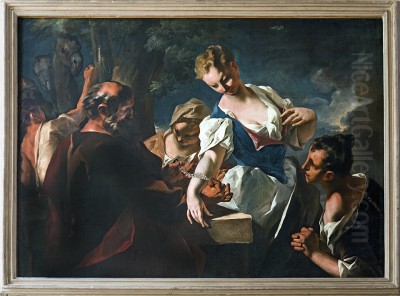
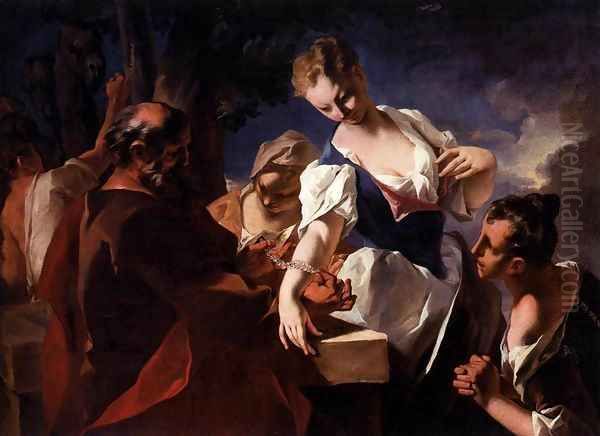
Other works, such as _Rebecca at the Well_, commissioned by a noble family to commemorate an important event, further illustrate his engagement with Old Testament narratives and his service to private patrons. These paintings, often rich in detail and narrative content, allowed for a display of skill in depicting figures, landscapes, and emotional interactions.
Patronage, Reception, and Career Trajectory
Nicola Grassi's career was sustained by a steady stream of commissions, primarily from ecclesiastical institutions and private collectors. Churches in Venice and his native Friuli, as well as across the Adriatic in regions like Dalmatia (modern-day Croatia), sought his altarpieces and devotional paintings. The presence of numerous works by Grassi in Croatian churches, such as those in Krk, Osor, and other locations, speaks to significant patronage networks, possibly facilitated by Venetian trade and cultural connections or by Friulian expatriate communities.
His patrons would have included clergy, religious orders, and affluent families seeking to adorn their private chapels or residences with religious art. While he may not have achieved the level of international renown enjoyed by contemporaries like Tiepolo or Ricci, who undertook major commissions in foreign courts, Grassi was a respected and sought-after artist within his sphere of operation. His ability to adapt his style, moving from a more somber Baroque to a lighter Rococo, likely helped him maintain appeal across changing tastes.
The incident involving the cutting of his Annunciation with Saints into three parts is a curious episode. While the exact reasons are lost to history, such interventions, though often detrimental from a modern conservation perspective, were not unheard of. They could result from changes in liturgical practice, spatial reconfigurations within a church, or even a desire to create multiple saleable artworks from a single large canvas. The later restoration of this work signifies its recognized importance.
In terms of critical reception, Grassi's work was appreciated in his lifetime for its technical skill, devotional sincerity, and decorative qualities. In the 20th century, as art historical scholarship delved deeper into regional schools and less globally famous masters, Grassi's contributions received renewed attention. He came to be seen as an important representative of Venetian painting in the 18th century, particularly for his role in the artistic exchange between Venice and the Eastern Adriatic coast. His work was discussed at academic forums, such as the Udine International Symposium in 1984, indicating his enduring relevance to art historical study.
Students and Workshop Practice
Like many artists of his time, Nicola Grassi likely maintained a workshop to assist with commissions, particularly larger ones, and to train younger artists. The provided information names Giovanni Visentin and Nicolò Zonca (possibly Zgonale) as his students. Interestingly, these two are also mentioned as students of Grassi's own master, Nicolò Cassana. This could imply several scenarios: they might have initially studied with Cassana and then continued with Grassi after Cassana's death or a change in workshop structure, or perhaps there was a period of overlap where Grassi, as a senior pupil or assistant in Cassana's studio, had some supervisory role over junior members.
The presence of students suggests that Grassi's techniques and stylistic approaches were passed on to a new generation. Workshop practice typically involved pupils assisting with preparatory work, painting less critical areas of canvases, and making copies of the master's compositions. This system was crucial for the dissemination of artistic styles and for meeting the demand for artworks.
Anecdotes and the Artist's Character
Specific anecdotes about Nicola Grassi's personal life are scarce, as is often the case for artists who did not achieve the level of biographical documentation afforded to figures like Michelangelo or Leonardo da Vinci. However, the story of his Annunciation with Saints being cut and later restored offers a glimpse into the posthumous life of his artworks and the changing attitudes towards art preservation and presentation.
His use of prints to inform his compositions, a common practice, suggests a pragmatic and resourceful artist, keen to learn from a wide range of visual sources. This was not seen as plagiarism but as a legitimate way of engaging with established iconographies and compositional solutions, which could then be adapted and reinterpreted in the artist's own style.
The evolution of his style from a darker, more dramatic Baroque to a lighter, more elegant Rococo suggests an artist responsive to the prevailing artistic climate and perhaps to the demands of his patrons. This adaptability, combined with a consistent level of craftsmanship, was key to his sustained career.
Legacy and Enduring Influence
Nicola Grassi's artistic legacy is multifaceted. He stands as a notable exponent of the Venetian school during a vibrant period of artistic production. His contribution lies in his skillful synthesis of late Baroque and Rococo elements, creating works that were both spiritually resonant and aesthetically pleasing.
His most tangible legacy resides in the numerous paintings that survive in churches, museums, and private collections, particularly in Venice, Friuli, and Croatia. These works continue to be objects of devotion, aesthetic appreciation, and art historical study. For regions like Croatia, Grassi's paintings represent an important part of their cultural heritage, reflecting the strong artistic ties with Venice. The re-evaluation of his work in the 20th century, particularly by Croatian scholars, has helped to solidify his place in the narrative of 18th-century European art.
While he may not have founded a major new school or dramatically altered the course of art history in the way some of his more famous contemporaries did, Grassi played a vital role in the artistic ecosystem of his time. He produced high-quality religious art that met the needs of his community, influenced his students, and contributed to the rich tapestry of Venetian painting. His works serve as a testament to the enduring power of religious imagery and the refined elegance of 18th-century Venetian art.
The ongoing study and conservation of his paintings, such as the restoration of the Krk Annunciation, ensure that his artistic voice continues to be heard. He remains a significant figure for understanding the nuances of the late Baroque and Rococo periods in Venice and its sphere of influence, an artist whose delicate touch and devotional sincerity created works of lasting beauty and importance. His paintings offer a window into the spiritual and aesthetic concerns of his era, reflecting a world where faith and art were inextricably intertwined.