Pieter van der Werff (1665-1722) stands as a notable figure in the twilight of the Dutch Golden Age of painting. Born in Kralingen, near Rotterdam, he navigated an artistic world already rich with established masters and evolving tastes. While often discussed in relation to his older, more famous brother, Adriaen van der Werff, Pieter carved out his own distinct, albeit related, niche. His oeuvre, encompassing portraits, genre scenes, and historical or mythological subjects, is characterized by a polished finish, rich coloration, and an enduring commitment to elegance, even if sometimes perceived as lacking the deeper emotional resonance of some of his contemporaries.
Early Life and Artistic Apprenticeship
Pieter van der Werff's artistic journey began under the direct tutelage of his elder brother, Adriaen (1659-1722). Adriaen was not only his primary teacher but also a lifelong collaborator. This close familial and professional bond was foundational to Pieter's development. He was immersed in Adriaen's studio practices, absorbing the meticulous techniques and refined aesthetic that would become hallmarks of both their styles. The brothers primarily lived and worked in Rotterdam, a bustling port city that, while not as central to the art market as Amsterdam, supported a thriving community of artists and patrons.
The family's background reportedly had Anabaptist connections through their father, which might have subtly influenced their worldview, though their art largely catered to a broader, often elite, clientele. Pieter's role in Adriaen's workshop was significant; he was more than just a student, evolving into a key assistant. This collaborative environment meant that their styles would inevitably share many commonalities, sometimes leading to complexities in attribution for art historians.
Artistic Style: Precision, Polish, and Palette
Pieter van der Werff's style is deeply rooted in the tradition of the Dutch "fijnschilders" (fine painters), particularly those associated with Leiden, such as Gerard Dou and Frans van Mieris the Elder. This tradition emphasized meticulous detail, smooth, almost invisible brushwork, and a highly polished surface that gave paintings an enamel-like quality. Pieter excelled in this demanding technique. His works are distinguished by their clarity, precision, and the careful rendering of textures, from lustrous silks to soft flesh tones.
His color palette was typically rich and harmonious, though art critics have sometimes noted that his works, while vibrant, might possess less of the overt emotional warmth or dramatic chiaroscuro found in artists like Rembrandt van Rijn or even the subtle atmospheric depth of Johannes Vermeer. Instead, Pieter's paintings often exude a cool, classical elegance. He was particularly adept at depicting the human form, especially female figures, which are rendered with grace and an idealized beauty. This skill was evident across his genre scenes, mythological narratives, and portraits. While his brother Adriaen was often lauded for a greater "spirit" or inventive genius, Pieter's technical mastery and consistent quality were highly regarded in their own right. He also absorbed influences from Dutch classicist painters like Gerard de Lairesse, whose theoretical writings and artistic output promoted a more academic, history-painting-oriented approach.
Thematic Concerns and Notable Genres
Pieter van der Werff's artistic output was diverse, covering the main categories popular in the late Dutch Golden Age.
Portraiture
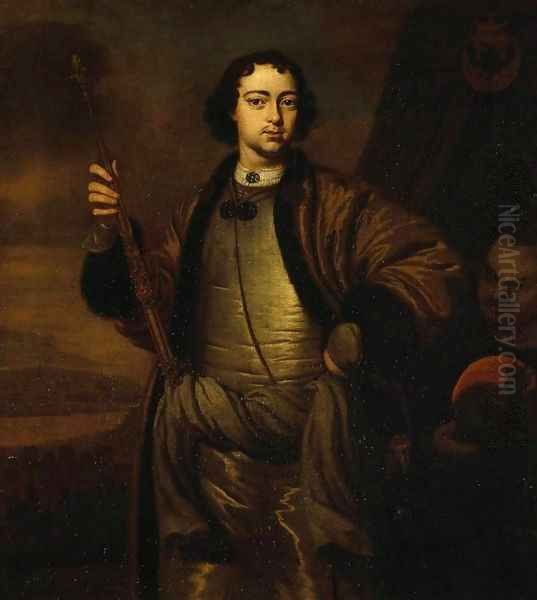
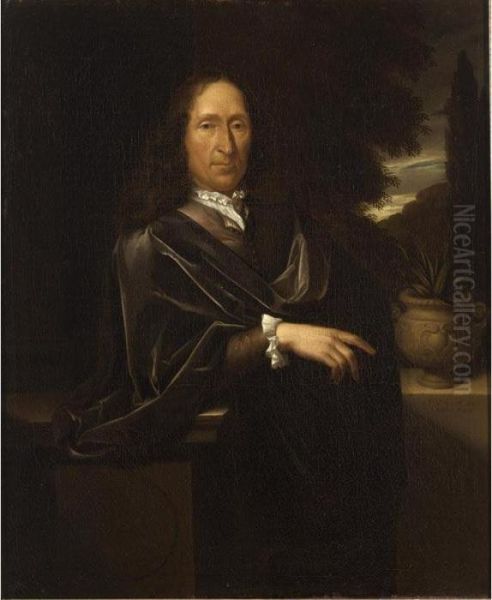
He was a sought-after portraitist, capturing the likenesses of wealthy burghers and notable figures. These portraits, while adhering to conventions of representation, showcase his skill in rendering fine clothing and conveying a sense of dignified composure. A significant commission was a portrait of the young Peter the Great of Russia, now housed in the Hermitage Museum, St. Petersburg, underscoring his international connections, likely facilitated through his brother's network.
Genre Scenes
His genre paintings often depict tranquil, idealized scenes of everyday life among the affluent, or allegorical representations featuring children and classical motifs. Works like Children Playing before a Statue of Hercules or A Young Artist Studying an Antique Statue combine charming depictions of youth with an appreciation for classical antiquity, a recurring theme in the Werff brothers' circle. These scenes are typically characterized by their refined atmosphere and meticulous detail, avoiding the boisterousness found in the genre works of artists like Jan Steen.
Historical and Mythological Paintings
Pieter also ventured into historical, biblical, and mythological subjects. These paintings allowed him to display his skill in composing complex multi-figure scenes and depicting the nude or classically draped figure. Examples include St. Jerome and Girl crowning a statue of Venus. These works often reflect the prevailing taste for classical themes and narratives, rendered with his characteristic polished finish. His religious paintings, such as The Entombment of Christ, demonstrate a capacity for conveying solemnity and pathos, albeit within a framework of classical restraint.
The Innovation of Prussian Blue
A fascinating and specific technical aspect of Pieter van der Werff's practice was his early adoption of Prussian blue. This synthetic pigment, one of the first modern artificial pigments, was discovered in Berlin around 1706 by Johann Jacob Diesbach. Pieter van der Werff is credited as one of the earliest Dutch painters to incorporate it into his palette. His painting, The Entombment of Christ, dated 1709, is among the first documented uses of Prussian blue in an oil painting. This demonstrates an openness to new materials and a desire to expand his chromatic possibilities, particularly for achieving deep, stable blues, which were previously reliant on expensive pigments like ultramarine (from lapis lazuli) or less permanent ones like smalt or indigo. The availability of Prussian blue would have been facilitated by the artistic and scientific exchanges of the time, possibly through his brother's connections with patrons like Johann Wilhelm II, Elector Palatine, who had ties to the Berlin court and its Academy of Arts.
Collaboration with Adriaen van der Werff
The artistic relationship between Pieter and Adriaen van der Werff was exceptionally close. Pieter was not merely an assistant but a significant collaborator who contributed substantially to the output of the Werff workshop. They worked together on numerous paintings, and their styles were so similar that distinguishing their individual hands can be challenging for connoisseurs and historians. This is particularly true for works produced during the peak of their collaboration.
To manage their joint efforts and ensure fair compensation, especially for commissions undertaken for prominent patrons like the Elector Palatine Johann Wilhelm, the brothers reportedly kept meticulous studio logs. These records, where available, can provide invaluable insights into the division of labor and the specific contributions of each brother to particular artworks. For instance, it's documented that between 1716 and 1722, they recorded their working hours to determine payments. One example of a collaborative piece is God reprimanding Adam and Eve. While Adriaen was generally considered the more inventive and leading partner, Pieter's role was crucial in maintaining the high level of finish and productivity of the studio. This symbiotic relationship allowed them to meet the considerable demand for their highly polished and sought-after paintings.
Patronage, Recognition, and European Reach
Pieter van der Werff, often in concert with his brother Adriaen, enjoyed significant patronage. Their refined, classicizing style appealed to the aristocratic tastes prevalent in the late 17th and early 18th centuries. Their most important patron was Johann Wilhelm II, Elector Palatine, who resided in Düsseldorf. Adriaen was appointed court painter to the Elector in 1697, and this prestigious position brought numerous commissions, some of which Pieter undoubtedly assisted with or executed under Adriaen's supervision. This connection to the Düsseldorf court elevated their status and provided access to a wider European network of collectors and connoisseurs.
The fact that Pieter painted a portrait of Peter the Great indicates the breadth of their reputation. His works were acquired by wealthy individuals and found their way into important collections. Today, his paintings are held in prestigious museums, including the Rijksmuseum in Amsterdam and the Hermitage Museum in St. Petersburg, attesting to their historical and artistic value. While Adriaen received more accolades and higher prices during their lifetime, Pieter was a respected artist in his own right, valued for his skill and the consistent quality of his output. His ability to work in a style so closely aligned with his brother's also meant he could effectively extend the "Werff brand," contributing to their overall success.
Pieter van der Werff in the Context of the Dutch Golden Age
By the time Pieter van der Werff was active, the Dutch Golden Age was transitioning. The robust republicanism and burgeoning middle-class patronage that characterized the earlier 17th century were giving way to more aristocratic tastes, influenced by French classicism and a desire for greater refinement and elegance. The demand for large-scale, dramatic history paintings in the style of Peter Paul Rubens or the intense psychological portraits of Rembrandt was waning among the elite, who increasingly favored smaller, more polished cabinet pictures.
The Werff brothers' style, with its emphasis on smooth surfaces, idealized figures, and often mythological or arcadian themes, perfectly matched this shift. They represented a later phase of Dutch art, one that looked towards international courtly standards. Their work can be contrasted with the more typically "Dutch" genre scenes of Gabriel Metsu or Gerard ter Borch, who, while also "fijnschilders," often depicted more intimate and recognizably Dutch interiors and social interactions. Pieter's art, like Adriaen's, had a more international, classicizing flavor, which contributed to their appeal beyond the borders of the Dutch Republic. Other contemporaries like Eglon van der Neer and Caspar Netscher also produced highly finished works for a discerning clientele, sharing some stylistic affinities with the Werffs.
Influence on Later Painters and Legacy
Pieter van der Werff's influence, though perhaps less pronounced than that of the towering figures of the earlier Golden Age, was felt among painters who continued the tradition of refined genre and historical painting into the 18th century. His meticulous technique and elegant compositions provided a model for artists who valued polish and grace.
Painters such as Philip van Dijk (1683-1753) are noted to have drawn inspiration from Pieter's work. For instance, Philip van Dijk's The Drawing Lesson shows stylistic echoes of the Werffs' approach to genre scenes involving children and artistic pursuits. Hendrik van Limborch (1681-1759) is another artist whose style shows affinities with the Werff brothers, continuing their polished manner, though perhaps, as some critics suggest, without always achieving the same level of artistic finesse.
The legacy of Pieter van der Werff is intertwined with that of his brother. Together, they represented a highly successful and influential workshop that catered to the elite tastes of the late Baroque period. While Adriaen often takes center stage in art historical narratives, Pieter's contribution as a skilled painter and collaborator was essential. His works are valued today for their technical brilliance, their embodiment of late Golden Age aesthetics, and their historical significance as examples of the refined art favored by European courts and collectors of the era. His early adoption of Prussian blue also marks him as an artist attentive to technical innovations.
Works in Collections and the Art Market
Pieter van der Werff's paintings are represented in numerous public and private collections across Europe and North America. Key institutions holding his works include:
The Rijksmuseum, Amsterdam
The Hermitage Museum, St. Petersburg (notably the Portrait of Peter the Great)
The Mauritshuis, The Hague (often in conjunction with Adriaen's works)
Various German museums, reflecting the Elector Palatine's patronage.
On the art market, works by Pieter van der Werff appear at auction, though less frequently than those by more prolific or universally famous artists. Prices can vary depending on subject matter, condition, provenance, and the certainty of attribution. Sometimes, works are cataloged as "attributed to Pieter van der Werff" or "workshop of Adriaen and Pieter van der Werff," reflecting the complexities of their collaboration.
For example, a painting titled Adam and Eve Expelled from the Garden of Eden, attributed to Pieter van der Werff, was noted to have sold for a significant sum (£80,000 in a 2024 mention, though such figures require specific auction verification). Historically, prices for "Van der Werff" works (sometimes not distinguishing clearly between the brothers in older records) have fluctuated. A 1976 sale mentioned six Van der Werff works fetching 16,000 Dutch guilders.
It is important to note that his brother Adriaen's works generally command higher prices and have a more extensive auction history, such as a Venus blindfolding Cupid by Adriaen selling for €371 (likely a print or a very minor work, or a typo in the source, as this is extremely low for an oil) in a 2024 mention, or a painting sold to Count Czernin de Chudeniz in 1717 for 5,000 French francs. Disentangling Pieter's specific market performance from Adriaen's requires careful attention to auction records and scholarly attributions.
Conclusion: A Master of Refined Craftsmanship
Pieter van der Werff died in Rotterdam in 1722, the same year as his brother Adriaen. His career spanned a period of transition in Dutch art, and he, alongside Adriaen, successfully adapted to the evolving tastes of an international clientele. While he may not have possessed the revolutionary genius of a Rembrandt or the poetic intimacy of a Vermeer, Pieter van der Werff was a master of his craft. His paintings are testaments to exceptional technical skill, a refined aesthetic sensibility, and a dedication to the ideals of elegance and classical beauty. As an early adopter of new pigments like Prussian blue, a key collaborator in one of the most successful studios of his time, and a producer of consistently high-quality portraits, genre scenes, and historical paintings, Pieter van der Werff holds a secure and respectable place in the annals of Dutch art history. His work continues to be appreciated for its meticulous finish, graceful compositions, and its reflection of the sophisticated artistic culture of the late Dutch Golden Age.