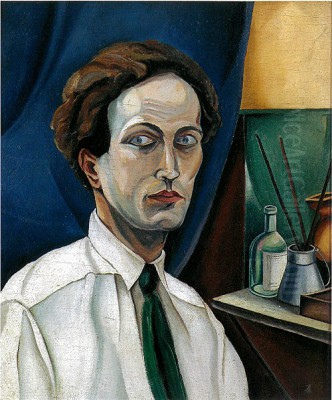
Renato Paresce stands as a significant, if sometimes overlooked, figure in the vibrant tapestry of early 20th-century European art. An Italian by birth, his artistic journey led him to the heart of the avant-garde, Paris, where he became a key member of the "Les Italiens de Paris" group. Active primarily during the 1920s and 1930s until his untimely death in 1937, Paresce's oeuvre reflects a fascinating synthesis of Italian sensibilities and the innovative currents тогда sweeping through the French capital. His work, characterized by a distinctive use of color and a thoughtful engagement with form and reality, contributed to the dialogue that sought to integrate Italian modern art into the broader international art scene.
Early Life and Artistic Awakening in Rome
Born in Rome in 1886, Renato Paresce's early environment, though not directly artistic in a formal sense, likely sowed seeds of creativity. The provided information notes his father was a carpenter, and young Renato showed an early aptitude and interest in craftsmanship and the applied arts. This foundational experience with materials and construction could have subtly informed his later approach to the plastic arts, instilling a respect for technique and the tangible qualities of the artwork.
While details of his formal artistic training in Italy are not extensively covered in the initial information, his emergence as an artist coincided with a period of immense cultural ferment in Italy. The nation was grappling with its rich artistic heritage while simultaneously seeking a modern voice, a tension exemplified by movements like Futurism, spearheaded by artists such as Umberto Boccioni, Carlo Carrà, and Giacomo Balla, which aggressively sought to break from the past. Though Paresce's style would diverge significantly from Futurist dynamism, the era's spirit of artistic exploration undoubtedly formed part of his formative context.
The Parisian Sojourn: "Les Italiens de Paris"
The allure of Paris, then the undisputed center of the Western art world, drew countless artists from across the globe, and Renato Paresce was among them. It was in Paris that he truly came into his own, becoming an integral part of a collective known as "Les Italiens de Paris" (The Italians in Paris). This group, active particularly between 1928 and 1933, was not a formal movement with a rigid manifesto but rather an association of Italian artists who, while retaining their individual styles, shared a common goal: to assert a modern Italian presence on the international stage.
Key figures in this circle, alongside Paresce, included Mario Tozzi, whose work often displayed a serene, classical monumentality; the celebrated Giorgio de Chirico, founder of Metaphysical Painting, and his brother Alberto Savinio, a multifaceted talent excelling as a painter, writer, and composer. Massimo Campigli, known for his figures reminiscent of Etruscan frescoes, and Filippo de Pisis, whose paintings were characterized by a light, almost fleeting touch and atmospheric sensitivity, were also prominent members. The group also had connections with Gino Severini, an artist who had earlier been a key signatory of the Futurist manifestos but whose style evolved considerably during his time in Paris.
These artists, including Paresce, actively sought to integrate Italian modern art into the Parisian art scene. They organized a series of exhibitions, particularly between 1928 and 1933, which garnered the support of influential contemporary critics like Waldemar George (referred to as Walter George in the source) and prominent gallery owners such as Léonce Rosenberg (possibly the "Raymond Lonce" mentioned, as Rosenberg was a major dealer). These exhibitions were crucial platforms for showcasing their work and fostering a dialogue with the Parisian avant-garde, which included luminaries like Pablo Picasso, Henri Matisse, and Georges Braque, whose revolutionary approaches to form and color were reshaping artistic practice.
Artistic Style: A Synthesis of Influences
Renato Paresce's artistic style is described as a compelling fusion, drawing from various sources yet achieving a personal synthesis. A significant influence noted is that of his compatriot Amedeo Modigliani. Modigliani, who had tragically died in 1920, left an indelible mark with his elegant, elongated figures and portraits that combined classical grace with a profound modern sensibility. Paresce's work, particularly in its figuration and a certain lyrical quality, may echo Modigliani's introspective humanism.
Furthermore, Paresce's art demonstrates a keen engagement with French Impressionism, especially in his approach to color. The Impressionists, such as Claude Monet and Camille Pissarro, had revolutionized painting with their emphasis on capturing the fleeting effects of light and atmosphere through broken brushwork and a brightened palette. Paresce seems to have absorbed these lessons, developing a "strong color revolution理念" (a concept of a strong color revolution). He even advocated for European filmmakers to adopt such revolutionary color techniques to compete with Hollywood, indicating a belief in the expressive power and modernity of vibrant, perhaps non-naturalistic, color.
His style also incorporated elements that could be loosely termed "Surrealist," or at least reflective of a reality imbued with a sense of mystery or deeper meaning, akin to the Metaphysical Painting of de Chirico and Savinio. This is evident in his "profound reflection on realism," suggesting his work was not merely a straightforward depiction of the visible world but an interpretation, a questioning, or an imbuing of reality with subjective or symbolic significance. This intellectual depth also manifested in his participation in art criticism and theoretical discussions, particularly concerning the complex relationship between art and reality.
Representative Works and Their Significance
Several key works by Renato Paresce are highlighted, offering glimpses into his artistic concerns and stylistic evolution across different media.
La finestra (The Window), 1926: Created during his Parisian period, La finestra is cited as a representative piece. The theme of the window is a recurring motif in art history, often symbolizing a threshold between interior and exterior worlds, the subjective and the objective, or the known and the unknown. Without a visual, one can speculate that Paresce might have used this theme to explore his characteristic concerns with light, color, and the nuanced representation of reality, perhaps framing a Parisian scene or an intimate interior with a view beyond.
La statua (The Statue), 1931: This watercolor painting is particularly noted for reflecting Paresce's "profound understanding of sculpture and painting" and his "fusion of realism and symbolism." The choice of a statue as a subject is inherently rich; it is an artwork depicting an artwork, allowing for commentary on mimesis, permanence, and the nature of representation itself. The description suggests that Paresce didn't just render a statue realistically but imbued it with symbolic weight, perhaps exploring themes of memory, the ideal, or the passage of time. The medium of watercolor, often prized for its translucency and immediacy, would have offered a different set of expressive possibilities compared to oil.
Paesaggio (Landscape), 1943: This oil painting, created later in his active period, demonstrates his continued engagement with landscape painting. The description emphasizes his "unique perspective on natural landscapes" and his "profound understanding of color and light." Landscape painting provided Paresce with a vehicle to explore atmospheric effects and the emotional resonance of color, likely pushing the boundaries of traditional representation towards a more expressive or abstracted vision of nature, consistent with his "color revolution" ideas.
Casa e barche (House and Boats), 1931: This work is mentioned in the context of its social impact. Its restoration and subsequent presentation, accompanied by cultural mediation, reportedly had a positive influence on inmates in a prison. This anecdote underscores a belief in the transformative power of art, its ability to communicate and resonate even in challenging social contexts, and speaks to Paresce's broader engagement beyond the purely aesthetic.
Exhibitions and Critical Reception
Renato Paresce was not an isolated artist; he actively participated in the exhibition culture of his time, which was crucial for an artist's visibility and career development. His involvement with "Les Italiens de Paris" naturally led to participation in their group shows in Paris between 1928 and 1933. These exhibitions were vital for establishing their collective identity and for engaging with the Parisian art world.
A particularly significant event was his involvement in the "Scuola di Parigi" (School of Paris) exhibition, organized by the influential Italian art critic and patron Margherita Sarfatti. Sarfatti was a complex figure, also known for her association with the Novecento Italiano movement, which advocated for a "return to order" and a revival of classical Italian artistic traditions in a modern context. Her organization of a "Scuola di Parigi" exhibition featuring Italian artists like Paresce aimed to showcase the unique contributions of Italian modern art on an international stage, linking it with broader European currents while asserting its distinctiveness. This exhibition would have placed Paresce's work in dialogue with other artists associated with the diverse and international milieu of the School of Paris, which included figures like Marc Chagall, Chaïm Soutine, Moïse Kisling, and Jules Pascin, among many others.
The support of critics like Waldemar George and gallerists such as Léonce Rosenberg was instrumental. George, in particular, championed "Les Italiens de Paris," providing intellectual framing for their work and helping to introduce them to a wider audience. Such critical and commercial backing was essential for artists seeking to establish themselves in the competitive Parisian environment. Paresce's participation in the Venice Biennale, one of the most prestigious international art exhibitions, further solidified his standing and demonstrated the reach of his reputation beyond Paris.
Collaborations, Connections, and Artistic Dialogue
The artistic life of Renato Paresce was deeply intertwined with those of his contemporaries, characterized more by collaboration and mutual influence than by overt competition. His association with "Les Italiens de Paris" was foundational. The regular exhibitions and shared artistic goals fostered a sense of camaraderie and collective purpose among members like Mario Tozzi, Giorgio de Chirico, Alberto Savinio, Massimo Campigli, and Filippo de Pisis. They were united in their endeavor to carve out a space for modern Italian art in Paris.
Beyond this core group, Paresce established "sincere friendships" with artists like Gino Severini and Massimo Campigli, indicating a supportive network where artistic ideas could be exchanged and developed. The influence was often mutual; while Paresce was influenced by figures like Modigliani, his own unique approach to color and form would have contributed to the ongoing artistic conversations of the time. The mention that his work might have been influenced by Mario Campigli (likely a typo for Massimo Campigli, given their close association) is framed as "mutual inspiration" rather than one-sided derivation, highlighting the reciprocal nature of artistic development within such circles.
His role sometimes extended to curatorial responsibilities, as seen in his involvement in organizing Italian art exhibitions, including aspects of the "Scuola di Parigi" initiative. This demonstrates a commitment not only to his own practice but also to the broader promotion of Italian modern art. His interactions were not limited to Italian artists; living and working in Paris meant inevitable contact and dialogue with the wider international avant-garde, including figures like Picasso, Matisse, and Braque, whose innovations were transforming the very language of art. While direct collaborations with these giants are not detailed, their presence and work formed the dynamic backdrop against which Paresce and his Italian colleagues operated. Other Italian modernists of the era, such as Giorgio Morandi, known for his subtle still lifes, also contributed to the rich landscape of Italian art, even if their paths did not directly intersect with Paresce's Parisian group in the same way.
Artistic Philosophy, Critical Voice, and Social Engagement
Renato Paresce was not merely a painter; he was an artist who engaged intellectually with the theories and debates of his time. His "profound reflection on the relationship between art and reality" suggests a philosophical underpinning to his work. He didn't just depict the world; he interrogated its appearance and the means by which art could represent or reinterpret it. This intellectual curiosity extended to art criticism and theoretical discussions, positioning him as an active participant in shaping the discourse around modern art.
His advocacy for a "color revolution," urging European filmmakers to adopt bold color strategies, reveals a forward-thinking perspective and a belief in the cross-pollination of ideas between different artistic media. It suggests an understanding of color not just as a descriptive tool but as an autonomous expressive force capable of conveying emotion and challenging conventional perception. This aligns with broader modernist explorations of color seen in Fauvism (e.g., Matisse, André Derain) and German Expressionism.
The anecdote concerning his painting Casa e barche (1931) and its positive impact on prison inmates through a program of restoration and cultural mediation highlights a dimension of social engagement. It suggests that Paresce, or at least his work, was seen as capable of transcending the confines of the art gallery to touch lives in more direct and socially meaningful ways. This resonates with a broader, albeit not always central, modernist concern with art's potential role in society and its capacity for human connection and even rehabilitation.
Legacy and Influence
Renato Paresce's career, though tragically cut short by his death in 1937, left a notable mark on the landscape of Italian modern art and its presence in the international arena. As a key member of "Les Italiens de Paris," he played an important role in asserting an Italian voice within the Parisian avant-garde, demonstrating that Italian artists could engage with international modernism while retaining a distinct cultural identity.
His artistic style, with its synthesis of influences ranging from Modigliani to French Impressionism, coupled with his innovative approach to color and his thoughtful exploration of form and reality, contributed to the diversity of modernist expression. His works, such as La finestra, La statua, and Paesaggio, stand as testaments to his unique vision.
Through his participation in significant exhibitions, including those organized by "Les Italiens de Paris," the "Scuola di Parigi" shows, and the Venice Biennale, Paresce helped to promote Italian modern art to a wider audience. His collaborations and friendships with fellow artists, and his engagement with critics and gallerists, were integral to this process. While perhaps not as globally renowned today as some of his contemporaries like de Chirico or Modigliani, Renato Paresce's contribution remains significant for understanding the dynamics of artistic exchange and identity formation in the crucial interwar period. His work continues to be valued for its aesthetic quality and its historical importance as part of a vibrant chapter in European art history, where Italian artists navigated tradition and modernity on the world's most dynamic artistic stage.