Abraham Pether, an English landscape painter born in Chichester in 1756, carved a unique niche for himself in the annals of British art history. Renowned primarily for his evocative depictions of moonlight scenes, he earned the affectionate moniker "Moonlight Pether." His life, spanning a period of significant artistic and scientific change, was marked by extraordinary talent, diverse interests, and ultimately, poignant hardship. He navigated the burgeoning London art scene, exhibited widely, and left behind a body of work that continues to fascinate viewers with its atmospheric beauty and technical skill, even as his personal story reflects the often-precarious existence of artists in the late Georgian era.
Early Life and Artistic Awakening
Born into a family with artistic connections – his cousin was the notable mezzotint engraver and miniaturist William Pether – Abraham Pether displayed remarkable precocity from a young age. However, his initial talents lay not in the visual arts, but in music. By the tender age of nine, he was already accomplished enough to serve as an organist in one of Chichester's churches, a testament to his innate abilities and dedication. This early exposure to the structures and harmonies of music may well have subtly influenced his later approach to composition and mood in his paintings.
Despite his musical promise, the lure of visual art proved stronger. He became a pupil of George Smith of Chichester, one of three brothers (George, William, and John Smith) who were respected landscape painters in their own right. Under Smith's tutelage, Pether honed his skills in landscape depiction. However, sources suggest that Pether's natural talent was such that he quickly absorbed his master's teachings and soon surpassed him in skill and originality, embarking on his own distinct artistic path. His relationship with his cousin William Pether also likely provided artistic stimulation and connection to the wider London art world.
The Signature Style: Capturing the Lunar Glow
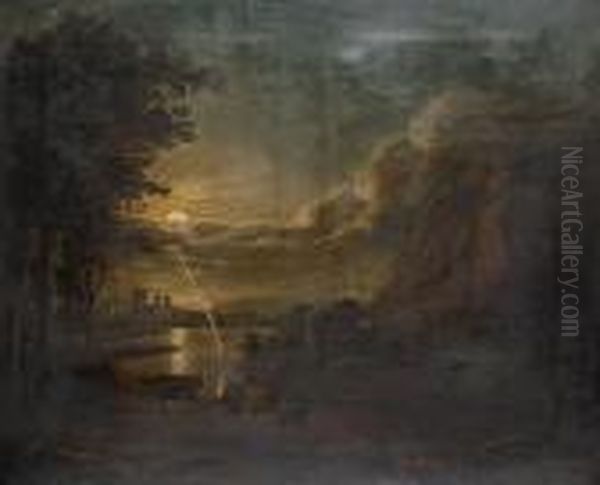
Pether's artistic identity became inextricably linked with his mastery of nocturnal scenes, particularly those illuminated by moonlight. While he painted a variety of landscapes, including river and mountain views often imbued with a sense of the picturesque, it was his moonlit canvases that captured the public imagination. He developed a distinctive technique for rendering the soft, ethereal glow of the moon, often reflecting it delicately upon the surface of water, creating scenes of tranquil beauty and sometimes, dramatic tension.
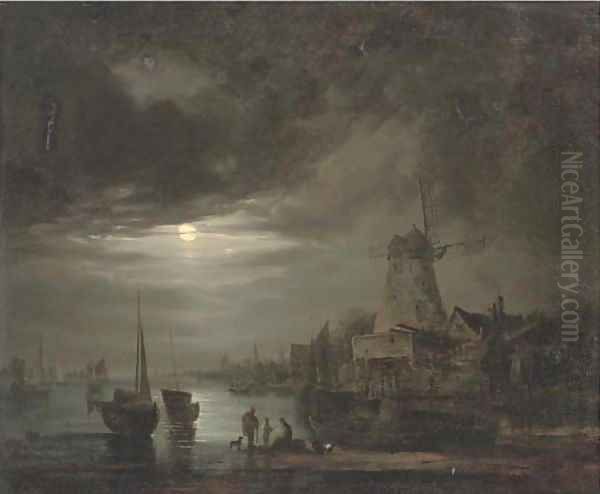
His style, while aiming for a naturalistic effect, was noted by some contemporaries as having a pleasing, if slightly "artificial," quality. This might refer to a certain smoothness or idealization in his compositions, perhaps influenced by classical landscape traditions or the desire to create a harmonious, aesthetically pleasing image. There are clear echoes of the Dutch Golden Age masters, particularly artists like Aert van der Neer, who specialized in nocturnal and winter landscapes, evident in Pether's handling of light and atmosphere. Yet, Pether's work remains distinctly British, reflecting the growing Romantic sensibility of his time.
Themes of Nature, Ruin, and Drama
The subjects of Pether's paintings often revolved around the interplay of nature and human presence, frequently set under the enchanting veil of night. River landscapes, coastal scenes, and views featuring classical or ruined architecture were common motifs. His Moonlit Landscape, depicting a serene lake bordered by the evocative silhouette of a ruined abbey, perfectly encapsulates his interest in the picturesque – a popular aesthetic ideal emphasizing natural beauty combined with elements of decay and historical resonance, championed by figures like William Gilpin.
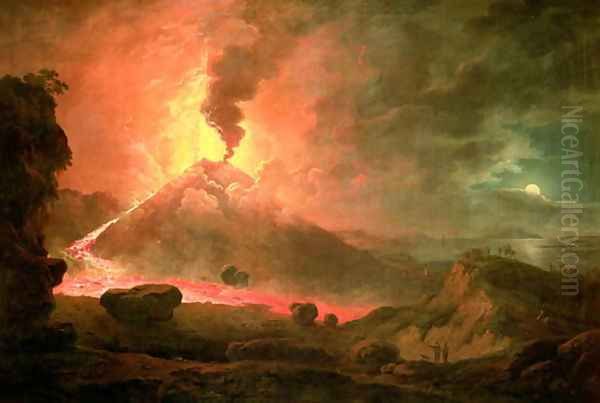
Beyond tranquil scenes, Pether also tackled more dramatic subjects, demonstrating his versatility. Works such as Eruption of Vesuvius and Shipwreck in a Storm showcase his ability to harness the moonlight not just for serenity, but also to heighten the sense of drama and the sublime power of nature. These paintings, capturing moments of natural catastrophe under the cool gaze of the moon, further cemented his reputation as "Moonlight Pether" and aligned him with other artists exploring dramatic themes, such as Philippe Jacques de Loutherbourg, known for his spectacular disaster paintings.
Notable Works and Artistic Recognition
Several key works stand out in Abraham Pether's oeuvre. His depiction of the Old Drury Lane on fire, London 24 February 1809 is a significant piece, capturing a real and dramatic contemporary event. This painting has been exhibited in modern times, for instance, at London's Guildhall Art Gallery and more recently at GHT in Southampton, highlighting its historical and artistic importance. It demonstrates his ability to apply his signature nocturnal lighting effects to a scene of urban disaster, creating a powerful and memorable image.
Another work often mentioned is Harvest Moon, which is particularly interesting as it reflects Pether's scientific interests, reportedly showcasing an accurate depiction of lunar phenomena. A painting titled Rocky landscape with cattle and sheep provides a glimpse into the contemporary art market; it was sold for a respectable sum (£17 17s) at the auction of the collector William Esdaile's estate in 1838, indicating that his work commanded value, even if it didn't secure his long-term financial stability. These examples illustrate the range of his landscape subjects, from tranquil pastorals to dramatic events, all unified by his distinctive handling of light.
The Artist as Scientist and Inventor
Abraham Pether was a man of remarkably diverse talents, extending far beyond the canvas. He possessed a keen scientific mind and was deeply interested in mathematics, philosophy, and invention. This intellectual curiosity directly informed his artistic practice. Unsatisfied with merely imagining the lunar landscape, he reportedly constructed his own powerful telescopes to observe the moon directly, striving for greater accuracy in his painted depictions. This dedication to empirical observation lent a unique authenticity to his celestial renderings.
His inventive spirit didn't stop at optics. He is also credited with making microscopes and even conducting experiments with electricity, utilizing musical instruments he had adapted or built himself. This fusion of artistic sensitivity and scientific inquiry marks Pether as a fascinating figure of the Enlightenment era, where the boundaries between disciplines were often more fluid. His scientific pursuits were not mere hobbies; they were integrated into his worldview and, demonstrably, into his art, particularly in works requiring astronomical precision like Harvest Moon.
A Career in the London Art World
Pether actively participated in the London art scene throughout his career. He was a regular exhibitor at the prestigious Royal Academy of Arts, showcasing his works there frequently between 1784 and 1811. He was also associated with other exhibiting bodies, including the Free Society of Artists and the Incorporated Society of Artists, which were important platforms for artists outside the formal structure of the Academy. His consistent presence at these exhibitions indicates a degree of recognition and acceptance within the artistic community.
His works were appreciated by the public for their pleasing aesthetics and masterful depiction of moonlight. He was considered a principal member or exhibitor within the societies he joined. However, the art market of the time was competitive and often relied heavily on patronage, which Pether seems not to have secured consistently or lucratively. Despite his regular exhibitions and the apparent popularity of his specialized subject matter, his career illustrates the financial precariousness faced by many talented artists of the period.
Contemporaries, Influences, and Artistic Milieu
Abraham Pether operated within a rich artistic landscape. His primary teacher, George Smith of Chichester, and his cousin, William Pether, were immediate influences. He also clearly absorbed lessons from earlier Dutch masters like Aert van der Neer. Furthermore, the influence of the great Welsh landscape painter Richard Wilson, a pioneer of classical landscape in Britain, can be discerned, perhaps in Pether's compositional structures and idealized approach to nature.
He was a contemporary of major figures who were reshaping British art. While perhaps not directly interacting with all of them, his career overlapped with landscape painters like Thomas Gainsborough, whose naturalistic landscapes were highly influential, and topographical artists like Paul Sandby. He worked during the period when Joseph Wright of Derby was also exploring dramatic effects of light, albeit often focusing on industrial scenes and scientific experiments alongside moonlight. The younger generation, including the revolutionary talents of J.M.W. Turner and John Constable, were beginning their careers towards the end of Pether's life, ushering in a new era of landscape painting that would eventually eclipse the quieter charm of Pether's style.
The Pether Artistic Legacy: A Family Affair
Abraham Pether's artistic inclinations extended to the next generation. He married Elizabeth, and together they had a large family, reportedly nine children. Among them, at least two sons, Sebastian Pether (1790–1844) and Henry Pether (fl. 1828–1865), followed in their father's footsteps, becoming painters in their own right. They too specialized in landscapes, particularly moonlight scenes, carrying on the family tradition.
This continuation led to the collective reference of the "Moonlight Pether family." While inheriting their father's thematic preference, Sebastian and Henry developed their own variations on the style. Sebastian, in particular, gained recognition for his moonlit views, often featuring rivers or coastal scenes, though like his father, he also faced significant financial struggles throughout his life. Henry's work is perhaps less well-known but also focused on similar nocturnal and topographical subjects. Their careers underscore the strong artistic current within the Pether family, centered around the evocative power of the moonlit landscape.
Later Life: Talent Amidst Hardship
Despite his considerable talents, his multi-faceted intellect, and consistent exhibition record, Abraham Pether's later life was overshadowed by financial difficulties. The income generated from his paintings, though appreciated, proved insufficient to support his large family adequately. The reasons for this are complex, likely involving the lack of sustained, high-level patronage, the changing tastes of the art market, and perhaps challenges in self-promotion or business acumen.
His situation reflects a common narrative for artists of the era: talent did not always translate into financial security. Many artists relied on teaching, commissions, or the favour of wealthy patrons to survive. Pether's inability to secure a comfortable living led to increasing poverty in his final years. He passed away in Southampton on April 2, 1812, leaving his wife Elizabeth and their children in challenging circumstances. His death in relative poverty stands in stark contrast to the enduring appeal and quiet beauty of the moonlit worlds he created.
Enduring Legacy and Collections
Abraham Pether's primary legacy lies in his specialization and mastery of the moonlight scene within British landscape painting. He popularized the motif and developed a recognizable style characterized by soft light, atmospheric depth, and often picturesque or dramatic compositions. His nickname, "Moonlight Pether," has endured, signifying his unique contribution to the genre. Furthermore, his life story offers a fascinating glimpse into the intersection of art and science during the late 18th and early 19th centuries.
His works are held in various public collections, ensuring their accessibility for future generations. Notable institutions housing paintings by Abraham Pether include the Royal Academy of Arts in London, the Guildhall Art Gallery (London), the National Gallery (London), the City of London Museum, and the Yale Center for British Art in the United States, among others. The continued presence of his work in these collections, alongside occasional appearances in exhibitions and the art market, attests to his lasting, albeit specialized, significance in the history of British art. He remains a compelling figure, remembered for the ethereal beauty he captured under the soft glow of the moon.