Antonio Gianlisi il Giovane: A Lombard Master of Baroque Still Life
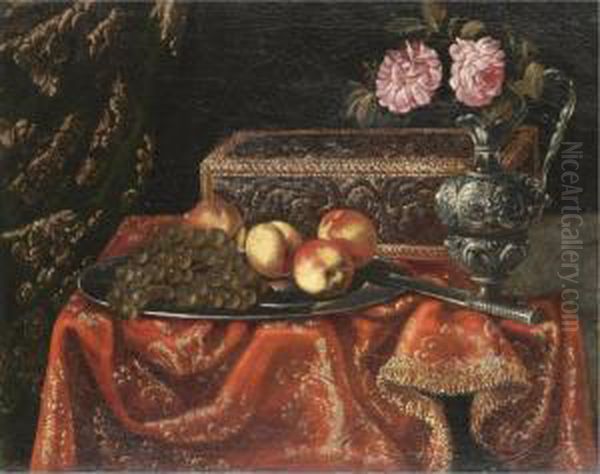
Antonio Gianlisi, known as "il Giovane" (the Younger) to distinguish him from other potential family members in artistic pursuits, was an Italian painter active during the late Baroque period. Born in the musically and artistically rich city of Cremona in 1677, he carved a niche for himself primarily as a painter of still lifes, a genre that had gained considerable traction and sophistication throughout the 17th century in Italy and across Europe. His lifespan, concluding in 1727, places him firmly within a vibrant era of Italian art, where regional schools flourished, each contributing unique characteristics to the broader Baroque movement. Gianlisi's work is particularly associated with the Lombard School, renowned for its commitment to naturalism and meticulous detail.
The Artistic Milieu of Cremona and Lombardy
Cremona, Gianlisi's birthplace, was not merely a provincial town; it was a significant cultural hub, especially famous for its unparalleled tradition of violin making, with families like Amati, Guarneri, and Stradivari elevating the craft to an art form. This environment, steeped in craftsmanship and an appreciation for tangible beauty, likely influenced young Gianlisi. The Lombard region, more broadly, had a strong artistic identity. Painters from this area often displayed a tendency towards a sober, direct form of realism, a legacy that can be traced back to earlier figures like Vincenzo Campi (c. 1530/35 – 1591), who, though active much earlier, contributed to a Lombard tradition of genre scenes and market paintings with abundant still-life elements.
By the 17th century, still life painting in Lombardy had developed distinct characteristics. Artists like Fede Galizia (1578–1630), one of the earliest Italian women to achieve international recognition as a painter, produced still lifes of remarkable clarity and simplicity, often featuring fruit in baskets. Her work predates Gianlisi but set a precedent for the focused observation of everyday objects. Later, and more contemporary to Gianlisi's formative years, Evaristo Baschenis (1617–1677) from Bergamo became celebrated for his extraordinary still lifes of musical instruments, rendered with astonishing precision and a profound understanding of form and texture. The works of Baschenis, often imbued with a quiet, melancholic atmosphere, are iconic of Lombard still life and undoubtedly formed part of the artistic landscape Gianlisi inherited.
Gianlisi's Stylistic Signature: Naturalism and Baroque Sensibilities
Antonio Gianlisi il Giovane's artistic output is characterized by a "naturalistic" approach. This term, in the context of Baroque art, doesn't imply photographic realism but rather a commitment to depicting subjects with a high degree of verisimilitude, capturing their textures, colors, and the play of light upon their surfaces. His paintings often feature carefully arranged compositions of fruits, flowers, and, notably, sumptuous fabrics and tapestries. These elements are rendered with a keen eye for detail, showcasing his technical skill in differentiating between the soft bloom on a grape, the delicate petals of a flower, and the rich sheen of silk or velvet.
While rooted in Lombard naturalism, Gianlisi's work also incorporates the decorative exuberance characteristic of the High Baroque. His compositions are often more elaborate and opulent than those of earlier Lombard still-life painters. The inclusion of ornate textiles, carpets, and curtains adds a theatrical quality to his scenes, creating a sense of richness and abundance that appealed to the tastes of his patrons. This fusion of detailed realism with decorative flair is a hallmark of his style. He masterfully balanced the tangible reality of the objects with an overall sense of elegance and visual pleasure.
Key Themes and Representative Works
Gianlisi's oeuvre primarily consists of still lifes, often set within interior contexts. These are not just random assortments of objects but carefully constructed scenes designed to delight the eye and showcase the painter's virtuosity.
One of his documented works is Pacche, tralcio d'uva e altri frutti (Pears, Grape Vine and Other Fruits). This title suggests a composition focused on the bounty of nature, a common theme in still life painting that could symbolize abundance, the transience of life (as fruit ripens and decays), or simply the pleasure of sensory experience. Such paintings would have been appreciated for their illusionistic qualities, making the painted fruit appear almost tangible. The dimensions cited for a work of this title, 77x64 cm, indicate a moderately sized canvas suitable for private collection.
Another notable work mentioned is Natura morta con fragole e arazzo (Still Life with Strawberries and Tapestry). Strawberries, with their vibrant red color and delicate texture, were a popular subject for still-life painters. The inclusion of a tapestry points to Gianlisi's interest in depicting luxurious textiles, allowing him to explore complex patterns, folds, and the interplay of light on different woven surfaces. This juxtaposition of natural elements (strawberries) with man-made luxury items (tapestry) creates a rich visual dialogue. The estimated value of such a piece (€4000-€5000 at auction) reflects a continued appreciation for his work in the art market.
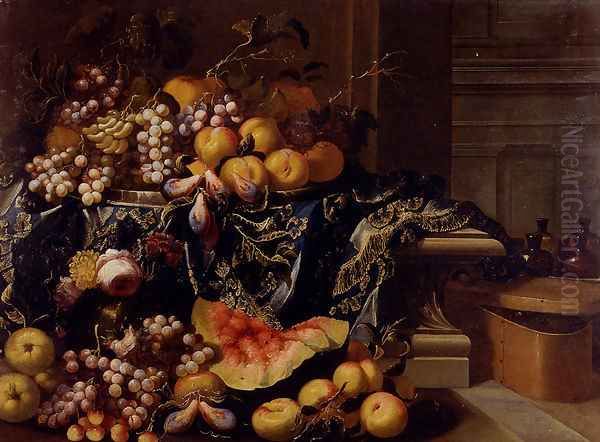
His paintings frequently feature musical instruments, a theme with particular resonance in Cremona. This interest connects him thematically to Evaristo Baschenis, though Gianlisi's approach might integrate these instruments into more lavishly decorated interior settings. The presence of lutes, violins, or guitars in his still lifes could allude to the harmony of the arts, the pleasures of culture, or serve as vanitas symbols, reminding viewers of the fleeting nature of worldly pleasures, including music.
Artistic Connections and Contemporaries
While direct master-pupil relationships or formal collaborations involving Gianlisi are not extensively documented, his work can be situated within a network of stylistic influences and regional schools. His connection to the Lombard School is paramount, with artists like the aforementioned Evaristo Baschenis and his pupil Bartolomeo Bettera (1639–c.1699), who continued the tradition of musical instrument still lifes, providing a clear local context.
The mention of a possible confusion with a Francesco Gianlisi suggests a familial connection or at least another artist of the same surname active in a similar field, a common occurrence in the workshop-based art world of the time. His style has also been compared to that of Francesco Zorzi (active late 17th–early 18th century), another North Italian still-life painter, indicating shared artistic concerns or regional trends.
Beyond Lombardy, the Italian peninsula was teeming with still-life painters during the Baroque era. In Naples, artists like Giuseppe Recco (1634–1695) and his family specialized in dramatic and richly painted still lifes, often featuring fish and other foodstuffs, executed with a robust naturalism. In Rome, Mario Nuzzi, also known as "Mario de' Fiori" (1603–1673), was highly celebrated for his lush and decorative flower paintings. Further north, in Florence, Giovanna Garzoni (1600–1670) produced exquisite still lifes in tempera on vellum, characterized by their delicate precision and scientific observation. While Gianlisi's style is distinctly Lombard, the broader Italian context shows a widespread fascination with the still-life genre, with artists exploring its potential for realism, symbolism, and decorative effect.
The influence of Flemish still life, with masters like Jan Brueghel the Elder (1568–1625) or Clara Peeters (1594–c.1657) who excelled in detailed and often opulent depictions of flowers, food, and precious objects, had also permeated Italian art, encouraging a high level of finish and illusionism. Gianlisi's attention to detail and texture aligns with this broader European trend.
The reference to Carlo Sferini of the Parma school in connection with musical themes suggests cross-regional artistic awareness. Parma, not far from Cremona, also had a rich artistic tradition. Artists like Cristoforo Munari (1667-1720), active in Reggio Emilia, Parma, Florence, and Rome, was another significant still-life painter contemporary with Gianlisi, known for his elaborate compositions featuring musical instruments, books, and tableware, often with a strong sense of trompe-l'oeil.
The "Naturalism" of Gianlisi in Baroque Context
The "naturalism" attributed to Gianlisi and the Lombard School deserves closer examination. It was not the stark, often gritty realism of Caravaggio (Michelangelo Merisi da Caravaggio, 1571–1610), whose revolutionary approach to light and subject matter had transformed Italian painting decades earlier. Rather, Lombard naturalism, by Gianlisi's time, was often a more polished and refined depiction of reality. It focused on the accurate rendering of surfaces, textures, and the effects of light to create a convincing illusion of the physical world. This was particularly suited to the still-life genre, where the artist's skill in mimicry (mimesis) was highly valued.
Gianlisi's compositions, while naturalistic in their individual elements, were also artfully constructed. The arrangements of fruit, flowers, and fabrics were not casual but carefully orchestrated to create harmonious designs, balanced colors, and engaging visual rhythms. The interplay of light and shadow (chiaroscuro), though perhaps not as dramatic as in Caravaggio's work, was crucial in defining form and creating a sense of depth and volume. This careful construction, combined with meticulous execution, resulted in paintings that were both believable and aesthetically pleasing.
The Role of Musical Instruments in Gianlisi's Art
The frequent appearance of musical instruments in Gianlisi's paintings is a significant aspect of his work, particularly given his Cremonese origins. Cremona was the world's epicenter for violin making, and instruments like lutes, guitars, and violins were not just objects of everyday life but also symbols of culture, refinement, and sometimes, as in vanitas paintings, the ephemeral nature of sound and pleasure.
In the tradition of Evaristo Baschenis, these instruments were often depicted with extraordinary care, their polished wood, strings, and intricate details rendered with loving precision. For Gianlisi, incorporating these instruments into his still lifes would have resonated with local pride and appealed to patrons who appreciated both music and painting. These depictions also allowed him to showcase his technical prowess in capturing complex forms and varied textures. The instruments could be part of a larger ensemble of objects signifying a cultured interior, or they could be the central focus, inviting contemplation on the relationship between the visual and auditory arts.
Scholarly Perspectives and Legacy
Despite his evident skill and the appeal of his works, Antonio Gianlisi il Giovane's position in art history has, according to some sources, been subject to debate or has not always received the scholarly attention of some of his more famous contemporaries. This is not uncommon for artists who specialized in still life, a genre that, despite its popularity, was sometimes ranked lower in the academic hierarchy of genres than history painting or portraiture.
The assertion that his identity and works have faced "controversy" or that some critics might have found his work lacking in "innovation" or "overly reliant on traditional styles" reflects the ongoing process of art historical evaluation. It's possible that his adherence to the established conventions of Lombard still life, combined with Baroque decorative trends, might have been seen by some later critics as less groundbreaking than the work of artists who more radically departed from tradition. However, working within established traditions and refining them with personal skill was a common and respected artistic practice during the Baroque period.
His recognition, particularly in Northern Italian art circles (Cremona and Romano are mentioned), and the continued presence of his works in auctions, attest to a lasting appreciation for his artistry. The valuation of his paintings indicates that collectors still find his detailed naturalism, rich compositions, and the sheer beauty of his depicted objects highly desirable.
Conclusion: Gianlisi's Enduring Contribution
Antonio Gianlisi il Giovane emerges as a skilled and sensitive practitioner of still-life painting in late 17th and early 18th-century Lombardy. His work successfully marries the region's tradition of meticulous naturalism with the opulent decorative tendencies of the High Baroque. Through his detailed renderings of fruits, flowers, luxurious fabrics, and musical instruments, he created images that delighted the senses and celebrated the beauty of both the natural and man-made worlds.
While perhaps not a revolutionary innovator in the mold of Caravaggio or a figure of the towering fame of some of his contemporaries in other genres, Gianlisi played an important role in the rich tapestry of Italian Baroque art. He represents the many talented artists who specialized in particular genres, achieving a high level of excellence and contributing to the distinct character of their regional schools. His paintings offer a window into the aesthetic tastes and cultural values of his time, and their enduring appeal lies in their technical mastery, their vibrant depiction of textures and light, and the timeless allure of the objects he chose to immortalize on canvas. His work stands as a testament to the enduring power of still life to capture not just the appearance of things, but also a sense of their presence and the rich web of meanings they can evoke. Artists like Gianlisi, Paolo Porpora (1617-1673/75) with his Neapolitan flair for flowers and undergrowth, or even the earlier Flemish pioneer Osias Beert the Elder (c. 1580–1623) whose meticulous tabletop scenes set a high bar, all contributed to the diverse and fascinating world of still life painting that Gianlisi inhabited and enriched.