Panfilo Nuvolone (1581–1651) stands as a significant, if sometimes overlooked, figure in the rich tapestry of Italian art during the late 16th and early 17th centuries. An artist whose career bridged the waning years of Mannerism and the burgeoning dynamism of the Baroque, Nuvolone made his mark primarily as a painter of religious subjects and, perhaps more notably, as one of Lombardy's pioneering practitioners of still life painting. Born in Cremona and active in both his native city and Milan, his work reflects the artistic currents of his time while also showcasing a distinct personal sensibility, particularly in his meticulous and engaging depictions of fruit and everyday objects.
Early Life and Artistic Formation in Cremona
Panfilo Nuvolone was born in Cremona, a city with a distinguished artistic heritage, in 1581. Cremona, during the 16th century, had been a vibrant center of painting, home to families of artists like the Campi (Giulio, Antonio, and Vincenzo Campi) who had cultivated a style known for its naturalism and rich color, often seen as a precursor to the Baroque. Sofonisba Anguissola, one of the most renowned female artists of the Renaissance, also hailed from Cremona, further cementing the city's artistic reputation. It was within this environment that Nuvolone likely received his initial exposure to art.
His formal training is recorded as being under Giovanni Battista Trotti, known as "Il Malosso" (1555–1619). Trotti was a prominent Cremonese painter, himself a product of the late Mannerist school, influenced by artists like Bernardino Campi. Under Trotti, Nuvolone would have been schooled in the principles of disegno (drawing and design) and colore (color), fundamental to Italian artistic practice. Trotti's own work, characterized by elongated figures, complex compositions, and a somewhat artificial elegance typical of late Mannerism, would have provided Nuvolone's foundational style. This apprenticeship shaped Nuvolone's early approach to religious compositions, which often retained a degree of Mannerist formality.
The artistic atmosphere of Cremona, and Lombardy in general, was also beginning to feel the tremors of change. The revolutionary naturalism of Michelangelo Merisi da Caravaggio, who had Lombard roots and whose early works were already causing a stir, was starting to permeate the artistic consciousness, advocating for a more direct and emotionally resonant depiction of reality. While Nuvolone's early work remained largely within the Mannerist framework of his master, the seeds of a new sensibility were being sown in the region.
The Artistic Milieu of Lombardy: Transition and Innovation
The period of Panfilo Nuvolone's activity, spanning the late 16th and the first half of the 17th century, was a time of profound artistic transition in Lombardy. Milan, the dominant city in the region, was a hub of artistic activity, influenced by the Counter-Reformation's call for art that was clear, persuasive, and emotionally engaging for the faithful. This spurred a move away from the more intellectualized and often obscure allegories of High Mannerism towards a more direct and dramatic style that would characterize the Baroque.
Key figures in Milanese painting during this era included Giovanni Battista Crespi, known as "Il Cerano" (c. 1573–1632), Giulio Cesare Procaccini (1574–1625), and Pier Francesco Mazzucchelli, called "Il Morazzone" (1573–1626). These artists, often referred to as the "Milanese Pesten" (plague saints, due to their works during plague outbreaks), were instrumental in forging a distinctive Lombard Baroque style, marked by intense emotion, dramatic lighting, and rich, often somber, color palettes. While Nuvolone was perhaps not as central to this Milanese triumvirate, he operated within this evolving artistic landscape, and his work, particularly his religious paintings, shows an awareness of these trends.
The influence of earlier Lombard masters, such as Leonardo da Vinci and his Milanese followers (the Leonardeschi), continued to resonate, particularly in the sfumato and psychological depth found in some regional art. Furthermore, the proximity to Venice meant that the Venetian emphasis on color and light also played a role in shaping Lombard aesthetics. Nuvolone, working between Cremona and Milan, was thus exposed to a complex interplay of established traditions and innovative impulses.
Religious Commissions and Fresco Work
Like most painters of his era, Panfilo Nuvolone dedicated a significant portion of his output to religious subjects. These commissions came from churches, religious orders, and private patrons, and often took the form of altarpieces, devotional paintings, and frescoes. His training under Il Malosso equipped him with the skills necessary for large-scale narrative compositions.
Among his documented religious works are frescoes. For instance, he is known to have painted frescoes in the Milanese church of Santa Maria della Passione, including a "Coronation of the Virgin" and an "Annunciation of the Death of the Virgin." Fresco painting required speed and confidence, as the artist worked on wet plaster, and Nuvolone's involvement in such projects indicates his established reputation. Other religious paintings attributed to him include works like "The Assumption of the Virgin" and various depictions of the "Madonna and Child."
Stylistically, Nuvolone's religious paintings often exhibit a blend of late Mannerist conventions and emerging Baroque sensibilities. The compositions can sometimes appear somewhat rigid or crowded, a characteristic inherited from Mannerism, with elongated figures and stylized gestures. However, there is also an attempt at greater naturalism and emotional expression, particularly in the rendering of faces and the use of light and shadow, which points towards the newer Baroque aesthetic. His color palette, while sometimes adhering to the brighter, more varied hues of Mannerism, could also adopt the more dramatic chiaroscuro (strong contrasts between light and dark) that was becoming fashionable, partly due to the pervasive influence of Caravaggio.
While his religious works were competent and fulfilled the devotional needs of his patrons, it is in another genre that Panfilo Nuvolone arguably made his most distinctive and lasting contribution: still life.
The Emergence of Still Life as an Independent Genre
The late 16th and early 17th centuries witnessed the rise of still life painting as an independent genre across Europe, and Italy was no exception. Previously, depictions of inanimate objects—flowers, fruit, tableware, books—had typically been subsidiary elements within larger religious or mythological scenes, often carrying symbolic meaning. However, artists began to explore these objects for their own sake, appreciating their formal qualities, textures, and the play of light upon their surfaces.
Several factors contributed to this development. The burgeoning scientific interest of the age encouraged close observation of the natural world. The growing affluence of merchant classes and a more secular worldview created a market for new types of subject matter beyond traditional religious and historical themes. In Lombardy, artists like Vincenzo Campi had already included prominent still life elements in his market scenes and kitchen interiors in the late 16th century, blurring the lines between genre painting and still life.
Caravaggio's famous "Basket of Fruit" (c. 1599, Pinacoteca Ambrosiana, Milan) is often cited as a seminal work in the history of Italian still life, showcasing an unidealized, strikingly realistic depiction of fruit, complete with imperfections. This work, housed in Milan, would have been accessible and undoubtedly influential on Lombard artists. Another key early figure in Italian still life was Fede Galizia (1578–1630), a Milanese contemporary of Nuvolone, who was producing exquisite and focused still life compositions of fruit and flowers from the early 1600s.
Panfilo Nuvolone's Pioneering Role in Lombard Still Life
It is within this context of burgeoning interest that Panfilo Nuvolone emerged as one of the earliest specialists in still life painting in Lombardy. His still lifes, primarily focusing on fruit, are characterized by their careful arrangement, meticulous detail, and a tangible sense of presence.
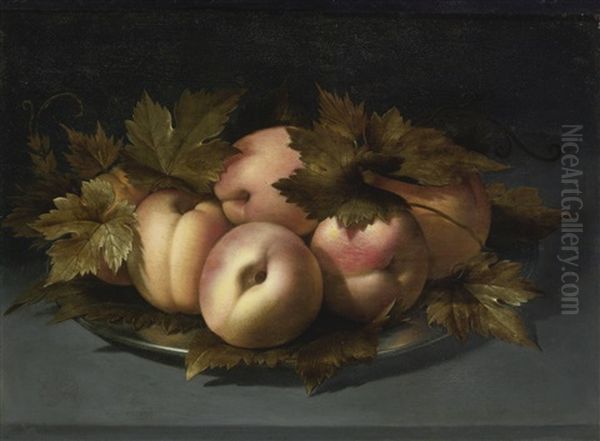
One of his most recognized works in this genre is the "Still-Life of Peaches on a Pewter Plate" (or similar titles for various versions). These compositions typically feature a selection of fruit—often peaches, plums, grapes, or figs—arranged in a bowl, on a plate, or directly on a stone ledge. Nuvolone paid close attention to the textures of the fruit, capturing the velvety skin of peaches, the translucent sheen of grapes, and the delicate bloom on plums. His lighting is often direct, illuminating the objects against a dark, undefined background, which enhances their three-dimensionality and creates a sense of quiet drama. This use of chiaroscuro echoes Caravaggesque principles, even if Nuvolone's overall mood is often less stark and more decorative.
His "Bowl of Peaches" is another notable example, often compared to the work of Fede Galizia and even Caravaggio in its directness and focus. Nuvolone's arrangements are typically simple and symmetrical, often featuring a central bowl or dish laden with fruit. He sometimes included leaves or small insects, details that added to the naturalism and perhaps carried vanitas symbolism (reminders of the transience of life and earthly pleasures). The cool, metallic sheen of pewter plates or the rustic texture of ceramic bowls are rendered with equal care, providing a contrast to the softness and ripeness of the fruit.
Compared to Fede Galizia, whose still lifes are often characterized by a crystalline clarity, a more formal, almost iconic presentation, and a delicate, precise touch, Nuvolone's approach can seem slightly more robust and painterly. While both artists shared an interest in the faithful depiction of natural objects, their individual temperaments led to subtle differences in style and mood. Nuvolone's still lifes often possess a certain earthy abundance, a celebration of nature's bounty that is both visually appealing and technically accomplished.
Ambrogio Figino (1553–1608), another Milanese artist, also produced notable early still lifes, particularly a "Pewter Plate with Peaches and Vine Leaves" which predates or is contemporary with the earliest works of Galizia and Nuvolone, indicating a shared regional interest in this subject matter. The interplay and potential mutual influence among these Lombard pioneers—Figino, Galizia, and Nuvolone—are subjects of ongoing art historical discussion.
Interactions and Influences: A Network of Artists
Panfilo Nuvolone did not work in isolation. The artistic communities of Cremona and Milan were relatively close-knit, and artists would have been aware of each other's work through direct contact, shared patrons, or the circulation of prints and drawings.
His relationship with Fede Galizia is particularly noteworthy. Both were among the earliest Italian artists to specialize in still life, and their works share certain thematic and compositional similarities. It is likely they knew each other's paintings, and there may have been a degree of mutual influence or friendly rivalry as they explored this new genre. Both artists contributed significantly to establishing still life as a respected form of painting in Lombardy.
The pervasive influence of Caravaggio, though perhaps indirect, is also evident. Caravaggio's revolutionary naturalism and dramatic use of light had a profound impact on Italian art, and his early still life elements, as seen in paintings like "Bacchus" or the aforementioned "Basket of Fruit," provided a powerful model for subsequent artists. Nuvolone's adoption of strong chiaroscuro and his focus on the unidealized reality of his subjects align with Caravaggesque tendencies.
Giovanna Garzoni (1600–1670), a renowned female painter specializing in still lifes, particularly miniatures on vellum, was also active during part of Nuvolone's career. While her delicate and highly detailed style differed from Nuvolone's oil paintings, her presence in cities like Venice, Florence, Rome, and Naples, and her connections to prominent patrons, contributed to the growing prestige of still life painting. It's plausible that Nuvolone was aware of her work, especially as the genre gained popularity.
Nuvolone's teacher, Giovanni Battista Trotti, provided his initial artistic grounding. While Nuvolone moved beyond Trotti's late Mannerist style, particularly in his still lifes, the foundational skills in drawing and composition learned in Trotti's workshop remained crucial throughout his career.
The Nuvolone Family Workshop: A Legacy Continued
Panfilo Nuvolone was the patriarch of an artistic family. He had at least two sons who also became painters, carrying on the family trade: Carlo Francesco Nuvolone (1609–1662) and Giuseppe Nuvolone (1619–1703).
Carlo Francesco Nuvolone became the more famous of the two sons. He initially trained with his father but later studied at the prestigious Accademia Ambrosiana in Milan under Giovanni Battista Crespi (Il Cerano). His style evolved significantly from his father's, becoming softer, more sensuous, and imbued with a lyrical grace that drew comparisons to artists like Guido Reni and Correggio. Carlo Francesco achieved considerable success, particularly with his religious and mythological paintings, characterized by their delicate sfumato, sweet facial types, and elegant compositions. He became one of the leading painters in Milan in the mid-17th century, representing a more classical and refined strand of Lombard Baroque.
Giuseppe Nuvolone, also known as Panfilo the Younger by some sources to distinguish him from his father, worked in a style closer to his brother Carlo Francesco, often collaborating with him on large-scale decorative projects. He too focused on religious and historical subjects, contributing to the family's artistic output and reputation.
The existence of a Nuvolone family workshop, with Panfilo as its founder and his sons continuing the tradition, was typical of artistic practice at the time. Such workshops allowed for the efficient production of artworks, the training of apprentices, and the transmission of artistic knowledge and styles across generations. While Carlo Francesco developed a distinct artistic personality, the initial influence of his father, Panfilo, particularly in the fundamentals of painting, would have been formative.
Style, Technique, and Artistic Evolution
Panfilo Nuvolone's artistic style evolved over his career, reflecting both his training and the changing artistic currents of his time. His early religious works bear the hallmarks of late Mannerism, learned from Il Malosso: elongated figures, somewhat artificial poses, and complex, often crowded compositions. The color palette in these works could be bright and varied.
As he matured, and as Baroque aesthetics gained traction, his religious paintings began to incorporate greater naturalism, more dynamic compositions, and a more dramatic use of light and shadow. There is a discernible move towards conveying more direct emotion, in line with Counter-Reformation ideals.
However, it is in his still lifes that Nuvolone's style is most distinctive and forward-looking. Here, he largely shed Mannerist conventions in favor of a direct, empirical observation of his subjects. His technique involved careful layering of paint to achieve realistic textures and a sense of volume. The use of strong chiaroscuro, with objects brightly lit against dark backgrounds, creates a sense of immediacy and focuses the viewer's attention on the tactile qualities of the fruit and other items. His compositions, though often simple, are carefully balanced, demonstrating a keen eye for arrangement and visual harmony. He showed a particular fondness for depicting peaches, capturing their fuzzy texture and subtle color variations with remarkable skill.
His contribution to still life lies not only in his early adoption of the genre but also in his ability to imbue these everyday objects with a sense of dignity and presence, elevating them beyond mere decoration to subjects worthy of serious artistic contemplation.
Legacy and Art Historical Significance
Panfilo Nuvolone's legacy is twofold. As a painter of religious subjects, he was a competent practitioner within the Lombard tradition, contributing to the decoration of churches and fulfilling the devotional needs of his patrons. His work in this area reflects the transition from Mannerism to the early Baroque in the region.
His more significant and lasting contribution, however, lies in his role as a pioneer of still life painting in Italy. Alongside Fede Galizia and Ambrogio Figino, Nuvolone helped to establish still life as a viable and respected independent genre in Lombardy. His focused, naturalistic depictions of fruit set a precedent for later still life painters and demonstrated the artistic potential of such humble subjects. His still lifes found favor with collectors and contributed to the growing appreciation for this type of painting.
While he may not have achieved the widespread fame of Caravaggio or the leading Milanese Baroque masters like Cerano or Procaccini, Panfilo Nuvolone played an important role in the artistic ecosystem of his time. He was a bridge figure, connecting the traditions of the late Renaissance with the innovations of the Baroque, and his dedication to still life helped to enrich the diversity of Italian painting.
His influence also extended through his sons, particularly Carlo Francesco, who became a major figure in Milanese art, ensuring that the Nuvolone name remained prominent in Lombard artistic circles for another generation. Today, Panfilo Nuvolone's works, especially his still lifes, are found in museums and private collections, valued for their historical importance as early examples of the genre and for their intrinsic artistic quality—their meticulous execution, appealing subject matter, and quiet, contemplative beauty. He remains a testament to the rich and varied artistic production of Lombardy during a pivotal period of transformation in Italian art. His dedication to capturing the simple beauty of nature's bounty provided a foundation upon which later generations of still life painters would build.