In the annals of nineteenth-century art, certain names resonate with immediate recognition—Monet, Degas, Renoir—figures who spearheaded revolutionary movements. Yet, beneath the glittering surface of Impressionism and Post-Impressionism lay a bedrock of academic tradition, a rigorous system of training that shaped generations of artists, including many who would later rebel against it. Central to this tradition, though often overlooked in popular art history, was Charles Bargue, a French painter and lithographer whose influence, particularly through his seminal drawing course, far outweighed his personal fame. His life, though not extensively documented, and his work, both as an independent artist and an educator, offer a fascinating glimpse into the meticulous world of academic art in a period of profound artistic change.
Early Life and Artistic Formation
Charles Bargue was born in Paris, a city then solidifying its status as the undisputed capital of the art world. While the exact year of his birth is subject to some minor scholarly debate, with most sources indicating 1826, some references suggest 1825. Regardless of this slight discrepancy, his formative years unfolded in an environment rich with artistic stimuli and established institutions. Like many aspiring artists of his time, Bargue sought formal training to hone his skills. He is known to have been a student of Jean-Léon Gérôme (1824-1904), one of the most prominent and successful academic painters of the era.
Gérôme was a towering figure in the French art establishment, a professor at the prestigious École des Beaux-Arts, and a master of historical, mythological, and Orientalist scenes, rendered with meticulous detail and a polished finish. The relationship between Bargue and Gérôme appears to have been more than a simple master-pupil dynamic; it evolved into a close collaboration, particularly in the realm of art education. It's also noted that Bargue received instruction from François-Édouard Picot (1786-1868) at the École des Beaux-Arts. Picot himself was a product of the Neoclassical tradition, having studied under Jacques-Louis David, linking Bargue to a lineage of rigorous classical training. This foundation in precise drawing and anatomical understanding would become a hallmark of Bargue's own work and pedagogical approach.
The Paris in which Bargue matured was a crucible of artistic ideas. The Académie des Beaux-Arts and its official Salon exhibitions still held considerable sway, championing historical subjects and a highly finished style. However, currents of change were palpable. The Realism of Gustave Courbet challenged academic idealism, while the Barbizon School, with artists like Jean-François Millet, Théodore Rousseau, and Jean-Baptiste-Camille Corot, brought a new focus to landscape and rural life, painted with a more direct observation of nature. Bargue's path would largely align with the academic tradition, yet his subject matter would occasionally touch upon the rustic themes gaining popularity.
The Monumental Cours de Dessin
Charles Bargue's most significant and enduring contribution to the art world was undoubtedly the Cours de Dessin (Drawing Course). Developed in collaboration with Jean-Léon Gérôme, this comprehensive set of lithographic plates was published by the influential art dealers and publishers Goupil & Cie between 1866 and 1871. The course consisted of 197 individual lithographs, meticulously drawn by Bargue himself, often based on casts of classical sculptures, drawings by Renaissance and contemporary masters, and, in its later stages, studies from live models.
The Cours de Dessin was designed as a systematic, progressive guide for art students. It began with studies of individual body parts drawn from plaster casts—eyes, noses, ears, hands, feet—gradually moving to full figures from classical antiquity, such as the Belvedere Torso or figures by Michelangelo and Raphael. The next stage involved copying drawings by established masters, allowing students to internalize principles of line, form, and shading. Finally, the course included plates of studies from the live nude model, representing the culmination of academic drawing practice.
The pedagogical philosophy underpinning the Cours de Dessin was rooted in the academic belief that mastery of drawing was the fundamental prerequisite for any aspiring painter or sculptor. It emphasized precise observation, accurate rendering of form through chiaroscuro (the use of light and shadow), and a thorough understanding of human anatomy. The lithographs themselves are masterpieces of draftsmanship, characterized by their clarity, subtlety of tone, and elegant line work. They provided students with exemplary models to emulate, fostering a disciplined approach to visual representation.
Impact and Enduring Influence of the Cours de Dessin
The Cours de Dessin achieved widespread adoption in art academies and private studios across Europe and America throughout the late nineteenth and early twentieth centuries. Its systematic approach and high-quality plates made it an invaluable teaching tool. Perhaps the most famous testament to its efficacy comes from Vincent van Gogh. During his early, self-taught period, Van Gogh painstakingly copied the entire set of Bargue plates, sometimes multiple times. In his letters to his brother Theo, Van Gogh repeatedly praised the course, writing in 1881, "I am very busy with Bargue’s ‘Cours de Dessin’... and am getting on well with it. If one really masters it, I say, one can draw anything." For Van Gogh, Bargue's exercises provided a crucial foundation in figure drawing and an understanding of form that he would later adapt to his own expressive style.
While the rise of Modernism in the early twentieth century led to a decline in the popularity of academic training methods, the Cours de Dessin never entirely faded from view. Even artists who would become pioneers of modern art, such as Pablo Picasso, underwent rigorous academic drawing instruction in their youth, likely encountering methods and models similar to those presented by Bargue. The principles of observational drawing and structural understanding embedded in the course remained relevant.
In more recent decades, there has been a significant resurgence of interest in classical realist art techniques, and with it, a renewed appreciation for Bargue's Cours de Dessin. Contemporary ateliers and art academies dedicated to teaching traditional drawing and painting skills often use reproductions of the Bargue plates as a core part of their curriculum. Artists and students today find the same value in its systematic approach that Van Gogh did over a century ago, recognizing it as an exceptional tool for developing fundamental drawing abilities. The course has been republished in book form, making it accessible to a new generation.
Bargue's Independent Artistic Oeuvre
Beyond his monumental contribution to art education, Charles Bargue was also an accomplished painter and lithographer in his own right, though his independent works are less widely known than the Cours de Dessin. His paintings reflect the meticulous skill and academic polish evident in his drawing plates. He worked primarily in oil and often favored genre scenes, historical subjects, and Orientalist themes, the latter undoubtedly influenced by his association with Gérôme, a leading exponent of Orientalism.
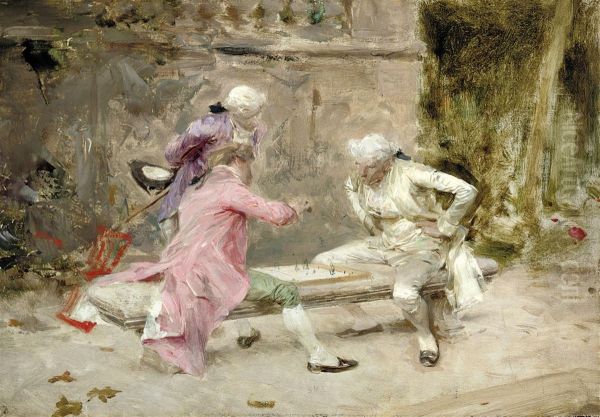
Orientalist painting, which depicted scenes from North Africa, the Middle East, and the Ottoman Empire, was immensely popular in nineteenth-century Europe, offering exotic and often romanticized visions of distant lands. Bargue's Orientalist works, such as The Turkish Sentinel or Playing Chess on the Terrace, are characterized by their fine detail, rich textures, and careful rendering of costumes and settings. These paintings demonstrate his mastery of composition, color, and the depiction of human figures in narrative contexts. He shared this thematic interest with other prominent artists of the time, such as Ludwig Deutsch and Rudolf Ernst, who also specialized in highly detailed Orientalist scenes, though earlier figures like Eugène Delacroix had approached similar subjects with a more Romantic and dynamic flair.
Bargue also produced paintings depicting scenes of everyday life and peasant figures, aligning him to some extent with the broader Realist interest in contemporary subjects, though his style remained more polished and academic than the rugged realism of Courbet or the empathetic portrayals of Millet. Works like An Albanian Guard or studies of figures in rustic settings showcase his ability to capture character and costume with precision. His lithographic work extended beyond the Cours de Dessin; for instance, his print Rustic Door and Stone Steps with Flowers and Weeds demonstrates a keen eye for detail and texture in a more humble, picturesque subject.
His paintings were exhibited at the Paris Salon, the official art exhibition of the Académie des Beaux-Arts, which was the primary venue for artists to gain recognition and patronage. While he may not have achieved the same level of fame as contemporaries like William-Adolphe Bouguereau or Alexandre Cabanel, whose grand mythological and historical paintings were highly celebrated, Bargue's work was respected for its technical proficiency and refined aesthetic.
Artistic Style and Characteristics
Charles Bargue's artistic style is firmly rooted in the academic tradition of nineteenth-century French art. His primary characteristic is an unwavering commitment to meticulous realism and technical precision. This is evident in both his drawings for the Cours de Dessin and his finished oil paintings.
Draftsmanship: Drawing was the cornerstone of his art. His lines are controlled, elegant, and descriptive, clearly defining forms and contours. He possessed an exceptional ability to render the subtle modulations of light and shadow (chiaroscuro) to create a convincing sense of three-dimensional volume. This is particularly apparent in the Bargue plates, where the forms of classical sculptures are rendered with almost sculptural solidity.
Detail and Finish: Bargue's paintings exhibit a high degree of finish, with smooth surfaces and carefully blended brushstrokes that conceal the artist's hand, a hallmark of academic painting often referred to as "fini." He paid close attention to the rendering of textures—the sheen of silk, the roughness of stone, the softness of skin—imbuing his scenes with a tangible reality.
Anatomical Accuracy: Reflecting his academic training and the emphasis of the Cours de Dessin, Bargue demonstrated a strong understanding of human anatomy. His figures are well-proportioned and convincingly structured, whether in classical poses or more relaxed, naturalistic stances.
Composition and Color: His compositions are generally balanced and harmonious, following classical principles. In his Orientalist paintings, he employed a rich and often vibrant palette, capturing the exotic colors of textiles, ceramics, and architectural details. However, his color choices always remained subservient to the clarity of form and the overall realism of the scene.
Influence of Classical Art: The inspiration drawn from classical Greek and Roman sculpture is evident, not just in the subject matter of many of the Cours de Dessin plates, but also in the idealized beauty and graceful poses of some of his figures. This classical underpinning provided a sense of order and timelessness to his work.
While his style was predominantly academic, Bargue was not immune to the broader artistic currents of his time. His genre scenes and depictions of peasant life show an interest in contemporary subjects, though rendered with academic polish rather than the more radical approaches of the Impressionists or Post-Impressionists who were beginning to emerge during the later part of his career. Artists like Edgar Degas or Mary Cassatt, for example, also possessed formidable drawing skills rooted in academic training but applied them to more modern subjects and compositions.
Later Life, Death, and Posthumous Reputation
Details about Charles Bargue's personal life remain relatively scarce. He appears to have dedicated himself primarily to his art and his teaching materials. He continued to work and live in Paris, the center of his artistic world. Charles Bargue passed away in Paris on April 6, 1883, at the age of 56 or 57. His death occurred at a time when the art world was undergoing significant transformations, with Impressionism having already made its controversial debut and new avant-garde movements on the horizon.
For much of the twentieth century, as Modernism became the dominant narrative in art history, academic artists like Bargue, and indeed Gérôme, were often relegated to the footnotes, their work sometimes dismissed as overly sentimental, derivative, or resistant to progress. The emphasis shifted towards artists who broke with tradition rather than those who upheld it. However, the Cours de Dessin quietly persisted, valued by those who sought a rigorous foundation in drawing, even if its author's name was not widely celebrated.
The late twentieth and early twenty-first centuries have witnessed a significant scholarly and popular reassessment of nineteenth-century academic art. Museums and art historians have begun to look more objectively at this period, recognizing the immense skill, intellectual depth, and cultural significance of artists who worked within the academic system. This revival of interest has brought figures like Bargue back into the spotlight, not only for his indispensable drawing course but also for his own accomplished paintings. His works now command respectable prices at auction, and he is recognized as a key figure in the transmission of classical drawing techniques. Artists like John Singer Sargent, who himself received rigorous Parisian academic training under Carolus-Duran, exemplify the sophisticated results that such foundational skills could produce, even when applied to a more painterly and modern sensibility.
Conclusion: A Legacy Cast in Line and Form
Charles Bargue's legacy is twofold. Firstly, and most prominently, he was the co-creator of one of the most influential drawing courses ever produced. The Cours de Dessin provided a clear, systematic pathway to mastering the fundamentals of academic draftsmanship, shaping the skills of countless students, including luminaries like Vincent van Gogh, and continues to serve as an invaluable resource for artists today. Its enduring relevance speaks to the timeless principles of observation, analysis, and rendering that it embodies.
Secondly, Bargue was a skilled and sensitive painter in his own right. His Orientalist scenes, genre paintings, and portraits demonstrate a refined aesthetic, technical brilliance, and a deep understanding of the academic tradition. While his painted oeuvre may be less extensive or revolutionary than that of some of his contemporaries, it stands as a testament to the beauty and precision achievable within the academic framework.
In a world that often prioritizes radical innovation, Charles Bargue reminds us of the profound value of discipline, tradition, and the patient cultivation of skill. He was a quiet master, whose primary contribution was to empower others with the foundational tools of artistic expression. His life and work offer a vital perspective on the richness of nineteenth-century art and the enduring importance of drawing as the bedrock of visual literacy and artistic creation. His influence, though sometimes subtle, is etched deeply into the history of art education, ensuring that the name Charles Bargue will continue to be respected by those who seek to understand and master the timeless art of drawing.