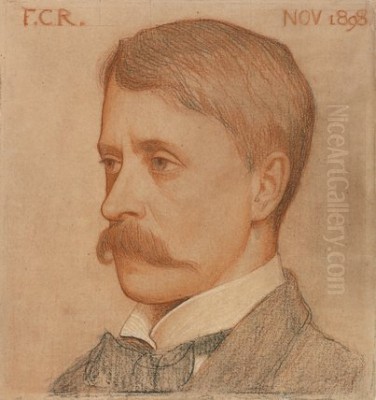
Frederick Cayley Robinson (1862-1927) stands as a distinctive, if sometimes overlooked, figure in the landscape of early 20th-century British art. A painter, decorator, and illustrator, he cultivated a unique visual language steeped in Symbolism, drawing inspiration from the Italian Renaissance masters and the quietude of contemporary French idealists. His works, often executed in the meticulous medium of tempera, evoke a world of serene mystery, spiritual contemplation, and timeless human drama. This exploration delves into the life, artistic achievements, influences, and enduring legacy of an artist whose quiet profundity continues to resonate.
Early Life and Artistic Awakening
Born in Brentford-on-Thames, Middlesex, on August 18, 1862, Frederick Cayley Robinson was the son of a stockbroker. His artistic inclinations were apparent early on, leading him to pursue formal training. He initially studied at the St John's Wood Academy and then at the prestigious Royal Academy Schools, beginning in 1885. These institutions would have provided him with a solid grounding in academic drawing and painting, a foundation upon which he would later build his more individualistic style.
His artistic education was not confined to Britain. Like many aspiring artists of his generation, Robinson sought further enrichment on the continent. He spent a significant period, from 1891 to 1894, in Paris, studying at the Académie Julian. This was a crucible of artistic innovation, where students from across the globe were exposed to a myriad of emerging styles, from Impressionism and Post-Impressionism to the burgeoning Symbolist movement. It was here that he likely first encountered the profound influence of Pierre Puvis de Chavannes, whose monumental, serene, and allegorical murals were highly esteemed.
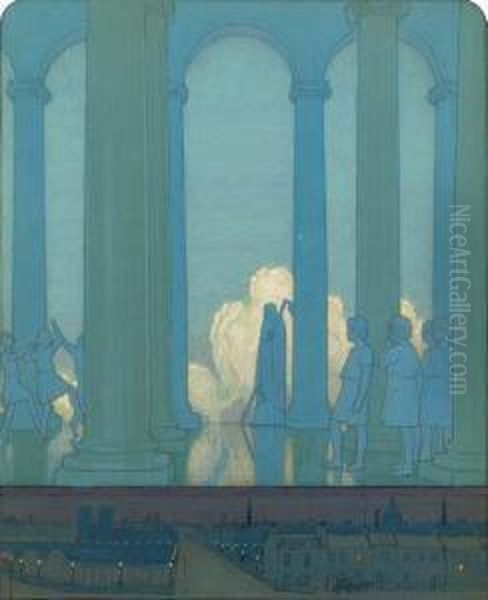
Following his Parisian sojourn, Robinson traveled to Italy, spending time in Florence. This immersion in the heart of the Renaissance was crucial. He dedicated himself to studying the techniques of the Old Masters, particularly the luminous qualities and precise application of tempera painting. Artists like Giotto di Bondone, with his narrative clarity and emotional depth, Andrea Mantegna, with his sculptural forms and mastery of perspective, and the divine Michelangelo, with his profound understanding of human anatomy and spiritual grandeur, left an indelible mark on Robinson's artistic consciousness. He was also drawn to the ethereal grace of Sandro Botticelli. This deep study of early Italian painting would inform his choice of medium and his approach to composition and surface quality throughout his career.
The Emergence of a Distinctive Style: Tempera and Symbolism
Cayley Robinson's mature style is characterized by a unique blend of meticulous technique, symbolic depth, and an atmosphere of profound stillness. His preference for tempera, a medium less common than oil painting at the time, was a deliberate choice. Tempera, made by mixing pigments with a water-soluble binder, typically egg yolk, dries quickly to a matte, luminous finish. It demands a careful, deliberate application, often in fine layers or hatched strokes, which suited Robinson's methodical temperament and his desire for clarity of form and subtle tonal gradations. This technique, reminiscent of early Renaissance panel paintings, contributed to the timeless, almost archaic quality of his work.
His compositions are often carefully balanced and symmetrical, creating a sense of order and harmony. Figures are typically rendered with a certain stylization, their gestures restrained and their expressions enigmatic. Robinson was a master of creating mood through light and shadow, often depicting interiors illuminated by a soft, diffused glow or twilight scenes imbued with a sense of mystery. His color palettes are generally subdued, favoring blues, greys, mauves, and ochres, which enhance the contemplative and otherworldly atmosphere of his paintings.
Symbolism was central to Robinson's artistic vision. His works are rarely straightforward depictions of reality; instead, they are imbued with allegorical meaning, inviting viewers to ponder deeper spiritual or philosophical themes. He often explored subjects related to human relationships, domesticity, the passage of time, and the search for spiritual solace. Figures are often shown in moments of quiet introspection, their gazes averted or fixed on some unseen point, suggesting an inner life rich with unspoken thoughts and emotions. This aligns him with the broader European Symbolist movement, which sought to express ideas and emotions indirectly through suggestive imagery, rather than overt narrative, a path also trodden by artists like Gustave Moreau in France or Fernand Khnopff in Belgium.
Major Commissions and Masterpieces: "Acts of Mercy"
Perhaps Frederick Cayley Robinson's most significant and widely recognized achievement is the series of four large allegorical paintings titled "Acts of Mercy." Commissioned between 1915 and 1920, these monumental works were created to adorn the rebuilt Middlesex Hospital in London. This commission stands as one of the most important decorative schemes undertaken in Britain during the early 20th century.
The "Acts of Mercy" panels depict scenes related to healing, care, and compassion, themes entirely appropriate for their hospital setting. The series includes: "The Doctor: The Orphan" (sometimes referred to as "Orphans"), "The Doctor: The Wounded," "The Doctor: The Rich and The Poor," and "The Doctor: The Outpatients." These paintings showcase Robinson's mature style at its most compelling. The figures, often clad in contemporary yet timeless attire, move with a solemn grace through carefully constructed architectural spaces. The compositions blend a sense of modern life with an almost sacred, ritualistic quality.
In "Orphans," for instance, young girls in simple, uniform-like dresses are depicted in a sparse, ordered interior, conveying a sense of vulnerability but also quiet dignity. The use of light, often emanating from windows or unseen sources, bathes the scenes in a soft, ethereal glow, enhancing their spiritual resonance. Robinson's meticulous tempera technique lends a clarity and luminosity to the surfaces, while his restrained color palette contributes to the overall atmosphere of calm and contemplation.
These works were conceived during and immediately after the First World War, a period of immense suffering and social upheaval. Robinson's "Acts of Mercy" can be seen as a profound meditation on the enduring power of human kindness and the importance of compassion in a world scarred by conflict. They celebrate the quiet heroism of caregivers and the resilience of the human spirit in the face of adversity. The paintings were highly praised for their serene beauty and their sensitive handling of profound themes, and they remain a testament to Robinson's skill as a decorative painter and a visual poet. They now reside in the Wellcome Collection, London, where they continue to inspire awe.
Illustration and Theatrical Design: Expanding the Narrative Realm
Beyond his easel paintings and large-scale decorative schemes, Frederick Cayley Robinson made significant contributions as an illustrator and a designer for the stage. His illustrative work shares the same meticulous craftsmanship and evocative atmosphere as his paintings.
One of his most notable illustrative projects was for Maurice Maeterlinck's Symbolist play, "The Blue Bird" ("L'Oiseau bleu"), published in an English edition in 1911. Maeterlinck, a Belgian playwright and poet, was a leading figure in the Symbolist literary movement, and his works, with their themes of spiritual quest and the search for happiness, resonated deeply with Robinson's own artistic sensibilities. Robinson created a series of six enchanting, and at times unsettling, illustrations for "The Blue Bird." These images capture the fairy-tale quality of the play while also hinting at its deeper, more mysterious undercurrents. His ability to convey a sense of wonder and the uncanny made him an ideal interpreter of Maeterlinck's vision, placing him in the esteemed company of other great illustrators of the era like Arthur Rackham or Edmund Dulac, who also brought fantastical worlds to life.
Robinson also provided illustrations for "The Little Flowers of St. Francis" (1915) and "The Book of the Saints of the Congregation" (1922). His deep, albeit undogmatic, religious feeling found a natural outlet in these projects, allowing him to explore themes of faith, humility, and spiritual devotion with sensitivity and grace.
His involvement with "The Blue Bird" extended to the theatre. He designed the stage sets and costumes for the play's production at the Haymarket Theatre in London. This work demonstrated his versatility and his understanding of how visual elements could enhance the dramatic impact of a performance. His stage designs, like his paintings, likely emphasized atmosphere and symbolic resonance over strict realism, creating a visually cohesive and immersive experience for the audience. This engagement with theatre design connects him to a tradition of artists contributing to the stage, from earlier figures like Inigo Jones to contemporaries involved in Diaghilev's Ballets Russes, such as Léon Bakst or Alexandre Benois, though Robinson's style was distinctly more restrained.
Themes, Motifs, and Artistic Influences
A recurring theme in Cayley Robinson's oeuvre is the depiction of domestic interiors, often inhabited by women and children. These scenes are rarely mere genre paintings; instead, they are imbued with a sense of quiet drama and psychological depth. Works like "Two Girls by a Table Look out on a Starry Night" (1905) or "The Winter Evening" (c. 1905) capture moments of stillness and introspection, where the figures seem lost in thought or contemplation. The interplay of light and shadow, the careful arrangement of objects, and the enigmatic expressions of the figures all contribute to the paintings' evocative power.
His figures often possess a statuesque quality, their forms simplified and their gestures economical. This can be traced back to his admiration for early Italian Renaissance art, particularly the frescoes of Giotto and the paintings of Piero della Francesca, whose figures combine monumentality with profound humanity. The influence of Pierre Puvis de Chavannes is also paramount here. Puvis's large-scale allegorical murals, with their pale colors, flattened perspectives, and serene, classical figures, provided a powerful model for artists seeking an alternative to academic naturalism and Impressionist immediacy. Robinson, like Puvis, aimed for a timeless, universal quality in his art.
While deeply influenced by these historical and contemporary masters, Robinson forged a style that was uniquely his own. He shared with the Pre-Raphaelites, such as Dante Gabriel Rossetti or Edward Burne-Jones (who was a more direct influence on the Symbolist generation), a love of detail and a penchant for symbolic meaning. However, Robinson's work is generally quieter, more introspective, and less overtly narrative than that of many Pre-Raphaelites. His connection to Burne-Jones is particularly evident in the melancholic beauty and dreamlike quality that pervades some of his paintings.
He also had an affinity with certain aspects of the Aesthetic Movement, championed by artists like James McNeill Whistler and Albert Moore, particularly in the emphasis on mood, harmony, and the decorative arrangement of form and color. However, Robinson's art typically carries a greater weight of spiritual or philosophical suggestion than the "art for art's sake" ethos often associated with Aestheticism.
Robinson and His Contemporaries: A Quiet Place in British Art
Frederick Cayley Robinson occupied a somewhat unique position within the British art world of his time. He was not aligned with the more radical avant-garde movements, such as Vorticism, led by figures like Wyndham Lewis, nor was he a central figure in groups like the Camden Town Group, with artists such as Walter Sickert or Spencer Gore, who were exploring different facets of modern urban life. Instead, Robinson pursued a more personal and introspective path, rooted in tradition yet infused with a modern sensibility.
He exhibited regularly at the Royal Academy (elected ARA in 1921), the Royal Society of Painters in Water Colours, and the New English Art Club (NEAC), indicating that his work was recognized and respected within established art circles. The NEAC, in particular, was a venue for artists who sought alternatives to the perceived conservatism of the Royal Academy, and it included a diverse range of talents, from Impressionist-influenced painters to more traditional figures.
Robinson's engagement with Symbolism connected him to a broader European trend, but British Symbolism had its own distinct characteristics, often tinged with a literary or mystical quality. Artists like George Frederic Watts, with his grand allegorical paintings, or Evelyn De Morgan, whose work explored spiritual and mythological themes, can be seen as kindred spirits, though Robinson's style was generally more subdued and his settings often more contemporary.
He is known to have interacted with other artists. For instance, there's evidence of connections with younger artists like Augustus John, who, in his earlier decorative phase, also showed an admiration for Puvis de Chavannes. The shared appreciation for Puvis created a common ground for a number of artists seeking a monumental and poetic form of expression.
During the First World War, Robinson also produced works that reflected the realities of the conflict, though filtered through his characteristic style. He painted scenes of soldiers in "hospital blues" – the distinctive blue uniforms worn by wounded soldiers during their convalescence. These paintings, such as "The Return" or "The Wounded Soldier," are poignant and understated, focusing on the human cost of war and the process of healing, themes that also informed his "Acts of Mercy" series.
Later Career and Teaching
In his later career, Frederick Cayley Robinson took on a significant teaching role. From 1914 to 1924, he was Professor of Figure Composition and Decoration at the Glasgow School of Art. This was a period of great vitality for the school, which, under the earlier influence of figures like Charles Rennie Mackintosh and the "Glasgow Boys" (such as James Guthrie and E.A. Hornel), had established itself as a leading center for art and design education.
Robinson's presence at Glasgow would have brought his distinctive blend of traditional craftsmanship and modern Symbolist sensibility to a new generation of students. His emphasis on careful composition, the expressive potential of the human figure, and the importance of decorative principles would have provided a valuable counterpoint to other artistic trends. His own meticulous working methods and his deep knowledge of historical techniques, particularly tempera, would have been an inspiration to those students interested in exploring alternatives to conventional oil painting.
His own work continued to evolve, but he remained true to his core artistic vision. Paintings from his later period, such as "The Capture" (1924), retain the enigmatic quality and carefully constructed compositions that are hallmarks of his style. He continued to explore themes of human interaction, spiritual longing, and the quiet mysteries of everyday life.
Legacy and Rediscovery
Frederick Cayley Robinson died in London on January 4, 1927. For many years after his death, his work, like that of many artists who did not fit neatly into the dominant narratives of modernism, was somewhat neglected. The prevailing taste in the mid-20th century often favored more overtly experimental or abstract forms of art.
However, in more recent decades, there has been a growing reappraisal of artists who pursued alternative paths, including those associated with Symbolism and other forms of figurative painting that fell outside the modernist mainstream. Robinson's work has benefited from this renewed interest. Exhibitions, such as the one held at the National Gallery, London, in 2010, which focused on his "Acts of Mercy" and other related works, have brought his art to a wider audience and helped to re-establish his reputation as a significant figure in British art.
His paintings are now held in major public collections, including Tate Britain, the Ashmolean Museum in Oxford, and the Wellcome Collection. Art historians and critics increasingly recognize the unique quality of his vision: the way he combined a deep respect for tradition with a subtle, modern sensibility; his mastery of the tempera medium; and his ability to create images of haunting beauty and profound emotional resonance.
His art speaks to a timeless human need for beauty, contemplation, and spiritual connection. In a world that is often loud and fast-paced, Cayley Robinson's paintings offer a sanctuary of quietude and reflection. They invite us to slow down, to look closely, and to ponder the deeper meanings that lie beneath the surface of everyday life. His figures, caught in moments of stillness, seem to inhabit a luminous realm where the mundane and the mystical coexist, a world that continues to captivate and intrigue.
Conclusion: The Enduring Light of Cayley Robinson
Frederick Cayley Robinson was an artist of quiet conviction and singular vision. He navigated the artistic currents of his time, drawing inspiration from the grandeur of the Italian Renaissance, the serene idealism of Puvis de Chavannes, and the mystical undercurrents of Symbolism, yet he forged a path that was distinctly his own. His mastery of tempera, his carefully constructed compositions, and his ability to imbue scenes of everyday life with a sense of timeless mystery set him apart.
From the monumental "Acts of Mercy" to his intimate domestic scenes and enchanting illustrations, Robinson's work consistently explores themes of human connection, spiritual longing, and the search for meaning in a complex world. He was a poet in paint, creating images that resonate with a quiet emotional depth and a profound sense of beauty. Though perhaps not as widely celebrated in his lifetime as some of his more flamboyant contemporaries, Frederick Cayley Robinson's legacy endures. His art offers a timeless reminder of the power of stillness, the beauty of contemplation, and the enduring light of the human spirit. His contribution to British art is a subtle but significant one, a gentle insistence on the profound found within the quiet moments of life and imagination.