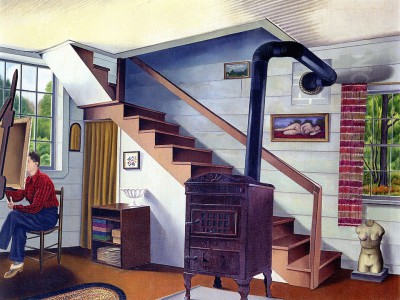
George Copeland Ault stands as a distinctive, if somewhat enigmatic, figure in the landscape of early 20th-century American art. Primarily associated with the Precisionist movement, his work is characterized by a stark, geometric clarity, yet often imbued with a profound sense of solitude and an almost haunting stillness. His life, marked by early privilege, artistic exploration, personal tragedy, and increasing reclusion, mirrors the complex emotional tenor of his paintings. This exploration delves into the life, artistic development, key influences, significant works, and lasting legacy of a painter who navigated the currents of modernism with a unique and deeply personal vision.
Early Life and Artistic Formation in Europe
George Copeland Ault was born on October 11, 1891, in Cleveland, Ohio, into a prosperous family. His father, Charles Henry Ault, was a successful businessman involved in the printing ink industry. This comfortable background afforded young George opportunities that would significantly shape his artistic inclinations. In 1899, when Ault was eight years old, the family relocated to London, England. This move proved pivotal, exposing him to the vibrant and rapidly evolving European art scene at the turn of the century.
In London, Ault received his formal art education. He attended the University College School, followed by more intensive artistic training at two prestigious institutions: the Slade School of Fine Art and the St. John's Wood School of Art. The Slade, in particular, was a crucible for emerging British talent, with influential figures like Henry Tonks and Philip Wilson Steer among its teaching staff. Here, Ault would have been immersed in a curriculum that, while rooted in traditional draftsmanship, was increasingly open to the currents of Impressionism and Post-Impressionism. Artists like Walter Sickert and the Camden Town Group were making their mark, depicting urban life with a new realism and atmospheric sensibility, which likely formed part of Ault's early visual vocabulary.
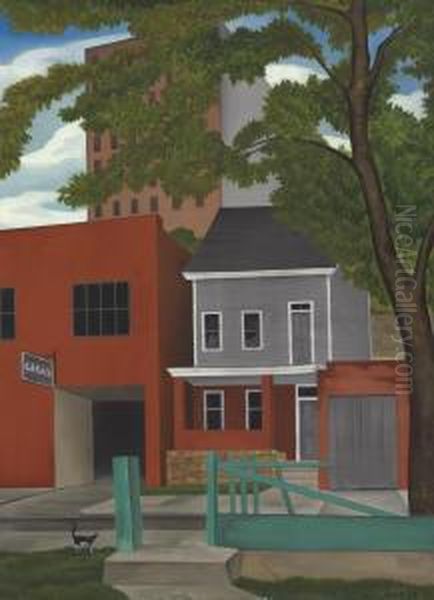
His time in London, spanning over a decade, allowed him to absorb the tail end of Victorian art, the rise of British Impressionism, and the burgeoning waves of modernism emanating from Paris and other European capitals. The emphasis on structure, light, and simplified form, hallmarks of Post-Impressionist painters like Paul Cézanne, would have been part of the artistic discourse, laying a foundation for his later Precisionist tendencies.
Return to America and Emergence in the Art World
In 1911, at the age of twenty, Ault returned to the United States, settling initially in Hillside, New Jersey, with his family. The American art scene he re-entered was itself on the cusp of a major transformation, soon to be electrified by the Armory Show of 1913, which introduced European avant-garde art to a largely unprepared American public. Ault began to establish himself as a painter, bringing with him the techniques and sensibilities honed during his European education.
His early works reflected an engagement with modern representational styles. He began exhibiting his paintings, and by the 1920s, he had moved to New York City, the burgeoning center of American modernism. He became associated with various artistic circles and participated in exhibitions, including those at the Whitney Studio Club, a precursor to the Whitney Museum of American Art, which was a vital platform for contemporary American artists. He also exhibited with the Society of Independent Artists, an organization founded on the principle of "no jury, no prizes," which provided an open venue for artists working outside academic traditions.
During this period, Ault's style began to crystallize. He was drawn to the architectural and industrial landscapes of the modern city, as well as the more tranquil, ordered environments of rural America. His approach was marked by a meticulous rendering of form, a simplification of detail into essential geometric shapes, and a palette that often emphasized strong contrasts and flat planes of color.
The Precisionist Current and Ault's Unique Voice
George Ault is most frequently aligned with Precisionism, an American art movement that flourished between the World Wars. Precisionism, while never a formally organized group, included artists like Charles Sheeler, Charles Demuth, Ralston Crawford, Niles Spencer, and Louis Lozowick. These artists shared an interest in depicting the industrial and urban landscape of America – skyscrapers, factories, bridges, and machinery – as well as vernacular architecture like barns and silos, with a smooth, sharply defined, and geometric style. Their work celebrated the clean lines and functional beauty of these modern structures, often stripping away extraneous detail to focus on underlying forms.
Ault’s work certainly shares many characteristics with Precisionism. His paintings often feature simplified, hard-edged geometric forms, flat application of paint, and a strong sense of order and design. Works like The Mill Room (1923) exemplify this, with its careful delineation of industrial interiors, reducing complex machinery and architectural elements to their essential geometric components. Similarly, View from Brooklyn Bridge (1927) captures the iconic structure with a focus on its powerful lines and the interplay of light and shadow, rendered with a cool detachment.
However, Ault’s Precisionism often carried a distinct emotional weight that set him apart from some of his contemporaries. While Sheeler, for instance, often approached his subjects with a more objective, almost photographic coolness, Ault’s paintings frequently exude a sense of quietude, melancholy, or even an unsettling stillness. There's a poetic, sometimes haunting quality to his depictions, suggesting a more personal, introspective engagement with his subjects. This can be seen in his nocturnal scenes and his renderings of isolated structures, which seem to resonate with an inner world as much as they document an external reality.
Influences Beyond Precisionism: Cubism and Surrealism
While Precisionism provides the primary framework for understanding Ault's art, his work also reveals the subtle absorption of other significant modernist currents, notably Cubism and Surrealism. The influence of Cubism, pioneered by Pablo Picasso and Georges Braque, is evident in his tendency to break down objects into geometric facets and his interest in structural composition. Though Ault rarely pushed into the full abstraction of analytical or synthetic Cubism, the Cubist emphasis on underlying geometric form and the flattening of pictorial space clearly informed his compositional strategies.
Later in his career, particularly in his Woodstock period, elements suggestive of Surrealism began to appear more prominently. Surrealism, with its exploration of the subconscious, dream imagery, and unexpected juxtapositions, found a different kind of echo in Ault's work. His paintings were not overtly fantastical in the manner of Salvador Dalí or René Magritte, but they often possessed a dreamlike atmosphere, a sense of mystery, and an emotional intensity that transcended straightforward representation. His starkly lit, isolated landscapes, often depicted under moonlight or in the eerie stillness of dawn or dusk, can evoke a sense of the uncanny, a feeling that there is more to the scene than meets the eye. This psychological dimension aligns with Surrealism's interest in the inner life and the evocative power of enigmatic imagery.
Urban Landscapes and Industrial Motifs
Throughout the 1920s and early 1930s, Ault produced a significant body of work focused on the urban environment, particularly New York City. He was captivated by the city's architecture, from its towering skyscrapers to its industrial waterfronts and iconic bridges. These subjects provided ample opportunity for his Precisionist approach, allowing him to explore the interplay of geometric forms, light, and shadow.
His depictions of the city were not typically bustling with human activity. Instead, he often focused on the structures themselves, imbuing them with a monumental, sometimes austere, presence. Morning in Brooklyn (1929) and Autumn in the Bronx (1936) are examples of his engagement with the urban fabric, capturing specific locales with his characteristic clarity and ordered composition. These works often convey a sense of stillness, as if time has momentarily paused, allowing the viewer to contemplate the stark beauty of the modern metropolis.
Industrial sites also held a strong attraction for Ault. Factories, grain elevators, and machinery became subjects through which he could explore themes of modernity, power, and the human-altered landscape. His meticulous rendering of these structures often highlighted their functional aesthetics, finding a kind of austere beauty in their utilitarian forms.
The Move to Woodstock and a Shift in Focus
The year 1937 marked a significant turning point in Ault's life and art. Plagued by increasing personal difficulties, including alcoholism and what was described as neurotic behavior, and seeking a more tranquil environment, he and his second wife, Louise Jonas (herself an artist), moved from New York City to the rural art colony of Woodstock, New York. This relocation was partly driven by health concerns and a desire to escape the pressures of the city and the art world, with which he was becoming increasingly estranged.
In Woodstock, Ault's financial situation became precarious. He lived in relative poverty, often in rented accommodations lacking modern amenities like electricity or indoor plumbing. Despite these hardships, the Woodstock period proved to be one of his most artistically productive, yielding some of his most iconic and emotionally resonant works. His focus shifted from the urban and industrial to the rural landscapes surrounding him, though his fundamental artistic concerns with light, form, and atmosphere remained.
He became particularly known for a series of paintings depicting the area around Russell's Corners, a specific rural crossroads near his home. These works, often nocturnal or set in the stark light of winter, are imbued with an intense, almost mystical quality. January Full Moon (1941) is a prime example, portraying a solitary barn and telegraph poles under a luminous moon, the scene rendered with an eerie precision and a profound sense of isolation. Another notable work from this period is Alston's Point at Night (1940), which captures a similar mood of nocturnal stillness and mystery.
These Woodstock paintings, while still exhibiting Precisionist clarity, often lean more heavily into a surreal or romantic sensibility. The landscapes are meticulously observed yet feel strangely empty and charged with an unspoken emotion. The play of light – moonlight, the single beam from a distant window, or the stark illumination of a streetlamp – becomes a key expressive element, heightening the sense of drama and solitude.
Personal Struggles and Their Reflection in Art
George Ault's life was shadowed by significant personal tragedies and ongoing struggles. His mother died from psychological and physical trauma when he was only three years old, an event in which his brother Donald also perished. Such early loss undoubtedly left a lasting mark. Throughout his adult life, he battled alcoholism, which at one point reportedly led to near-blindness from consuming tainted "bathtub gin" during Prohibition.
His behavior became increasingly erratic and reclusive, leading to a gradual alienation from friends, dealers, and the broader art community. His first marriage to Betty Whitman ended in divorce, and while he found companionship with Louise Jonas, their life together, particularly in Woodstock, was marked by financial hardship and his deepening isolation. These personal difficulties inevitably seeped into his artistic output. The pervasive sense of solitude, the melancholic atmosphere, and the often stark, unpopulated scenes in his paintings can be seen as reflections of his own inner state.
His art, especially from the Woodstock period, often seems to be a search for order and stillness in a world that felt chaotic and overwhelming. The meticulous control evident in his technique and the carefully balanced compositions might have been a way of imposing a sense of structure on his turbulent inner life. The recurring motif of the isolated building or the lonely road can be interpreted as a metaphor for his own sense of detachment.
Later Works, Artistic Evolution, and Tragic End
During his years in Woodstock, despite his poverty and the difficulty he faced in selling his work, Ault continued to paint with dedication. His style, while retaining its core Precisionist elements, continued to evolve. Some later works show an increased interest in texture and a slightly looser handling of paint, though the underlying commitment to geometric structure and atmospheric effect remained. He explored still life subjects as well, often imbuing them with the same sense of quiet intensity found in his landscapes.
His efforts to re-engage with the New York art world in the 1940s met with little success. His financial situation remained dire. The cumulative effect of personal struggles, professional isolation, and persistent poverty took its toll.
On December 30, 1948, George Copeland Ault's life came to a tragic end. He was found drowned in the Esopus Creek near his Woodstock home. The death was officially ruled an accidental drowning, likely occurring during a solitary walk on a stormy night. However, given his history of depression and personal difficulties, the possibility of suicide has often been considered, adding a poignant final chapter to his story. He was only 57 years old.
Legacy and Historical Reassessment
For a period after his death, George Copeland Ault's work fell into relative obscurity, overshadowed by the rise of Abstract Expressionism and other post-war art movements. However, a gradual reassessment of American modernism in the latter half of the 20th century led to a renewed appreciation for his unique contributions.
His paintings are now held in the collections of major American museums, including the Museum of Modern Art in New York, the Whitney Museum of American Art, the Smithsonian American Art Museum, the Addison Gallery of American Art, and the San Francisco Museum of Modern Art. Retrospectives and scholarly attention have helped to illuminate his place within the Precisionist movement and as a distinctive voice in American art.
Art historians recognize Ault for his masterful handling of light and shadow, his ability to distill complex scenes into essential geometric forms, and the profound psychological resonance of his work. He is seen as an artist who, while working within the Precisionist idiom, infused it with a personal, often melancholic, romanticism. His connection to earlier American romantic painters like Albert Pinkham Ryder, with whom he felt an affinity, is also noted, particularly in the moody, atmospheric quality of his landscapes. Ryder's dark, visionary paintings share a certain spiritual intensity with Ault's more solitary scenes.
Ault's work stands as a testament to an artist grappling with the complexities of the modern world and his own inner demons. He found a stark, haunting beauty in both the industrial might of the city and the quiet solitude of the countryside. His paintings are not merely records of places, but deeply felt responses to them, filtered through a sensibility that was both precise and poetic.
Comparisons with Contemporaries
To fully appreciate Ault's position, it's useful to consider him alongside his contemporaries. Within Precisionism, Charles Sheeler's work, often derived from his own photography, emphasized a more clinical, objective depiction of industrial forms, as seen in his paintings of the Ford River Rouge plant. Charles Demuth, another key Precisionist, often incorporated lettering and a more fragmented, Cubist-influenced style into his depictions of industrial architecture and vernacular subjects, such as his famous I Saw the Figure 5 in Gold, inspired by a William Carlos Williams poem. Ralston Crawford focused on the abstract, geometric qualities of ships, bridges, and grain elevators, often pushing his subjects towards greater abstraction than Ault.
Niles Spencer, like Ault, often depicted urban and industrial scenes with a strong sense of simplified form and quietude, but perhaps with less of the overt psychological tension found in Ault's work. Louis Lozowick celebrated the dynamism of the modern city and its machinery, often with a more optimistic, less melancholic tone. Elsie Driggs, one of the few women associated with Precisionism, created iconic images like Pittsburgh, capturing the industrial sublime.
Beyond Precisionism, Ault's work can be contrasted with that of Edward Hopper. Both artists often depicted scenes of American life imbued with a sense of solitude and introspection. However, Hopper's focus was more on human figures within their environments and the narrative implications of their isolation, rendered with a more painterly realism. Ault, by contrast, typically focused on the landscapes and structures themselves, allowing them to carry the emotional weight.
Artists from the Stieglitz Circle, such as Georgia O'Keeffe, Marsden Hartley, and John Marin, were also exploring American modernism. O'Keeffe, like Ault, created iconic images of American architecture (New York skyscrapers) and landscapes (the American Southwest), often with a Precisionist clarity, but her work is also deeply infused with her personal symbolism and a more organic sensibility.
Enduring Significance
George Copeland Ault's art offers a compelling vision of America during a period of profound transformation. His meticulously crafted paintings, with their clean lines, stark lighting, and often unsettling stillness, capture a unique intersection of modernist aesthetics and personal introspection. He was an artist who sought order and meaning in the geometric forms of the man-made world and the timeless landscapes of nature, yet his work is always tinged with an awareness of the fragility and solitude of human existence.
His legacy is that of a painter who, despite personal adversity and a degree of professional isolation, produced a body of work that is both formally rigorous and emotionally resonant. He remains a key figure for understanding the nuances of American Precisionism and the broader currents of modern art in the United States, an artist whose quiet, intense vision continues to captivate and intrigue. His journey through light and shadow, order and isolation, has left an indelible mark on the story of American art.