Henry Siddons Mowbray (1858-1928) stands as a significant, if sometimes overlooked, figure in American art at the turn of the 20th century. An artist whose career bridged the academic traditions of Europe with the burgeoning cultural landscape of the United States, Mowbray distinguished himself primarily as a muralist and a painter of exquisite Orientalist scenes. His work, characterized by refined draftsmanship, a harmonious sense of color, and a deep engagement with historical and allegorical themes, adorned some of America's most prestigious public and private buildings, leaving an indelible mark on the Gilded Age and its artistic aspirations.
Early Life and Transatlantic Beginnings
Born in Alexandria, Egypt, in 1858 to British parents, Henry Siddons Mowbray's early life was marked by upheaval. Orphaned at a young age, he was brought to the United States by his maternal aunt and her husband, who raised him in North Adams, Massachusetts. This early exposure to a vastly different culture from his birthplace, followed by an American upbringing, perhaps sowed the seeds for his later fascination with diverse historical and exotic themes.
His formal education initially took a different path. Mowbray attended the prestigious United States Military Academy at West Point for a year. However, the call of art proved stronger than a military career. Recognizing his true passion, he made the pivotal decision to leave West Point and pursue artistic training, a choice that would set him on a course towards international art circles.
Parisian Apprenticeship and Formative Influences
Like many aspiring American artists of his generation, Mowbray understood that Paris was the epicenter of the art world. He traveled to the French capital to immerse himself in its rich artistic environment and to seek instruction from its renowned masters. In 1879, he entered the atelier of Léon Bonnat, a highly respected academic painter known for his portraiture and historical scenes. Bonnat's rigorous training, emphasizing strong drawing skills and a solid understanding of anatomy and composition, provided Mowbray with a firm technical foundation.
During his time in Paris, Mowbray was exposed to a myriad of artistic currents. While academicism still held sway, Impressionism was making its revolutionary impact, and other movements were emerging. Critically for Mowbray's development, he encountered the work and, reportedly, the person of Jean-Léon Gérôme. Gérôme was a towering figure in French academic art, celebrated for his meticulously detailed historical paintings and, significantly, his captivating Orientalist scenes. Gérôme's influence, particularly his romanticized yet highly finished depictions of Middle Eastern and North African life, would profoundly shape Mowbray's thematic interests.
Other artists whose work Mowbray would have encountered and absorbed in Paris included contemporaries like William-Adolphe Bouguereau, with his idealized figures, and Jules Bastien-Lepage, who offered a more naturalistic approach to academic painting. The annual Paris Salon, the most important art exhibition in the world at the time, would have been a crucial venue for Mowbray to study the works of established masters and ambitious newcomers alike. He also reportedly received guidance from artists such as Walter Gay, an American expatriate known for his depictions of elegant interiors, and Achille Bordes.
Early Works and Developing Vision
Mowbray's early works began to reflect his Parisian training and his burgeoning interest in historical and exotic subjects. One of his notable early paintings, The Young Bacchus (1879), demonstrated his classical leanings and his ability to handle complex figural compositions. This work was exhibited at the Paris Salon in 1880, a significant achievement for a young artist. Following this, a trip to Spain allowed him to study the masterpieces of Spanish Golden Age painters, particularly Diego Velázquez, whose masterful use of paint and profound psychological insight left a lasting impression on many artists.
Another important early piece, The Etcher (1883), also garnered recognition at the Salon. These early successes indicated Mowbray's growing confidence and his ability to compete on an international stage. His style during this period was characterized by a polished finish, careful attention to detail, and a preference for narrative clarity, all hallmarks of the academic tradition in which he was trained. The influence of Gérôme was becoming increasingly apparent in his choice of subjects and his meticulous rendering of textures and settings.
Return to America and a Flourishing Career
In 1885, Mowbray returned to the United States, choosing New York City as his base. The city was rapidly becoming a major cultural center, with a growing appetite for art and a class of wealthy patrons eager to commission works for their homes and public institutions. Mowbray quickly established himself within this vibrant artistic community.
A significant aspect of his American career was his role as an educator. From 1886, he began teaching at the Art Students League of New York, a progressive institution that played a crucial role in training generations of American artists. His tenure there lasted until 1901, and his influence as an instructor was considerable. He imparted the rigorous technical skills he had acquired in Paris while also encouraging his students to develop their own artistic voices. Among his students were artists who would go on to achieve their own renown, such as Frederick Coffay Yohn, known for his historical illustrations, Charles Webster Hawthorne, who became a prominent figure painter and founder of the Cape Cod School of Art, and Paul King, who developed into a respected Impressionist painter.
The Muralist Par Excellence
While Mowbray continued to produce easel paintings, it was in the field of mural decoration that he achieved his most enduring fame. The late 19th and early 20th centuries in America were a period of great civic and commercial building, often referred to as the American Renaissance. This era saw a surge in demand for large-scale decorative schemes that would imbue these new structures with cultural significance and aesthetic grandeur. Mowbray emerged as one of the leading muralists of his time, alongside contemporaries like John La Farge, Edwin Austin Abbey, Kenyon Cox, and Elihu Vedder.
His mural work was characterized by its allegorical complexity, its harmonious integration with architecture, and its rich, often jewel-like, color palettes. He drew heavily on the traditions of the Italian Renaissance, particularly artists like Pinturicchio, whose decorative schemes in the Vatican were a source of inspiration for Mowbray's approach to creating opulent and narrative-rich surfaces.
One of his earliest major mural commissions was for the ceiling of the library in the University Club in New York (completed around 1897-1904). This ambitious project, with its intricate allegorical figures and decorative motifs, established his reputation as a master of large-scale decoration. The work was praised for its erudition and its beautiful execution, seamlessly blending figures, ornament, and architectural space.
Perhaps his most famous mural cycle is The Development of Law, executed for the Appellate Division Courthouse of New York State in Manhattan (completed c. 1900-1903). These panels, depicting historical and allegorical figures representing various stages and aspects of legal history, are a testament to Mowbray's skill in composing complex multi-figure scenes and his ability to convey abstract concepts through visual symbolism. The figures are rendered with a classical dignity, and the overall effect is one of solemn grandeur, appropriate for the building's function.
Other significant mural commissions included decorations for the residences of prominent Gilded Age patrons, such as the F.W. Vanderbilt mansion in Hyde Park, New York, and the magnificent library of J. Pierpont Morgan in New York City (now The Morgan Library & Museum). For Morgan, Mowbray created lunettes and ceiling panels that drew inspiration from Raphael and the High Renaissance, depicting muses and allegorical figures in a style that was both opulent and refined. He also created a significant mural for a building in Greenwich Village in 1906, further cementing his status.
Enduring Fascination with Orientalism
Alongside his mural work, Mowbray continued to explore Orientalist themes in his easel paintings. These works, often smaller in scale but no less meticulously crafted, transported viewers to romanticized visions of the Middle East and North Africa. His painting Rose Harvest, exhibited at the World's Columbian Exposition in Chicago in 1893, is a prime example of this genre, showcasing his ability to capture exotic beauty and narrative charm.
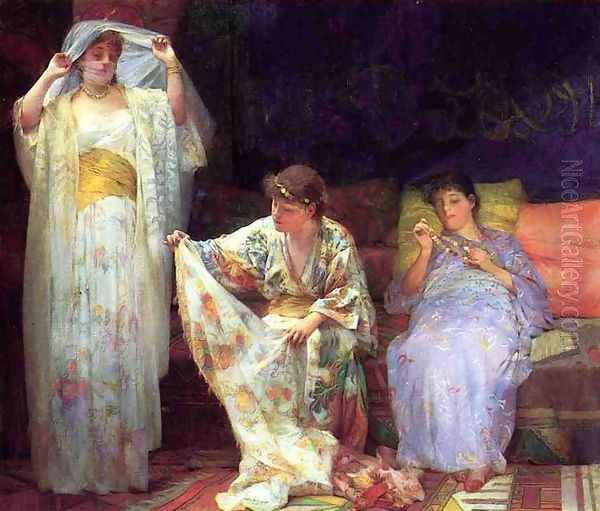
The Harem (also known as Harem Scene or Reclining Odalisque), now in the collection of Hirschl & Adler Galleries, is another quintessential Mowbray Orientalist piece. It depicts a languid scene within a harem, featuring beautifully rendered figures, rich textiles, and intricate architectural details. These paintings catered to a Western fascination with the "Orient," a complex phenomenon that often blended genuine curiosity with stereotypical and romanticized notions. Mowbray, like Gérôme and other Orientalist painters such as Frederick Arthur Bridgman or Ludwig Deutsch, excelled at creating visually seductive images that appealed to this taste. His Orientalist works are characterized by their warm color palettes, attention to ethnographic detail (however idealized), and a sense of quiet intimacy or leisurely opulence.
Other notable easel paintings include A Lady in Black, showcasing his skill in portraiture and elegant figure painting, and Leisure Time. His painting The Breeze earned him the prestigious Thomas B. Clarke Prize from the National Academy of Design in 1888, an institution to which he was elected an Associate in 1888 and a full Academician in 1891. This award signified his acceptance and recognition within the American art establishment.
Artistic Style and Lasting Influence
Mowbray's artistic style was a sophisticated amalgamation of various influences. At its core was the strong academic training he received under Bonnat, evident in his precise drawing, balanced compositions, and smooth, polished finish. To this, he added the rich color and decorative sensibility inspired by Italian Renaissance masters, particularly for his murals. His engagement with Orientalism, heavily influenced by Gérôme, provided him with a popular and visually rich thematic vein.
While some sources connect him loosely with Impressionism, likely due to his time in Paris when the movement was active and his use of vibrant color, Mowbray's work remained fundamentally rooted in academic and decorative traditions. He did not adopt the broken brushwork or the emphasis on capturing fleeting moments of light and atmosphere that characterized Impressionists like Claude Monet or Camille Pissarro. Instead, his paintings, whether murals or easel works, prioritized clarity of form, narrative content, and a sense of timeless beauty. His approach was more aligned with the "American Renaissance" artists who sought to create a national art that was both sophisticated and morally uplifting, drawing on European traditions but adapting them to an American context.
His influence extended through his teaching at the Art Students League, where he helped shape a new generation of artists. His success as a muralist also contributed to the prestige of this art form in America, encouraging its use in public and private buildings. While the taste for large-scale allegorical murals and Orientalist scenes waned with the rise of Modernism in the early 20th century, Mowbray's work remains an important testament to the artistic achievements of his era. Artists like John Singer Sargent and James McNeill Whistler, while pursuing different stylistic paths, were part of the same broader generation of American artists who sought international training and recognition, bringing a new level of sophistication to American art.
Personal Life and Final Years
Details about Mowbray's personal life are relatively scarce. He is known to have never married. He remained active as an artist and a respected figure in the art world for many years. He served on the U.S. Commission of Fine Arts from 1921 to 1928, a testament to his esteemed position. Henry Siddons Mowbray passed away in Washington, D.C., in 1928.
His works are held in the collections of major American museums, including the Metropolitan Museum of Art in New York, the Smithsonian American Art Museum in Washington, D.C., and the Detroit Institute of Arts, among others. His murals, many of which remain in situ, continue to be admired for their beauty and craftsmanship.
Conclusion: A Legacy in Decoration and Dreams
Henry Siddons Mowbray carved a distinguished career as an American artist who masterfully blended academic rigor with a flair for the decorative and the exotic. His murals transformed public and private spaces into realms of allegorical meaning and aesthetic delight, drawing inspiration from the grandeur of the Italian Renaissance. Simultaneously, his Orientalist paintings offered captivating glimpses into romanticized distant lands, appealing to the Gilded Age's fascination with the exotic.
Though perhaps not as widely known today as some of his more avant-garde contemporaries, Mowbray's contributions to American art are significant. He was a key figure in the American Renaissance mural movement, a respected teacher, and a painter of consummate skill. His legacy endures in the opulent beauty of his decorations and the alluring charm of his Orientalist visions, reflecting the aspirations and tastes of a transformative period in American cultural history. His dedication to craftsmanship and his ability to synthesize diverse artistic traditions mark him as a notable master of his time.