Venny Soldan-Brofelt: A Luminary of Finnish Art and Social Reform
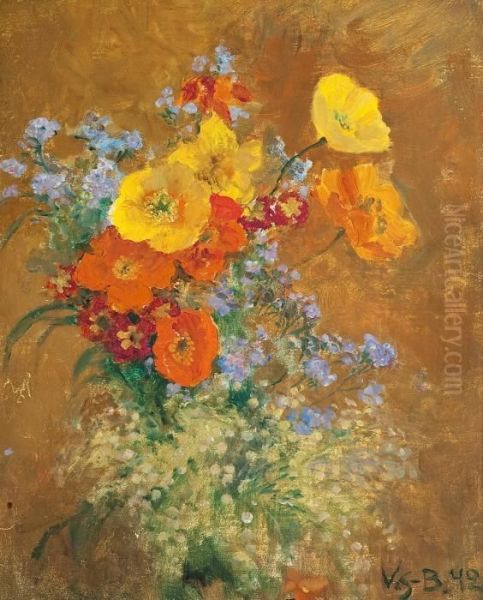
Venny Soldan-Brofelt, born Wendla Irene Soldan, stands as a pivotal figure in the rich tapestry of Finnish art and social history. Her life, spanning from November 2, 1863, in Helsinki, to October 10, 1945, in Lohja, was one of remarkable artistic versatility and unwavering commitment to progressive ideals. She was not merely a painter but also a gifted illustrator, a skilled graphic artist, an adept woodcarver, and an innovative jewelry designer, whose contributions resonated deeply within the cultural landscape of Finland during a transformative era.
Early Life and Artistic Inclinations
Born into an intellectually vibrant and supportive family, Venny's path towards an artistic career was encouraged from a young age. Her father, August Fredrik Soldan, was the esteemed director of the Mint of Finland, a man of science and engineering, while her mother, Marie Müller, hailed from Germany, bringing a different cultural perspective to the household. This environment, which valued both intellectual pursuit and artistic expression, undoubtedly nurtured Venny's innate talents and burgeoning interest in the visual arts.
The Finland of Venny's youth was an autonomous Grand Duchy within the Russian Empire, a period marked by a growing sense of national identity and a fervent desire to define and celebrate Finnish culture. This cultural awakening, often referred to as the Golden Age of Finnish Art, provided a fertile ground for artists seeking to express a unique Finnish spirit. Venny Soldan-Brofelt would become an integral part of this movement, contributing her unique voice and vision.
Formal Training and Parisian Horizons
Recognizing her potential, Venny pursued formal art education. She initially studied at the Finnish Art Society's Drawing School in Helsinki (now the Academy of Fine Arts, University of the Arts Helsinki) from 1880 to 1884, a key institution for aspiring Finnish artists. Here, she would have been exposed to the teachings of figures like Adolf von Becker, a proponent of French Realism, and Gunnar Berndtson, known for his elegant genre scenes and portraits. Her contemporaries at the school likely included other burgeoning talents who would also shape Finnish art, such as Helene Schjerfbeck and Maria Wiik, though Schjerfbeck had already established herself by this time.
Seeking broader artistic exposure, Venny, like many ambitious Nordic artists of her generation, traveled abroad. She spent time in St. Petersburg, absorbing the academic traditions of the Imperial Academy of Arts, before making the pivotal move to Paris in the mid-1880s. Paris was the undisputed center of the art world, a melting pot of innovation and tradition. For female artists, however, access to premier institutions like the École des Beaux-Arts was restricted. Consequently, many, including Venny, enrolled in private ateliers such as the Académie Colarossi and the Académie Julian, which welcomed female students and offered a more liberal environment.
It was in Paris that she encountered a vibrant international community of artists. This period was crucial for her development, exposing her to the currents of Realism, Naturalism, and the nascent stirrings of Impressionism and Symbolism. She honed her skills, broadened her artistic vocabulary, and formed connections that would last a lifetime.
A Defining Friendship: Hanna Pauli and an Iconic Portrait
One of the most significant relationships Venny formed in Paris was with the Swedish artist Hanna Hirsch-Pauli. They worked alongside each other, sharing studios and artistic aspirations. This camaraderie between female artists, navigating the male-dominated art world, was a source of mutual support and inspiration.
This friendship resulted in one of the most iconic portraits in Nordic art history: Hanna Pauli's Portrait of Venny Soldan (later Soldan-Brofelt), painted between 1886 and 1887. The painting, now housed in the Gothenburg Museum of Art, is a radical departure from conventional female portraiture of the era. It depicts Venny not in a passive, idealized pose, but actively engaged, sitting unconventionally on the studio floor, legs outstretched, clay in hand, a half-smile playing on her lips. Her attire is practical, her gaze direct. Pauli captures Venny's bohemian spirit, her intellectual intensity, and her identity as a working artist. This portrayal was considered bold, even audacious, challenging societal norms of feminine decorum and offering a powerful image of the "New Woman" artist.
Venny Soldan-Brofelt's Artistic Oeuvre: Versatility and Vision
While Pauli's portrait of Venny is famous, Venny herself was a prolific and accomplished artist in her own right. Her artistic output was characterized by a keen observational skill, a sensitivity to atmosphere, and a versatile command of different media. She embraced a realistic approach, often imbued with a gentle lyricism.
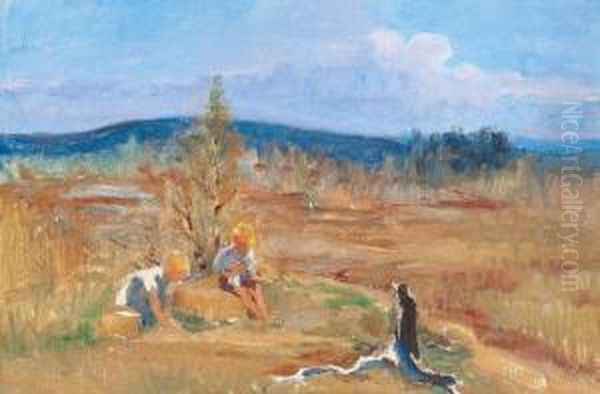
Her paintings frequently featured still lifes, particularly floral compositions like Still Life with Flowers and Summer Flowers. These works demonstrate her meticulous attention to detail, her understanding of light and texture, and her ability to capture the ephemeral beauty of nature. She also painted landscapes, drawing inspiration from the Finnish countryside, and portraits that revealed a psychological acuity. Her work often reflected the domestic sphere, depicting children and scenes of everyday life, themes that were increasingly validated in art circles that valued intimate, personal expressions.
Beyond painting, Venny Soldan-Brofelt made significant contributions as an illustrator. She created illustrations for numerous books, including children's literature and works by her future husband, the prominent Finnish author Juhani Aho. Her illustrations were characterized by their charm, narrative clarity, and empathy for her subjects, making her a beloved figure in Finnish book art.
Craftsmanship and Design: Expanding Artistic Boundaries
Venny's artistic talents were not confined to the traditional "fine arts." She was also a skilled woodcarver and an innovative jewelry designer. This engagement with applied arts aligned with the ideals of the National Romantic movement and the broader Arts and Crafts philosophy, which sought to elevate craftsmanship and integrate art into everyday life.
Her jewelry designs were often inspired by nature and traditional Finnish motifs, crafted with a distinctive aesthetic that was both modern and rooted in heritage. Similarly, her woodcarvings reflected a deep appreciation for material and form. This multifaceted approach to art-making was characteristic of many artists of the Finnish Golden Age, such as Akseli Gallen-Kallela, who also worked across painting, printmaking, and design, often drawing inspiration from the national epic, the Kalevala. Venny's work in these areas contributed to the burgeoning field of Finnish design, which sought to create a distinctly national aesthetic.
Marriage, Family, and a Cultural Hub
In 1891, Venny Soldan married Juhani Aho (born Johannes Brofeldt), one of Finland's most celebrated writers and a leading figure in the National Romantic movement. Their marriage brought together two powerful artistic personalities. Their home, particularly their summer residence, Ahola, in Järvenpää, became a lively cultural salon, attracting a circle of prominent artists, writers, and intellectuals. This group, often referred to as the "Järvenpää artists' colony," included figures like the composer Jean Sibelius, the painter Eero Järnefelt (brother-in-law to Sibelius), and Pekka Halonen, another key painter of the Finnish Golden Age.
The marriage, however, was not without its complexities. Juhani Aho also had a significant relationship with Venny's younger sister, Mathilda "Tilly" Soldan. Despite these personal challenges, Venny and Juhani maintained a working partnership, and she continued to illustrate his works. They had two sons, Heikki Aho and Björn Soldan, who would later become pioneers in Finnish documentary filmmaking, carrying on the family's artistic legacy through the Aho & Soldan production company. Venny, after Juhani's death in 1921, even took on a role representing the company, traveling and promoting their work.
A Force for Social Change: Feminism and Activism
Venny Soldan-Brofelt was not content to be solely an artist; she was also a passionate advocate for social reform, particularly women's rights. She was a prominent figure in the Finnish feminist movement, a contemporary and collaborator of pioneering activists.
She was one of the co-founders of Naisasialiitto Unioni (the Feminist Association Unioni, or the Finnish Women's Association) in 1892, alongside other leading feminists such as Lucina Hagman and Maiikki Friberg. This organization was at the forefront of the fight for women's suffrage, equal pay, educational reform for girls and women, and the abolition of regulated prostitution. Venny's involvement in these causes was deeply felt and actively pursued. Her commitment to these issues reflected a broader Nordic trend where women were increasingly demanding political and social equality. Finland, in fact, became the first country in Europe to grant women full suffrage in 1906, a testament to the efforts of women like Soldan-Brofelt and her colleagues.
Her art, particularly the way she lived her life as an independent, professional woman, can be seen as an extension of her feminist principles. She challenged conventional expectations for women, both in her personal choices and through her public advocacy.
The Art for Schools Association: Cultivating National Identity
A significant aspect of Venny Soldan-Brofelt's public life was her dedication to art education and the dissemination of art to wider audiences. She was a founding member and a driving force behind the "Konstföreningen för skolorna" (Art for Schools Association), established in 1906. The association's mission was to bring art into educational institutions, believing in its power to cultivate aesthetic appreciation, moral development, and a sense of national identity among young Finns.
The association commissioned and acquired artworks, including large-scale murals, for schools and public libraries. Venny played an active role in this, for instance, by recommending that the Tampere education committee purchase Pekka Halonen's painting Johannes’ School. She also facilitated other art procurement initiatives for schools. This movement for public art was part of a broader effort to democratize culture and to use art as a tool for nation-building, particularly important in a Finland striving for greater autonomy and, eventually, independence (achieved in 1917). Artists like Albert Edelfelt, with his historical paintings, and Pierre Puvis de Chavannes in France, with his monumental public murals, provided international precedents for the ennobling power of public art, a spirit echoed in the Finnish initiative.
Interactions and Collaborations with Contemporaries
Venny Soldan-Brofelt's life was interwoven with the leading artistic and cultural figures of her time. Her friendship with Hanna Pauli has already been noted. Her marriage to Juhani Aho placed her at the center of a literary and artistic circle that included Eero Järnefelt, Pekka Halonen, and Jean Sibelius. These artists often collaborated, shared ideas, and supported each other's work, creating a vibrant cultural ecosystem.
Her involvement with the Art for Schools Association brought her into professional contact with numerous artists, including Pekka Halonen, whose work she championed. She would have also been aware of and interacted with other significant Finnish artists of the period, such as the symbolist painter Hugo Simberg, known for his melancholic and fantastical imagery, and Ellen Thesleff, another pioneering female artist who explored Symbolism and early Modernism. The artistic landscape of Finland was relatively small but intensely dynamic, and figures like Venny Soldan-Brofelt played a crucial role in fostering its development. Her appreciation for art extended beyond her immediate Nordic circle, as evidenced by her noted admiration for Spanish masters like Bartolomé Esteban Murillo and Diego Velázquez, suggesting a broad art historical awareness.
Wartime Contributions and Later Life
The early 20th century was a tumultuous period for Finland, encompassing World War I and the Finnish Civil War (1918). During these challenging times, Venny Soldan-Brofelt, along with her family, continued to be active. They participated in cultural activities, including those at Koli National Park, a site of immense natural beauty and symbolic importance for Finnish national identity, famously painted by artists like Eero Järnefelt and Akseli Gallen-Kallela. Her engagement during these periods reflected a deep-seated social responsibility and a belief in the sustaining power of culture.
After the death of her husband Juhani Aho in 1921, Venny continued her artistic pursuits and took on new responsibilities, including her involvement with her sons' film company, Aho & Soldan. She remained a respected figure in Finnish cultural life. Her decision in her later years to be buried next to her husband in Järvenpää, rather than in her family plot in Helsinki, was a personal choice that spoke to the enduring, if complex, bond they shared.
Legacy and Art Historical Evaluation
Venny Soldan-Brofelt's legacy is multifaceted. As an artist, she produced a significant body of work across various media, characterized by its skill, sensitivity, and connection to Finnish life and landscape. Her paintings, illustrations, and designs are held in important collections, including the Finnish National Gallery (Ateneum Art Museum) and the Gothenburg Museum of Art (through Pauli's portrait). Exhibitions of her work, such as those at the Riihimäki Art Museum, continue to affirm her artistic importance.
Her art, while often rooted in Realism, also reflected the broader currents of her time, including National Romanticism and an engagement with the principles of the Arts and Crafts movement. She was part of a generation of artists who sought to define a distinctly Finnish cultural identity, and her contributions to this endeavor were significant.
Beyond her artistic achievements, Venny Soldan-Brofelt's impact as a social reformer and feminist activist is undeniable. Her work with the Naisasialiitto Unioni and her advocacy for women's rights contributed to the progressive social changes that characterized early 20th-century Finland. Her role in the Art for Schools Association demonstrated her commitment to art education and the democratization of culture.
In art historical terms, Venny Soldan-Brofelt is recognized as a pioneering female artist who navigated the challenges and opportunities of her time with determination and talent. She, along with contemporaries like Helene Schjerfbeck, Maria Wiik, Ellen Thesleff, and Sigrid Schauman, helped to pave the way for future generations of women artists in Finland. Her life and work offer a compelling example of an artist deeply engaged with her society, using her talents not only for personal expression but also for the betterment of her community and the advancement of cultural and social ideals. She remains an inspiring figure, embodying the spirit of artistic innovation and progressive thought that defined a crucial era in Finnish history. Her influence can be seen in the continued strength of Finnish design, the high regard for art education, and the nation's long-standing commitment to gender equality.