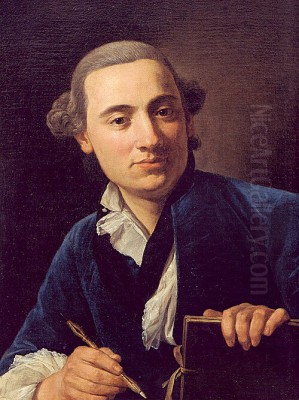
Gaspare Traversi stands as a significant, if once overlooked, figure in the vibrant artistic landscape of 18th-century Italy. Active primarily in Naples and later in Rome, Traversi carved a unique niche for himself with his keenly observed genre scenes, often imbued with a sharp wit, social satire, and a dramatic flair inherited from the Caravaggesque tradition. His work offers a fascinating window into the society of his time, particularly the burgeoning middle class, capturing their aspirations, foibles, and everyday dramas with an unflinching yet humorous eye.
Early Life and Neapolitan Foundations
Gaspare Traversi was born in Naples, a bustling cultural and artistic hub in the Kingdom of Naples. He was baptized on February 15, 1722, in the church of Santa Maria dell'Incoronatella, with the full name Gasparro Giovanni Battista Pascale Traversa. His family background was that of Genoese merchants, a detail that perhaps provided him with an early exposure to the dynamics of commerce and the varied strata of urban society that would later populate his canvases.
The Naples of Traversi's youth was a city teeming with artistic energy. The legacy of Baroque masters like Luca Giordano and Jusepe de Ribera was still potent, and the city was a crucible for new artistic developments. It was in this environment that Traversi received his formative artistic training.
The Workshop of Francesco Solimena and Early Influences
The most crucial aspect of Traversi's artistic education was his apprenticeship under Francesco Solimena (1657-1747). Solimena was, by then, the undisputed doyen of Neapolitan painting, a prolific artist whose studio attracted a generation of aspiring painters. Solimena's own style, a grand and dynamic reinterpretation of Baroque principles, evolved throughout his long career, and his later works, often characterized by a lighter palette and more fluid brushwork, leaned towards the emerging Rococo sensibility. This late style of Solimena undoubtedly left an imprint on Traversi.
In Solimena's bustling workshop, Traversi would have been a contemporary of other notable artists who would go on to shape Neapolitan art, including Giuseppe Bonito (1707-1789) and Francesco de Mura (1696-1782). Bonito, in particular, became known for his own genre scenes, often with a similar satirical edge to Traversi's, leading to occasional confusion in attributions between the two artists. The shared tutelage under Solimena fostered an environment of artistic exchange and mutual influence, though each artist would eventually develop a distinct voice. Traversi's active period as a painter is generally considered to be from around 1732 to 1769.
A Career Divided: Naples and Rome
Traversi's artistic career unfolded primarily in two major Italian cities: his native Naples and, from approximately 1752 onwards, Rome. While he spent a significant portion of his formative and early mature years in Naples, the move to Rome marked a new phase in his development. Rome, as the historical center of the art world, offered different patronage opportunities and a diverse artistic milieu, then witnessing the interplay between late Baroque, Rococo, and the nascent stirrings of Neoclassicism, championed by figures like Anton Raphael Mengs and Pompeo Batoni.
Despite the move, Traversi's Neapolitan roots remained evident in his work, particularly in the earthy humor and dramatic intensity that characterized his genre scenes. He continued to produce works that resonated with the themes and stylistic approaches he had developed in Naples, but his Roman period also saw him tackle important commissions, including religious subjects. He remained in Rome until his death in 1770.
Artistic Style: A Confluence of Traditions
Gaspare Traversi's artistic style is a fascinating amalgamation of various influences, skillfully synthesized into a personal and recognizable idiom.
The Rococo Framework
Traversi operated firmly within the Rococo period. This era, succeeding the grandeur of the Baroque, favored intimacy, elegance, and often playful or sentimental themes. While Traversi's work sometimes eschewed the overt prettiness associated with French Rococo artists like Jean-Honoré Fragonard or Jean-Antoine Watteau, it shared the Rococo interest in human interaction, private life, and a certain lightness of being, albeit often undercut by his satirical intent. His compositions, frequently featuring groups of figures in domestic interiors, align with the Rococo preference for smaller-scale, less formal subjects than the grand historical or mythological narratives of the High Baroque.
Enduring Echoes of Caravaggio
A defining characteristic of Traversi's art is its strong connection to the Caravaggesque tradition. The influence of Michelangelo Merisi da Caravaggio (1571-1610), who had spent significant periods in Naples, was deeply embedded in Neapolitan painting. Traversi adopted Caravaggio's dramatic use of chiaroscuro – strong contrasts between light and shadow – to model his figures and create a sense of theatricality. This is evident in the way light often picks out faces and gestures, heightening the emotional impact of his scenes. Unlike the often-idealized figures of some Rococo painters, Traversi's characters possess a tangible, sometimes gritty, realism that also harks back to Caravaggio's revolutionary approach.
Neapolitan Humour and Satire
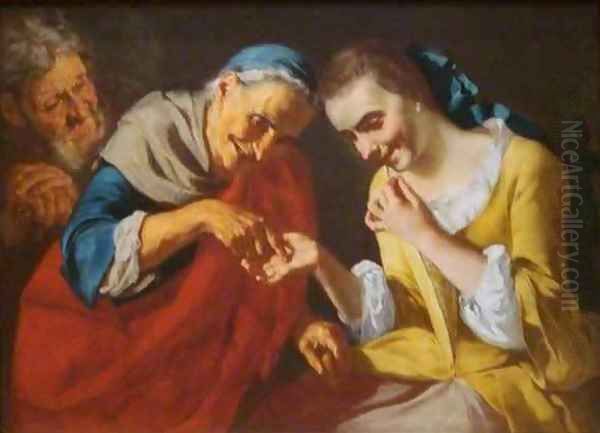
Perhaps the most distinctive element of Traversi's style is his sharp, often biting, Neapolitan humor and satire. He had an acute eye for human folly and the absurdities of social conventions. His paintings frequently depict scenes of everyday life where characters are engaged in activities that reveal their vanity, greed, gullibility, or simple foolishness. This satirical bent aligns him with other European artists of the period who used genre painting for social commentary, such as William Hogarth (1697-1764) in England and, in a gentler way, Pietro Longhi (1701-1785) in Venice. Traversi's satire, however, often possessed a more robust, almost theatrical quality, typical of the Neapolitan character. His figures are not merely observed; they are actors in small human comedies, their expressions and gestures often exaggerated for comic or dramatic effect.
Social Commentary and Moral Tales
Many of Traversi's genre scenes can be interpreted as "moral tales," visual narratives that critique contemporary mores and social types. He often focused on the aspirations and anxieties of the rising bourgeois class, depicting their attempts to emulate aristocratic manners, their engagement in new forms of leisure like card games, or their encounters with professionals like doctors or musicians. These scenes are rarely neutral; they often carry an undercurrent of judgment or amusement at the pretensions and vulnerabilities on display. His work reflects the intellectual currents of the Enlightenment, which encouraged critical examination of society and human behavior. The crowded compositions, often set in somewhat claustrophobic interiors, further amplify the intensity of the interactions and the scrutiny to which the characters are subjected.
Key Works and Thematic Explorations
Traversi's oeuvre encompasses a range of subjects, but he is best known for his vivid and engaging genre paintings.
Scenes of Everyday Life and Social Interaction
A significant portion of Traversi's output is dedicated to capturing the pulse of daily life. _The Card Game_ (also known as Il Gioco di Carte) is a prime example. Such scenes were popular, depicting a common pastime that often led to disputes and revealed character. Traversi masterfully captures the tension, the sly glances, and the potential for deception inherent in such gatherings. Similarly, _A Quarrel over a Board Game_ (or La Rissa) showcases his ability to depict heightened emotion and conflict, with figures animated by anger and argument, their faces contorted in expressive grimaces. The dramatic lighting and dynamic composition make the viewer feel like an immediate witness to the unfolding drama.
Another well-known work, often titled _Teasing a Sleeping Girl_ (or Lo Scherzo alla Ragazza Addormentata), exemplifies his playful yet slightly risqué humor. The scene typically involves a group of figures conspiring to play a prank on an unsuspecting sleeper, allowing Traversi to explore a range of expressions from mischievous delight to feigned innocence. These works highlight his skill in orchestrating multi-figure compositions where each individual contributes to the overall narrative and psychological interplay.
The Professions and Human Vulnerability
Traversi also turned his satirical gaze towards the professions. His most famous work in this vein is undoubtedly _The Surgical Operation_ (L'operazione chirurgica, c. 1753-54). This painting is a stark and unflinching depiction of a medical procedure in an era before anesthesia or modern sterile techniques. The patient's agony, the surgeon's intense concentration, and the varied reactions of the onlookers – some curious, some distressed – are rendered with a powerful realism. While it documents a contemporary practice, the painting also serves as a commentary on human suffering and the often-brutal realities of 18th-century medicine. The dramatic lighting focuses on the central action, emphasizing the raw physicality of the scene.
The Arts and Education
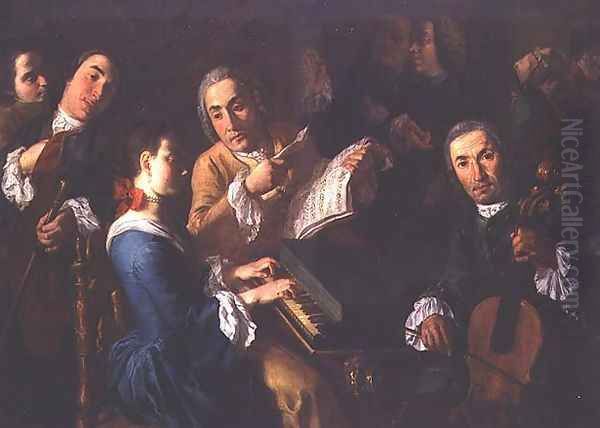
Scenes related to the arts and education also feature in his work. _The Arts of Music_ and _The Arts of Painting_ are allegorical or genre scenes that reflect contemporary interest in cultural pursuits. Paintings depicting music lessons, like _The Music Lesson_, were common, often carrying subtle amorous undertones or satirizing the efforts of the nouveau riche to acquire cultural polish. Traversi's treatment of these subjects is typically lively, with expressive figures and a keen attention to the details of instruments, attire, and setting.
Portraiture
While best known for his genre scenes, Traversi was also an accomplished portraitist. _The Sitting_ (Il Ritratto, c. 1754) is considered one of his important works in this genre. His portraits often share the psychological acuity of his genre paintings, seeking to capture not just a likeness but also the personality and social standing of the sitter. He could adapt his style, sometimes imbuing his portraits with a formal dignity, while at other times allowing a more informal, characterful representation to emerge, consistent with his genre work. His experience in depicting a wide array of human types in his narrative paintings undoubtedly enriched his approach to portraiture.
Religious Commissions
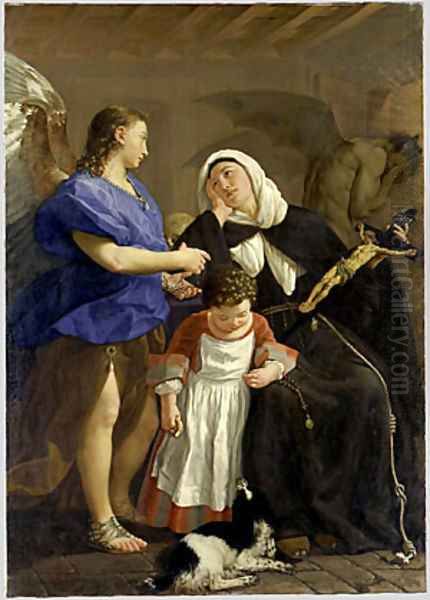
Despite his fame for secular subjects, Traversi also undertook religious commissions, particularly during his time in Rome, where the Church remained a significant patron of the arts. Among his religious works are paintings such as _The Birth of the Virgin Mary_, _The Annunciation of the Virgin Mary_, and _The Assumption of the Virgin Mary_. He also painted a notable _Saint Margaret of Cortona_. In these works, Traversi adapted his style to the demands of sacred art, often employing a more idealized and dignified manner, yet his inherent sense of drama and his skill in depicting human emotion remained evident. These commissions demonstrate his versatility and his ability to work within the established conventions of religious iconography, even as he brought his unique artistic personality to bear. His contemporary in Rome, Corrado Giaquinto, was another Neapolitan-born painter who excelled in large-scale religious and allegorical decorations, though Giaquinto's style was generally more aligned with the grand Rococo manner.
Traversi and His European Contemporaries
Traversi's work can be situated within a broader European context of genre painting and social satire. As mentioned, his critical eye and narrative impulse find parallels in the work of William Hogarth in England, whose series like "A Rake's Progress" or "Marriage A-la-Mode" offered scathing critiques of contemporary society. While Hogarth often employed overt moralizing and complex allegories, Traversi's satire tended to be more situational, embedded in the interactions of his characters.
In Italy, Pietro Longhi provided charming, though generally less biting, glimpses into the daily life of Venetian aristocracy and bourgeoisie. The French painter Jean-Baptiste-Siméon Chardin (1699-1779), a contemporary, also focused on genre scenes, but Chardin's work is characterized by a quiet intimacy and a profound respect for the dignity of ordinary people and domestic life, contrasting with Traversi's more boisterous and satirical approach. Another Venetian, Giovanni Battista Piazzetta (1683-1754), also created powerful genre heads and scenes, often with a strong chiaroscuro reminiscent of the Caravaggesque tradition that also informed Traversi.
Challenges in Attribution
The stylistic similarities between Gaspare Traversi and his fellow Solimena pupil, Giuseppe Bonito, have historically led to challenges in attribution. Bonito also specialized in genre scenes with a humorous or satirical bent, and their shared Neapolitan artistic heritage and training resulted in overlapping thematic concerns and painterly techniques. For a period, some of Traversi's works were misattributed to Bonito, and it has taken careful scholarly research and connoisseurship to disentangle their respective oeuvres. This ongoing process of clarification has helped to solidify Traversi's distinct artistic identity and to highlight his specific contributions to 18th-century painting.
Legacy and Influence
Although Gaspare Traversi did not have formal students in the traditional master-apprentice sense, his distinctive style and thematic preoccupations exerted an influence on other artists. His impact can be seen in the work of later Neapolitan painters who continued the tradition of genre painting. Figures such as Lorenzo de Caro (c. 1719-1777), who was a contemporary, and perhaps Orazio Romani or Orazio Mazzei, show affinities with Traversi's approach to characterization and narrative. The continued interest in everyday subjects and social observation in Neapolitan art owes a debt to pioneers like Traversi and Bonito.
For a long time, Traversi remained a somewhat underappreciated figure in the broader narrative of Italian art history. However, since the mid-20th century, and particularly in more recent decades, there has been a significant reassessment of his work. Exhibitions and scholarly publications have brought his art to a wider audience, recognizing his originality, his technical skill, and the insightful social commentary embedded in his paintings. He is now acknowledged as one of the most engaging and individualistic painters of the Italian Rococo, particularly for his contribution to the genre of satirical and narrative scenes. His work is seen as a vital link in the tradition of realist observation that stretches from Caravaggio through the Neapolitan Baroque and into the more socially aware art of the 18th century. His paintings offer a unique Neapolitan perspective, distinct from the genre traditions of Venice or Rome, characterized by its energy, its theatricality, and its unvarnished depiction of human nature.
Conclusion: An Enduring Vision
Gaspare Traversi's art provides a vivid, entertaining, and often thought-provoking glimpse into the world of 18th-century Naples and Rome. His ability to combine technical prowess—evident in his command of light, color, and composition—with a keen psychological insight and a robust sense of humor sets him apart. He masterfully captured the commedia umana of his time, populating his canvases with a memorable cast of characters whose aspirations, vanities, and vulnerabilities remain surprisingly relatable.
From the boisterous energy of a tavern brawl to the quiet tension of a card game, or the stark drama of a surgical operation, Traversi’s paintings are more than mere depictions of everyday life. They are carefully constructed narratives that invite viewers to engage, to interpret, and often, to smile in recognition of the timeless aspects of human behavior he so skillfully portrayed. As a satirist, a storyteller, and a superb painter, Gaspare Traversi holds a secure and increasingly celebrated place in the rich tapestry of Italian art. His legacy is that of an artist who looked closely at the world around him and translated his observations into works of enduring vitality and appeal.