Julius Rolshoven stands as a fascinating figure in the landscape of late 19th and early 20th-century art, an American artist whose career traversed the great art centers of Europe and the burgeoning art colonies of the American Southwest. His work, characterized by a sophisticated blend of academic training and a keen sensitivity to light and color, reflects a life lived across diverse cultural settings. From the hallowed halls of European academies to the sun-drenched adobes of New Mexico, Rolshoven forged a unique artistic path, leaving behind a legacy of evocative portraits, vibrant genre scenes, and insightful depictions of indigenous cultures.
Early Life and Formative Artistic Education
Born on October 28, 1858, in Detroit, Michigan, Julius Rolshoven's artistic inclinations were apparent from a young age. His father, a skilled German goldsmith, not only encouraged his son's burgeoning talent but also provided him with foundational training in the precise art of engraving. This early exposure to meticulous craftsmanship likely instilled in Rolshoven a deep appreciation for detail and technical skill that would inform his later painterly pursuits.
His formal artistic education began in earnest in 1877. After an unsuccessful application to the prestigious National Academy of Design in New York, Rolshoven enrolled at the Cooper Union for the Advancement of Science and Art. This institution, known for its accessible and comprehensive art programs, provided him with a solid grounding. However, like many ambitious American artists of his generation, Rolshoven soon felt the pull of Europe, then considered the epicenter of artistic training and innovation.
European Sojourns: The Crucible of Academic Training
Rolshoven's European odyssey commenced with studies in Düsseldorf, Germany, a city with a strong academic tradition. He then moved to Munich, another major art hub, where he further honed his skills. It was in Munich that he became associated with the "Duveneck Boys," a group of American artists studying under the charismatic Cincinnati-born painter Frank Duveneck. Duveneck, himself trained in the Munich Royal Academy, championed a vigorous, realistic style characterized by dark palettes and bravura brushwork, heavily influenced by Old Masters like Diego Velázquez and Frans Hals. This period was crucial for Rolshoven, immersing him in a dynamic environment alongside fellow aspiring artists such as John Henry Twachtman and Joseph DeCamp, who would also go on to achieve significant renown.
The allure of Paris, the undisputed capital of the art world, eventually drew Rolshoven. In 1882, he enrolled in the Académie Julian, a progressive private art school that attracted students from around the globe. There, he studied under esteemed academic painters Tony Robert-Fleury and Adolphe William Bouguereau. Bouguereau, in particular, was a towering figure of French academic art, celebrated for his meticulously rendered mythological and genre scenes. Under their tutelage, Rolshoven mastered the rigorous discipline of figure drawing and classical composition, absorbing the refined techniques and aesthetic ideals of the French academic tradition. He also studied with another notable figure, Thomas Couture, known for his emphasis on direct observation and a more painterly approach within the academic framework.
His training was not limited to these masters. Rolshoven also benefited from the instruction of Hugo Crola in Germany, whose influence further shaped his developing style. This comprehensive European education equipped him with a versatile technical arsenal and a sophisticated understanding of art history.
An International Career: Paris, Florence, and Beyond
Having completed his formal studies, Rolshoven established himself as a professional artist and educator. He opened his own international life classes in Paris, which he successfully ran until 1906. These classes attracted a diverse student body, eager to learn from an artist who combined American pragmatism with European academic rigor. His own work began to gain recognition, with regular exhibitions at the prestigious Paris Salon and the Munich Royal Academy, where he also garnered several awards.
In 1902, Rolshoven made a significant move, relocating to Florence, Italy. The Renaissance city, with its rich artistic heritage, deeply appealed to him. He acquired and meticulously restored a medieval castle, the "Castello del Diavolo" (Devil's Castle), which served as his home and studio. This romantic setting, steeped in history, undoubtedly influenced his work, perhaps contributing to the rich, often opulent, textures and a certain timeless quality found in his paintings from this period. His time in Italy also exposed him more directly to the works of the Venetian masters, whose command of color and light resonated with his own artistic sensibilities.
Rolshoven's peripatetic nature also led him to North Africa. He undertook painting expeditions to Tunisia, where, like artists such as Eugène Delacroix and Jean-Léon Gérôme before him, he was captivated by the exotic landscapes, vibrant local life, and the unique quality of the North African light. These experiences broadened his thematic repertoire and further enriched his palette.
The American Southwest: A New Artistic Frontier
The outbreak of World War I in 1914 prompted Rolshoven to return to the United States, at least temporarily. This return marked a pivotal shift in his artistic focus. He was drawn to the burgeoning art colony in the American Southwest, particularly Santa Fe and Taos in New Mexico. The region's dramatic landscapes, unique light, and rich Native American cultures offered fresh inspiration.
In 1916, after marrying his second wife, Harriette Blazo (following a honeymoon in New Mexico), Rolshoven established a more permanent presence in Santa Fe. He set up a studio in the historic Palace of the Governors, a symbolic center of the region. He became an early and active member of the Taos Society of Artists, joining a distinguished group of painters dedicated to depicting the landscapes and peoples of the Southwest. Though perhaps not as widely known today as some of the society's founding members like Bert Geer Phillips, Ernest L. Blumenschein, Joseph Henry Sharp, Oscar E. Berninghaus, E. Irving Couse, and W. Herbert Dunton, Rolshoven's talent was highly respected by his peers. Later members like Walter Ufer and Victor Higgins also contributed to the society's prominence.
Rolshoven's European training and cosmopolitan experience brought a unique perspective to the Taos school. He applied his sophisticated technique to portray the local Pueblo Indian communities, particularly those from Tesuque Pueblo. His depictions were noted for their dignity, sensitivity, and masterful handling of light and form, avoiding the overly romanticized or stereotypical representations sometimes found in the era.
Artistic Style and Signature Techniques
Julius Rolshoven's artistic style evolved throughout his career, yet certain characteristics remained consistent. He was known for his bold and fluid brushwork, a legacy, perhaps, of his Munich training, but refined with Parisian elegance. His compositions were often strong and graphic, demonstrating a clear understanding of design principles.
A hallmark of Rolshoven's work is his use of saturated color. Whether capturing the rich brocades of a Florentine interior or the sun-drenched earth tones of a New Mexican landscape, his palette was vibrant and expressive. He was adept at conveying the interplay of light and shadow, creating a sense of atmosphere and depth. Rolshoven was proficient in both oil painting and tempera, often employing them to achieve specific textural effects and luminosity. His figures, whether portraits or characters in genre scenes, possess a tangible presence and psychological depth.
His European academic background ensured a strong foundation in anatomical accuracy and draughtsmanship, but he was not constrained by rigid academicism. Instead, he infused his work with a sense of vitality and an emotional connection to his subjects. The influence of the Venetian School, with its emphasis on color and light to create mood, is particularly evident in many of his paintings.
Representative Works: A Glimpse into Rolshoven's World
Several key works exemplify Julius Rolshoven's artistic achievements and thematic interests:
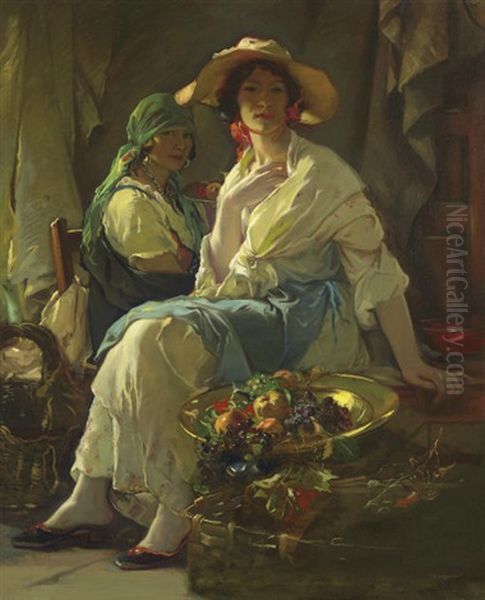
Assisi Market Girls: This painting likely captures a scene from his time in Italy, showcasing his ability to render figures with grace and to depict the vibrant atmosphere of everyday life. The work would demonstrate his skill in capturing local character and the interplay of light on textiles and figures in an outdoor setting.
Donna Tosca: A portrait, this work would highlight Rolshoven's refined technique in capturing likeness and personality. The title suggests an Italian subject, possibly a noblewoman or a character study imbued with a sense of drama or elegance, reflecting his Florentine period.
Fiesta in Taos: This piece represents his engagement with the culture of the American Southwest. It would likely depict the color, energy, and communal spirit of a Native American festival, showcasing his ability to handle complex multi-figure compositions and capture the unique light and atmosphere of New Mexico.
The Crusaders Depart: An example of his historical or allegorical work, this painting demonstrates Rolshoven's ambition to tackle grand themes. Such a piece would draw upon his academic training in composition and historical detail, possibly reflecting the romantic or symbolic tendencies prevalent in late 19th-century art.
Other notable works that further illustrate his range include To the Land of Sip-o-phe, a significant painting depicting a Pueblo Indian spiritual journey, The Council, showcasing his interest in Native American governance and traditions, and various Indian Market scenes that capture the vibrancy of Southwestern commerce and culture. His portraits of Tesuque individuals are particularly lauded for their sensitivity and insight.
Anecdotes, Later Life, and Enduring Legacy
Julius Rolshoven's life was not without its interesting facets. Despite his considerable talent and international experience, his works are considered relatively scarce and can be challenging to find, which has perhaps contributed to him being less of a household name compared to some of his Taos contemporaries. Some art historians suggest his talent was on par with, or even exceeded, that of many more celebrated figures from the Taos school.
His personal life included his marriage to Harriette Blazo and their decision to make New Mexico a significant base. His commitment to the region was profound. Even during World War I, after a brief return to the US in 1915, his focus increasingly shifted towards the Southwest.
Rolshoven's dedication to art extended beyond his own creations. He was also a respected teacher, both in Paris with his "Rolshoven Life Classes" and later, reportedly holding a professorship at the University of New Mexico, though details on the latter are less prominent.
Tragically, Julius Rolshoven passed away in 1930 at the age of 71. His death occurred aboard a ship in the Atlantic while he was returning to the United States, reportedly to visit his ailing, elderly mother, who herself passed away around the same time. This poignant end to a life of extensive travel underscores his transatlantic existence.
His widow, Harriette Blazo Rolshoven, ensured his artistic legacy would endure. She made a substantial donation of his works and property, valued at approximately $200,000 at the time, to the University of New Mexico. This generous bequest formed a significant part of the university's art collection and helped to preserve his contribution to American art.
Today, Julius Rolshoven's paintings are held in the collections of esteemed institutions such as the Detroit Institute of Arts (in his city of birth), the New Mexico Museum of Art, the University of New Mexico Art Museum, and the Smithsonian American Art Museum. These holdings testify to his artistic importance and his role as a bridge between European artistic traditions and the emerging art of the American West. Artists like John Singer Sargent, a contemporary, also navigated these transatlantic currents, though with a different stylistic focus, highlighting the international nature of art at the turn of the century. Rolshoven's engagement with Native American subjects also places him in a lineage of artists who sought to document and interpret these cultures, a lineage that includes earlier figures like George Catlin and later Taos painters.
Conclusion: A Reappraisal of a Master
Julius Rolshoven was an artist of considerable skill and cosmopolitan experience. His journey from the industrial heartland of America to the sophisticated art capitals of Europe, and finally to the inspiring landscapes of the American Southwest, shaped a unique and compelling body of work. He masterfully blended the rigorous discipline of his academic training with a romantic sensibility and a keen eye for color and light.
While perhaps not always afforded the same level of prominence as some of his contemporaries, Rolshoven's contributions as a painter, particularly his sensitive portrayals of Native American life and his role in the Taos art colony, are significant. His work serves as a testament to a life dedicated to the pursuit of artistic excellence across diverse cultural landscapes, earning him a rightful place in the annals of American art history. His legacy continues to resonate, inviting a deeper appreciation for an artist who truly saw the world through a painter's discerning eye.