Michele Tosini, a significant painter of the Florentine school during the 16th century, represents a fascinating bridge between the late High Renaissance and the burgeoning Mannerist style. Often known by the name Michele di Ridolfo del Ghirlandaio, or simply Michele del Ghirlandaio, his nomenclature itself tells a story of artistic lineage and workshop association rather than direct familial connection to the famed Ghirlandaio dynasty. Born in Florence in 1503, Tosini's long and productive career saw him adapt to the shifting artistic currents of his time, collaborating with prominent figures and contributing to some of Florence's most important decorative projects.
Understanding Michele Tosini requires a careful disentanglement of names. His birth name was Michele di Jacopo Tosini. The appellation "di Ridolfo del Ghirlandaio" was adopted later in his career, signifying his close association and likely period of significant work within the workshop of Ridolfo Ghirlandaio, who was himself the son of the illustrious Early Renaissance master Domenico Ghirlandaio. This practice was not uncommon, as pupils or principal assistants often became known by their master's name, indicating a shared style or workshop output.
Early Training and Influences
Michele Tosini's initial artistic training is believed to have been under Lorenzo di Credi, a painter who had himself been a fellow pupil with Leonardo da Vinci in the workshop of Andrea del Verrocchio. Lorenzo di Credi was known for his meticulous technique and somewhat conservative style, which would have provided Tosini with a solid grounding in the fundamentals of Florentine draughtsmanship and oil painting. Another early master mentioned in connection with Tosini is Antonio del Ceraiolo, a painter whose style was somewhat indebted to Fra Bartolommeo and Ridolfo Ghirlandaio, perhaps providing an early link to the Ghirlandaio circle.
These formative years would have exposed Tosini to the prevailing artistic ideals of the High Renaissance in Florence, which emphasized harmony, balance, and idealized naturalism. The towering figures of Leonardo da Vinci, Michelangelo, and Raphael, though perhaps not direct teachers, cast long shadows over all aspiring artists in the city. Their achievements in anatomical accuracy, compositional complexity, and expressive power set a high bar. More immediately, the work of painters like Fra Bartolommeo and Andrea del Sarto, who were leading figures in Florence during Tosini's youth, would have been crucial in shaping his early artistic sensibilities.
Fra Bartolommeo, known for his grand and solemn religious compositions, and Andrea del Sarto, celebrated for his sfumato, graceful figures, and rich color, were particularly influential. Their ability to imbue traditional religious scenes with emotional depth and sophisticated artistry was a hallmark of the Florentine High Renaissance. Tosini's early works likely reflected these influences, demonstrating a careful study of composition, figure drawing, and the use of light and shadow to create volume and drama.
The Workshop of Ridolfo Ghirlandaio
The most defining period in Michele Tosini's development came with his association with Ridolfo Ghirlandaio (1483–1561). Ridolfo, son of the great Domenico Ghirlandaio (1449–1494), inherited a prestigious artistic legacy. Domenico Ghirlandaio was a leading painter of the late Quattrocento, renowned for his large-scale fresco cycles, such as those in the Sassetti Chapel in Santa Trinita and the Tornabuoni Chapel in Santa Maria Novella, which vividly depicted contemporary Florentine life within sacred narratives. Domenico was also famously, if briefly, the teacher of Michelangelo.
Ridolfo Ghirlandaio, after his father's early death, was likely trained by his uncle, Davide Ghirlandaio, and also studied with Fra Bartolommeo. He became a respected painter in his own right, known for his portraits and altarpieces, and was a friend of Raphael, whose influence is visible in Ridolfo's work, particularly in the softness of modeling and the sweetness of expression. Ridolfo maintained a busy workshop, and it was here that Michele Tosini became a key figure, eventually becoming so closely identified with his master that he adopted the "di Ridolfo del Ghirlandaio" moniker.
The collaboration between Ridolfo and Tosini was extensive, often making it difficult for art historians to definitively attribute certain works from the workshop to one hand or the other. They frequently worked together on large commissions, with Tosini likely executing significant portions of paintings under Ridolfo's supervision or in partnership with him. This period, probably beginning in the 1520s, was crucial for Tosini. He absorbed Ridolfo's style, which blended the solidity of his father's tradition with the High Renaissance grace influenced by Fra Bartolommeo and Raphael.
Works emerging from Ridolfo's workshop during this time often displayed a competent, if sometimes conservative, adherence to High Renaissance principles. They were well-drawn, harmoniously composed, and featured the clear, bright palette characteristic of the Florentine school. Tosini's hand in these collaborative efforts would have been increasingly significant, and he likely managed many aspects of the workshop's production.
Emergence as an Independent Master and Stylistic Shifts
By the 1540s, Michele Tosini was operating more independently, though the Ghirlandaio name association persisted. Florence, however, was undergoing a significant artistic transformation. The High Renaissance ideals of clarity and naturalism were giving way to the more stylized, complex, and often emotionally charged language of Mannerism. Artists like Pontormo and Rosso Fiorentino had already pioneered this new direction, characterized by elongated figures, ambiguous spaces, vibrant and sometimes clashing colors, and a focus on artifice and elegance.
Tosini, ever adaptable, began to incorporate Mannerist elements into his work. This shift was likely accelerated by his exposure to and collaboration with Giorgio Vasari (1511–1574), a pivotal figure in the development and dissemination of Mannerism, as well as a renowned architect and the first true art historian with his "Lives of the Most Excellent Painters, Sculptors, and Architects."
The influence of other Mannerist painters, such as Francesco Salviati and Agnolo Bronzino, also became apparent in Tosini's evolving style. Salviati, known for his dynamic compositions and decorative flair, and Bronzino, celebrated for his cool, polished portraits and allegories, represented the height of Florentine Mannerism. Tosini's figures became more elongated, their poses more artificial and graceful, and his compositions often took on a greater complexity and decorative quality. His palette also shifted, sometimes employing the more acidic or jewel-like tones favored by Mannerist painters.
Despite these Mannerist leanings, Tosini often retained a certain Florentine solidity and a clarity in storytelling that harked back to his earlier training. He managed to synthesize these newer trends with the more traditional grounding he had received, resulting in a style that was both contemporary and accessible. This adaptability ensured his continued success and relevance in a rapidly changing artistic landscape.
Major Commissions and Representative Works
Michele Tosini's oeuvre is extensive and includes altarpieces, devotional paintings, portraits, and mythological scenes. His participation in large decorative schemes, often in collaboration, marks significant points in his career.
One of his most notable collaborations was with Giorgio Vasari on the redecoration of the Palazzo Vecchio in Florence, the city's town hall. This massive project, undertaken for Duke Cosimo I de' Medici, involved numerous artists working under Vasari's direction to create a series of grand apartments celebrating the Medici dynasty and Florentine power. Tosini's involvement in such a prestigious project underscores his standing in the Florentine artistic community. He is documented as having painted several works for these decorative cycles, including scenes in the Quartiere degli Elementi.
Among his independent works, several stand out. The Leda and the Swan, now in the Galleria Borghese in Rome, is a fine example of his engagement with mythological subjects and displays clear Mannerist characteristics in the elegant, elongated figure of Leda and the sophisticated composition. Another mythological painting, Night, is often cited as a key work, reflecting the period's interest in complex allegories and sophisticated nudes, possibly inspired by Michelangelo's famous sculpture of the same name in the Medici Chapel.
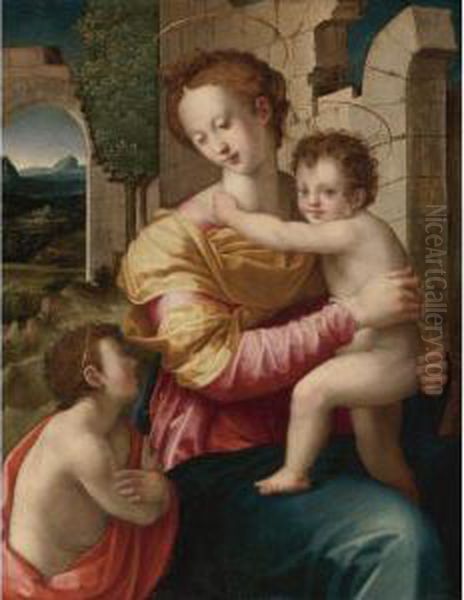
Tosini also produced numerous religious paintings. Altarpieces such as the Madonna and Child with Saints for various churches in Florence and its surrounding territories demonstrate his ability to handle large-scale compositions and traditional iconography, updated with Mannerist grace. His depictions of the Holy Family, the Annunciation, and various saints were popular and catered to the devotional needs of both private patrons and religious institutions. For instance, his Assumption of the Virgin and The Three Archangels showcase his skill in creating dynamic, multi-figured compositions.
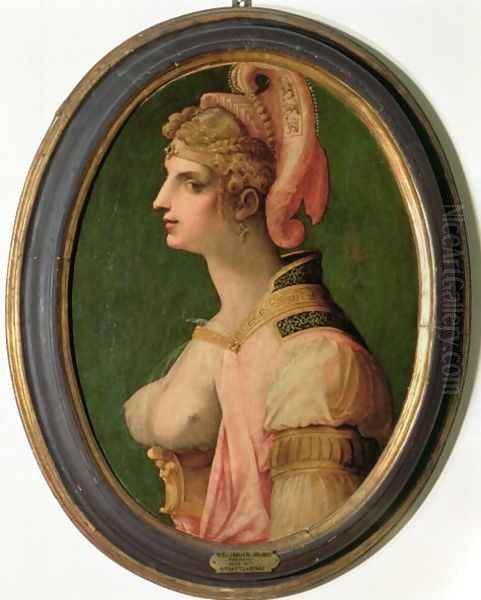
Portraits by Michele Tosini, though perhaps less famous than those by Bronzino, also form an important part of his output. He captured the likenesses of Florentine citizens with a competent and often insightful approach. These portraits, like his Portrait of a Woman or Portrait of a Young Man, reflect the era's demand for individualized representation, often imbued with a sense of status and psychological presence.
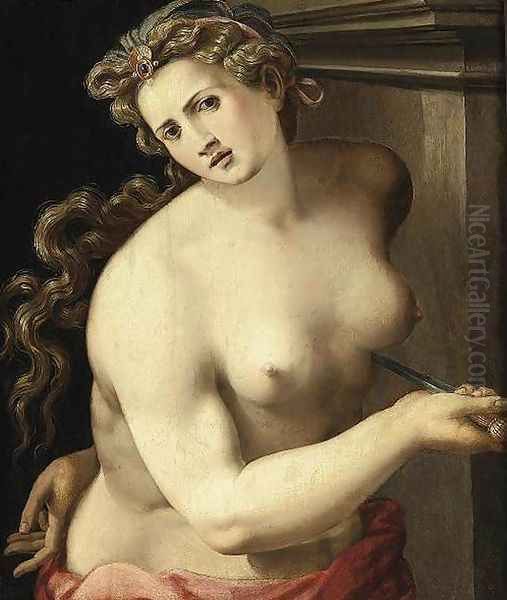
Other significant works attributed to him or his workshop include The Adoration of the Magi, The Visitation, Lucretia (a popular subject for its dramatic and moralizing content), and numerous depictions of the Madonna and Child with the Young St. John the Baptist. The sheer volume of work associated with Tosini suggests a highly productive and well-organized workshop that continued the Ghirlandaio tradition of prolific output.
The Accademia del Disegno
A testament to Michele Tosini's respected position in the Florentine art world was his involvement in the founding of the Accademia del Disegno (Academy of Drawing) in 1563. This institution, championed by Giorgio Vasari and supported by Duke Cosimo I, was the first formal art academy in Europe. Its aim was to elevate the status of artists, provide structured training, and oversee artistic standards in Florence.
The founding members of the Accademia included the most prominent artists of the day, such as Agnolo Bronzino, Francesco Salviati (though he died shortly after its founding), Benvenuto Cellini, Bartolomeo Ammannati, and, of course, Giorgio Vasari and Michele Tosini. Tosini's inclusion in this elite group signifies his recognition as a master of his craft and a respected elder statesman of the Florentine artistic community. He served the Accademia in various capacities, contributing to its early organization and activities. This involvement further cemented his legacy as a key figure in the artistic life of mid-16th century Florence.
Later Years and Legacy
Michele Tosini remained active as a painter until his death in Florence in 1577. His later works continued to reflect the prevailing Mannerist style, though often tempered with a clarity and directness that perhaps stemmed from his earlier training. He successfully ran a large workshop that produced a considerable number of paintings, catering to a wide range of patrons. His son, Baccio Tosini, also became a painter, continuing the family's artistic pursuits.
The legacy of Michele Tosini is that of a versatile and highly skilled painter who successfully navigated the transition from High Renaissance to Mannerism. While he may not have been an innovator on the scale of Michelangelo, Pontormo, or Vasari, he was a crucial figure in the dissemination and popularization of contemporary artistic styles. His ability to adapt, collaborate, and manage a productive workshop ensured his long and successful career.
His adopted name, "Michele di Ridolfo del Ghirlandaio," while a source of potential confusion, also highlights the importance of the workshop tradition in Renaissance Florence. It speaks to a system where skills were passed down, styles were shared, and artistic identities were often intertwined with those of one's master. Tosini's career exemplifies the professional life of a successful Florentine painter in the 16th century, marked by rigorous training, important collaborations, prestigious commissions, and active participation in the city's vibrant artistic institutions.
His works are found today in numerous museums and collections worldwide, including the Uffizi Gallery and Pitti Palace in Florence, the Galleria Borghese in Rome, and various international institutions, bearing witness to his prolific output and enduring, if sometimes overlooked, contribution to Italian Renaissance art. He remains an important figure for understanding the complex artistic fabric of 16th-century Florence, a city teeming with talent that included not only giants like Leonardo da Vinci and Michelangelo but also a host of other highly skilled masters such as Perugino (Raphael's teacher), Filippino Lippi, and later, Santi di Tito, who would lead the Counter-Reformation style. Tosini's career provides a valuable lens through which to view the evolution of artistic practice during a period of profound change.