Pietro Buonaccorsi, known to the art world as Perino del Vaga (1501-1547), stands as one of the most gifted and influential Italian painters of the High Renaissance and early Mannerist periods. Born in Florence, his journey took him to the heart of the artistic world in Rome, where he became a pivotal figure in Raphael's workshop and later a sought-after master in his own right. His art, characterized by its sophisticated grace, intricate compositions, and decorative richness, played a crucial role in disseminating the Roman style and shaping the course of Mannerism throughout Italy.
Early Life and Florentine Foundations
Perino del Vaga's story begins in Florence, the cradle of the Renaissance, around 1501. Orphaned at a young age, his early life was marked by hardship. His artistic talents, however, soon became apparent. He received his initial training in the workshop of Andrea de' Ceri. Later, and more significantly, he studied with Ridolfo Ghirlandaio, the son of the more famous Domenico Ghirlandaio, who had himself been a master to Michelangelo. Florence at this time was a vibrant artistic center, still resonating with the innovations of Leonardo da Vinci, Michelangelo, and Raphael, though Raphael had long since departed for Rome.
In Ghirlandaio's workshop, Perino would have learned the fundamentals of Florentine disegno – the emphasis on drawing and clear delineation of form. A crucial part of his self-education, as noted by Giorgio Vasari in his "Lives of the Artists," was his intensive study and copying of Michelangelo’s famous cartoon for the Battle of Cascina. This monumental work, though never fully realized as a fresco, was a school for an entire generation of artists, admired for its dynamic portrayal of nude figures in complex poses. This early exposure to Michelangelo's powerful anatomical understanding and dramatic energy would leave a lasting impression on Perino, though his own artistic temperament would lean towards a more refined and graceful aesthetic. Other prominent Florentine artists of the period, such as Andrea del Sarto and Fra Bartolommeo, were also shaping the city's artistic landscape, contributing to an environment rich in innovation and mastery.
Arrival in Rome and Raphael's Workshop
Around 1516, seeking greater opportunities, Perino del Vaga made the pivotal move to Rome. The city, under the lavish patronage of Popes Julius II and Leo X, was the undisputed center of the Italian art world. Here, Perino's talent quickly gained recognition, and he was brought into the bustling workshop of Raphael Sanzio. Raphael, then at the height of his fame, was engaged in numerous large-scale projects, most notably the decoration of the Vatican Stanze and Logge.
Joining Raphael's workshop was a transformative experience for Perino. He became one of Raphael's most important assistants, working alongside other talented young artists such as Giulio Romano, Giovanni da Udine, and Polidoro da Caravaggio. This collaborative environment was instrumental in shaping Perino's style. He absorbed Raphael's grace, his harmonious compositions, and his mastery of narrative clarity.
Perino's contributions to the Vatican Logge, a long, arcaded gallery decorated with frescoes depicting scenes from the Old Testament, were significant. He was responsible for painting many of the biblical scenes, demonstrating a remarkable ability to adapt to Raphael's style while also infusing the work with his own burgeoning elegance and decorative sensibility. The Logge project, with its intricate stucco work and grotteschi (grotesque decorations inspired by ancient Roman examples), provided Perino with invaluable experience in large-scale decorative schemes, a field in which he would later excel. Even after Raphael's untimely death in 1520, Perino continued to work on completing projects initiated by his master, further solidifying his reputation.
The Influence of Michelangelo and the Rise of Mannerism
While Raphael was Perino's direct mentor, the colossal presence of Michelangelo Buonarroti loomed large over every artist in Rome. Michelangelo's work on the Sistine Chapel ceiling, completed in 1512, had redefined the possibilities of the human form in art, imbuing it with unprecedented power, dynamism, and emotional intensity. Artists like Perino, while schooled in Raphaelesque grace, could not ignore the impact of Michelangelo's heroic style.
Perino's art shows a sophisticated synthesis of these two giants. From Raphael, he took elegance, compositional harmony, and a certain sweetness of expression. From Michelangelo, he absorbed a greater sense of anatomical complexity, muscularity, and the use of dynamic, often contorted, poses – the figura serpentinata (serpentine figure) – which would become a hallmark of the emerging Mannerist style.
Mannerism, which developed in the wake of the High Renaissance masters, was characterized by a move away from the naturalism and balanced harmony of the earlier period towards a more artificial, elegant, and intellectually complex style. Figures often became elongated, compositions more crowded and asymmetrical, and colors sometimes more vibrant or unsettling. Perino del Vaga, along with contemporaries like Rosso Fiorentino and Pontormo in Florence, and Parmigianino in Parma, became a leading exponent of this new artistic language. His work often displayed a refined artificiality, a delight in intricate detail, and a sophisticated understanding of classical motifs, all hallmarks of early Mannerism.
The Sack of Rome and a New Chapter in Genoa
The flourishing artistic environment of Rome was brutally interrupted in 1527 by the Sack of Rome, when the troops of Holy Roman Emperor Charles V mutinied and pillaged the city. This catastrophic event led to a diaspora of artists, scattering the Roman school and its influences throughout Italy and beyond. Perino del Vaga was among those who fled the devastated city.
He found refuge and significant patronage in Genoa, a wealthy maritime republic. His most important patron there was Andrea Doria, the powerful admiral and statesman. For Doria, Perino undertook the extensive decoration of his newly built palace, the Palazzo del Principe. This commission, which occupied him for several years (roughly 1528-1533), was a landmark in his career and a key monument of Genoese Renaissance art.
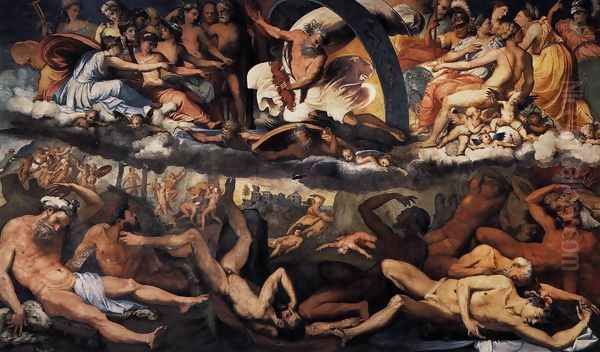
In the Palazzo del Principe, Perino created a series of magnificent frescoes and stucco decorations, primarily depicting mythological and historical subjects that glorified his patron. One of the most famous of these is The Fall of the Giants, a dramatic and dynamic ceiling fresco that showcases Perino's mastery of complex, multi-figure compositions and his ability to create illusions of vast space. The figures, muscular and contorted, reveal the enduring influence of Michelangelo, while the overall decorative scheme, with its rich ornamentation and classical allusions, is pure Perino. His work in Genoa was highly influential, establishing a local school of painting and introducing the sophisticated Roman Mannerist style to the region. Artists like Luca Cambiaso would later build upon the foundations Perino laid in Genoa.
Return to Rome and Papal Service
Around 1536 or 1537, Perino del Vaga returned to Rome. The city was slowly recovering from the Sack, and artistic patronage was reviving, particularly under Pope Paul III Farnese. Perino quickly re-established himself as one of Rome's leading painters. He received numerous important commissions, including work in the Castel Sant'Angelo, which was being refurbished as a papal residence.
In the Castel Sant'Angelo, Perino decorated several rooms, most notably the Sala Paolina (or Sala del Consiglio). Here, he created an elaborate scheme of frescoes and stuccoes depicting scenes from the life of Alexander the Great and Saint Paul, drawing parallels between the ancient hero and the Pope. The decorations are characterized by their opulence, their intricate combination of painted narratives, allegorical figures, and rich ornamental motifs. This project further solidified his reputation as a master of complex decorative ensembles. He worked alongside other artists, including Luzio Romano and Girolamo Siciolante da Sermoneta, in these papal projects.
During this later Roman period, Perino also undertook commissions for other prominent patrons, such as the decoration of the Pucci Chapel in Trinità dei Monti and work in the Palazzo Massimo alle Colonne. His style continued to evolve, maintaining its characteristic elegance and complexity, but perhaps with a greater sense of monumentality. He was a highly sought-after designer, not only for frescoes but also for tapestries, festival decorations, and other ephemeral works, demonstrating his versatility. His contemporary, Giorgio Vasari, who knew Perino and documented his life, admired his facility and inventiveness.
Artistic Style: Elegance, Complexity, and Decorative Flair
Perino del Vaga's artistic style is a quintessential expression of Mannerism, yet it retains a distinct personal character rooted in his Raphaelesque training. His figures are typically elegant and elongated, often arranged in graceful, flowing poses that emphasize sinuous lines – the figura serpentinata. While capable of depicting powerful musculature, as seen in The Fall of the Giants, his figures generally possess a refined, almost aristocratic grace rather than the raw power of Michelangelo's.
Compositionally, his works are often complex and densely populated, yet they maintain a sense of clarity and decorative rhythm. He had a remarkable ability to organize numerous figures within a coherent narrative and spatial framework, often employing sophisticated perspectival effects. His use of color was typically rich and varied, contributing to the overall decorative effect of his works.
A key aspect of Perino's art is its decorative sensibility. He excelled in creating all-encompassing environments where frescoes, stucco work, and ornamental motifs were seamlessly integrated. His designs often incorporated classical elements, grotteschi, putti, and intricate patterns, reflecting a deep understanding of both ancient Roman art and the decorative vocabulary developed in Raphael's workshop. This made him particularly adept at palace and chapel decorations. Artists like Francesco Salviati and Daniele da Volterra, who were also active in Rome, shared some of these Mannerist tendencies, though each developed a unique artistic personality.
Representative Works: A Closer Look
Several works stand out in Perino del Vaga's oeuvre, showcasing his stylistic development and mastery.
Vatican Logge (c. 1517-1519): As one of Raphael's principal assistants, Perino was responsible for numerous Old Testament scenes. Works like Joseph Interpreting Dreams or Jacob's Dream demonstrate his early assimilation of Raphael's style, characterized by clear narrative, graceful figures, and harmonious compositions, but already with a hint of his own decorative elegance.
The Fall of the Giants (c. 1530-1533), Palazzo del Principe, Genoa: This ceiling fresco is one of his Genoese masterpieces. It depicts the Olympian gods hurling thunderbolts down upon the rebellious Giants. The composition is a whirlwind of dynamic, foreshortened figures, showcasing Perino's command of anatomy and perspective, heavily influenced by Michelangelo and Giulio Romano's similar work in Mantua's Palazzo Te. The dramatic energy and muscularity are hallmarks of his mature Mannerist style.
The Holy Family with the Infant St. John the Baptist (various versions): Perino painted several variations of this popular theme. These panel paintings, such as the one in the Courtauld Gallery, London, often feature elegantly posed figures, soft modeling, and a tender, intimate mood, reflecting the enduring influence of Raphael's Madonnas. The elongated proportions and graceful contortions of the figures, however, place them firmly within the Mannerist idiom.
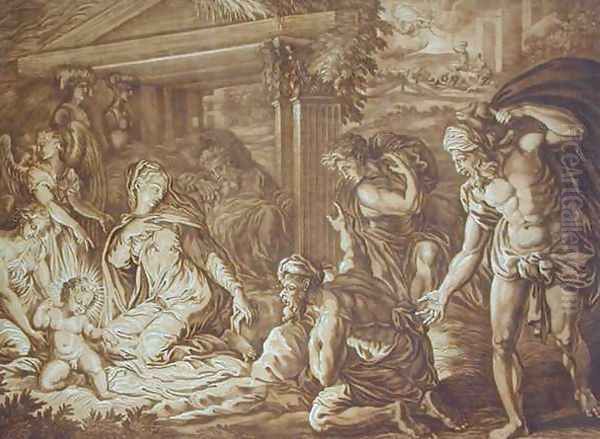
The Adoration of the Shepherds (e.g., Kress Collection, National Gallery of Art, Washington D.C.): This work exemplifies his ability to create complex, multi-layered compositions. The scene is filled with figures, angels, and symbolic animals, all rendered with exquisite detail and a refined palette. The elegant gestures and elongated forms of the Virgin and other figures are characteristic of his style.
Sala Paolina, Castel Sant'Angelo, Rome (c. 1545-1547): The frescoes here, depicting scenes from the life of Alexander the Great and St. Paul, represent the culmination of his career in large-scale decorative painting. The compositions are grand and complex, filled with richly dressed figures and elaborate architectural settings, all integrated with opulent stucco work.
Relationships, Rivalries, and Workshop Practices
The art world of 16th-century Italy was a competitive one. While Perino was a respected member of Raphael's workshop, the environment was not without its internal dynamics. After Raphael's death, his principal heirs, Giulio Romano and Gianfrancesco Penni, took over the workshop, and artists like Perino eventually struck out on their own.
In Genoa, Perino established his own successful workshop, training local artists such as Lazzaro and Pantaleo Calvi. However, Vasari recounts tales of professional jealousies and even extreme actions, such as the alleged poisoning of a talented disciple by rivals, highlighting the sometimes-fraught nature of artistic competition.
Later in Rome, Perino would have encountered other leading artists. There is an anecdote mentioned in the provided information about Perino feeling pressure from the arrival of the Venetian master Titian in Rome in 1545-1546, fearing Titian's fame might overshadow his own standing, particularly concerning commissions. This illustrates the constant vying for patronage and prestige among top artists.
Like many masters of his time, Perino relied on assistants to help execute large commissions. He was known for his prolific inventiveness in design (invenzione), often providing detailed drawings and cartoons that his workshop would then translate into finished frescoes or paintings. While this was a standard practice, the provided text notes that his tendency to design but not always personally complete works sometimes led to dissatisfaction. This was not uncommon; even Raphael relied heavily on his workshop for the execution of his later, vast projects.
Legacy and Art Historical Significance
Perino del Vaga died in Rome in 1547 at the relatively young age of 46, at the height of his career. Despite his somewhat shorter lifespan, his impact on Italian art was considerable. He is regarded as one of the most important figures in the transition from High Renaissance to Mannerism and a key disseminator of the sophisticated Roman style.
His work in Raphael's workshop placed him at the epicenter of artistic innovation in the early 16th century. His subsequent career in Genoa was instrumental in spreading Mannerism to Northern Italy. Upon his return to Rome, he became one of the leading painters in the city, his style influencing a generation of artists who followed.
Perino's particular brand of Mannerism, characterized by its elegance, decorative richness, and technical brilliance, found many admirers and imitators. Artists like Francesco Salviati, Taddeo Zuccaro, and Pellegrino Tibaldi, who were active in the mid-to-late 16th century, show the influence of his complex compositions and refined figure types. His mastery of large-scale decorative schemes, integrating painting, stucco, and grotteschi, set a standard for palace and villa decoration that would endure for decades.
Giorgio Vasari, in his "Lives of the Most Excellent Painters, Sculptors, and Architects," dedicated a biography to Perino, recognizing his talent and importance. While Vasari sometimes criticized Perino for a certain facility that could lead to a lack of ultimate finish in some works, he praised his inventiveness, his skill in drawing, and the grace of his figures.
Conclusion: An Enduring Master of Grace and Invention
Perino del Vaga remains a pivotal figure in the history of 16th-century Italian art. From his formative years in Florence and his crucial role in Raphael's Roman workshop to his independent triumphs in Genoa and his final, highly productive years in Rome, he consistently demonstrated exceptional talent and versatility. His art embodies the elegance, complexity, and intellectual sophistication of Mannerism, bridging the High Renaissance ideals of Raphael with the more stylized and decorative tendencies that followed.
His ability to synthesize the influences of giants like Raphael and Michelangelo into a distinctive personal style, his mastery of large-scale fresco decoration, and his prolific output as a designer ensured his place as one of the most accomplished artists of his era. Perino del Vaga's legacy endures in the magnificent decorative ensembles he created and in the influence he exerted on the subsequent development of Italian painting, securing his reputation as a true master of Mannerist grace and invention. His works continue to be admired for their beauty, their intricate craftsmanship, and their embodiment of a fascinating and transformative period in art history.